Monday, 26 August 2024

GT7 W71: BMW Z8 '01

The name's Z8. BMW Z8.


(no tags)

Unfortunately, unlike the famous movie character that drove it, the Z8 actually needs an introduction to most, as it's a very obscure car by BMW standards. With just 5,703 produced and each costing upwards of 135,304 USD when new (about 248,155 USD in 2024), not many were in the privileged position of getting to know the elusive car, and so I thought it'd be a good idea to familiarise ourselves with the Z8 by quickly dropping some names and comparisons: It's meant to be a tribute to the BMW 507, perhaps the company's most influential car yet. It's got a near perfect weight balance thanks to its transaxle layout, just like a Porsche 924. With a 4.9L NA V8 from its stable mate, the M5, it can go from 0–100km/h in a claimed 4.7 seconds, which lets it keep up with modern cars like the C7 Stingray. It's styled by Henrik Fisker, whose last name you may recognise, only to be sawn into two halves by a helicopter in the James Bond Movie, "The World Is Not Enough". Oh, and some guy by the name of XSquareStickIt drove one in GT Sport back in 2021 and said he didn't like it very much.


But perhaps the most relevant name drop comparison is this: the Z8 drives like a beefed up, loaded out Mazda Roadster: it's much too soft to be a hardcore sports car, requiring its handler to keep the heavy, obscure gadget in check, lest they attract unwanted attention (i.e. ridicule) to themselves. Yet at the same time, the Z8 possesses incredible balance and poise, thanks to a nearly perfect 51:49 weight balance front to rear, and the Z8 is proportionate, cooperative, and—dare I even say—agile, before its springs reach the end of their travel, at which point the car quickly lets go. While capable, the Z8 very much wants to be treated like a Fairlady; it doesn't respond well at all to brute force, instead asking of its driver to be a cognisant gentleman and to be smooth, gentle, and attentive to the car, because it's certainly not shy about wanting a show of heroic saving from its driver every now and then.


And so, just like driving an old, rear–engined car like the Alpine A110, the driver has to be ultra aware of where the weight is on the Z8 when driving it hard, knowing when to use the full capabilities of each component of the car, and when to show gentlemanly restraint. The brakes on the Z8 are ABSURDLY strong, but fully depressing the middle pedal at speed unsettles the rear end greatly, and even mild trial braking will see the transaxle car swing out its laden rear end all too easily. The NA V8 not only barks out a soundtrack that would rival American muscle, and it has solid torque from as low as 3,000rpm, but just like the brakes, the full power of the engine has to be sparingly used, because the rear springs will run out of travel soon before the engine can deliver all its power on the default suspension and Sports Hard tyres, easily resulting in a fishtail. 2nd gear is just about redundant after a standing start with how much shove this M5–derived powerplant has, and so its driver will have to know when to use which gear out of which corner for the best performance. In other words, any driver looking to win the Z8 over has to remain calm and calculated at all times; after all, the last thing a spy can do even in the most dire of situations is to panic, and the Z8 is here to remind any prospective spy of that.


Treat it right however, and the driver is rewarded with an open–top luxury experience that has enough poise and firepower to stay within a second of a contemporary track toy in the 996 GT3 around Grand Valley Highway, and even make the Porsche's standard steel brakes feel like they've come right out of a luggage cart's while it's at it. In that respect, it stands alone as its own unique thing incomparable to anything else in my mind.


...buuuut, I'd also be remiss if I didn't mention that, ever since our barn burner race at Brands Hatch, there's a car that I haven't been able to stop thinking about, and every time I lay eyes on it, I just melt into a puddle on the inside and giggle. It's also FR with an NA V8 going through a 6–speed manual, with on–track performance nigh inseparable from the Z8. It's not an open top car, but it has a see–through roof and a pair of headlights among the sexiest mankind has dared conjure, and v1.50 of Gran Turismo 7 has arguably given it much more of a glow–up in driving experience than the Z8.


I'm sorry, Bond, but I'm going over to the dark side.


A "Small" Rant:

The Z8's horizontal interior piece is supposed to be body colour. However, in GT Sport and GT7, it's stuck as silver regardless of the car's base colour, with no way of changing the look of it in the livery editor; it can't be painted, nor can decals be applied to it.


The odd thing is, they got it right in GT6! The dash is body colour!


Real life car in blue for comparison:

Sunday, 18 August 2024

GT7 W68: Renault Sport Clio V6 24V '00

They may look like any other automaker playing it safe today, but French carmaker Renault has been known in years past to be perhaps the most utterly insane and daring car maker in the industry's history, seemingly just for the sake of it. In the 80s, they were the first to put an engine in the passenger bay of a hatchback and sold it to paying customers, just so they could race that Frankenstein design in rallies, only to follow that up in the 90s by putting a screaming F1 engine into a minivan. No, not an F1–derived engine; an actual, honest–to–FIA F1 engine. One would think then, that not a lot can scare balls–to–the–wall Renault into reconsidering its lunacy going into the new millennium, but ironically, all it took was a seemingly innocuous repeat of the Renault 5 Turbo formula to scare Renault—and other car makes—into never selling another rear midship hatchback to paying customers ever again. One could say then, that the Clio V6 single–handedly scared Renault into snapping back to its senses.


"Really? What's so scary about a 229HP hatchback?", you might be thinking at this point. Given its unhinged family tree, a Clio developed with Tom Walkinshaw Racing of Le Mans fame with a NA V6 engine in the back seems almost predictable, but the car itself was anything but when driven at speed. The initial run of the Clio V6 produced from 2000–2003, dubbed the "Phase 1", quickly earned itself a deadly reputation in real life for being an extremely difficult, if not outright impossible car to handle, with the car wont to spin itself out for reasons as clear and numerous as there are for anyone to spend 240,000 FRF (31,297 USD in 2000, 51,101 USD in 2024) to buy a 2–seater Clio V6 over the 4–seater FF Clio 172 it was barely quicker than to 100km/h. It's only years after the cars' production run ended did we get a clear answer as to why the Phase 1 drove the way it did; evo has a deeply fascinating interview with Steve Marvin, former director of Renault Sport, over the rushed and troubled development of the original Clio V6, where the passionate man goes in–depth into the hows and whys of the Clio V6's tendencies, necessitating the drastic—and arguably overkill—remedies of the Phase 2 Clio V6.


We Gran Turismo 7 players, for better or worse, have only the ill–reputed Phase 1 to accompany us in our campaigns. Thankfully however, the Phase 1's widowmaker tendencies just never seemed to translate across the digital divide into the PS4 era of Gran Turismo; I drove the Phase 1 back in GTS COTW Week 188, when I raced it against the 2015 and 2016 Clio R.S. 220 EDC Trophy, where I found that the older car was not only slightly faster than its newfangled siblings, but I also noted that "All three (cars) corner incredibly flat with very little drama", emphasis on the last three words. When RX8 later drove it in GT7 COTW Week 46, he (presumably) liked it so much that he just told me on the spot to automatically make the Phase 1 his next pick. And now, fresh off yet another physics update, the Phase 1 still feels incredibly solid, neutral, and chuckable in v1.49/v1.50 of Gran Turismo 7.


Like any hot hatch worth its petrol, the Phase 1 immediately gives its driver that emblematic sense of fitting snug in the palm of one's hand, as though all four tyres are within easy reach from the cockpit of the car as it rotates and dances through a corner with unassailable neutrality, with understeer gradually and tacitly being peppered in as the car approaches its limit. Even torrential downpour does little to faze the Phase 1, and classic RMR traps of Bathurst and Suzuka barely register as threats. Sure, it does feel rather heavy within said hand for its size and class, but it also has about twice the displacement a sane person might expect from a hot hatch, and just like the handling of the car, the power curves of this Laguna–derived 2.9L V6 are even and gradual, encouraging drivers to take it near the rev limiter with each shift while being more than capable of punching from below if the need arises. The only residues of the car's murderous reputation in real life found here in Gran Turismo 7 is at high–speed, where the rear can feel a bit floaty, and it dislikes sharp, sudden steering inputs regardless of where the speedo is pointing. Driven with the respect and smoothness any RMR sports car is due however, the digital Phase 1 presents itself as an incredibly well–balanced, communicative sports car that is difficult to fault!


Of course, serious structural changes and hardware are needed to transform an FF grocery–getter into a midship motorsports machine. Despite still looking very much like a regular Clio to the untrained eye, the Clio V6 measures 171mm wider and 66mm lower than a regular Clio, with increased track width and wheelbase to accommodate the rear seats' permanent mechanical passenger and the power it brings to the rear axles, which can reach a healthy 229HP (171kW) when the tach sits square at 60. Handling this power are Michelin Pilot Sport tyres, 205/50ZR17 up front and 235/45ZR17 rear, Comfort Soft by GT7's standards. A six–speed manual gearbox is the only option offered on this track focused wolf in sheep's clothing, though it does come with amenities like air con, power steering, leather–wrapped steering wheel, and an ample 61–litre petrol tank to make living with this exotic pet a little easier. The entire flared package balloons the Phase 1's mass to a frankly astounding 1,335kg (2,943lbs)—stupendously heavy for a hot hatch by contemporary standards.


All told, the RMR Phase 1 does the 0–100km/h dash in a claimed 6.4 seconds, which wasn't exactly slow. With this newfound power and rear drive, the Phase 1 can not only duke it out with much more modern hot hatches of today, but also lets it fit right into a conversation among some of the industry's most well known sports cars like the RX-8 and 86 twins despite its heavy mass figure. Cars in this performance bracket are my favourite to drive, because I feel that they have just the right balance of power, handling, and lightness to let the whole package shine without anything dominating the experience, with some of the industry's most renowned sports cars like the 901 Carrera RS 2.7, M3 SE, and S2000 falling within this bracket. None of the aforementioned cars however, are rear mid–engine, rear drive, and so the Clio V6 fills an aching void together with the MR2 Turbo and Elise, the former of which just isn't as quick as the Clio, and latter of which is sorely missing in the game.


In short, the Clio V6 fills a niche within a niche in GT7, and it takes some proper lunacy, or just laser–focused passion, to fill a gap so specific. It's just a shame that the Phase 1 in real life was so ill–received that it seemingly scared Renault into growing up, never to try anything this experimental and outlandish ever again, because the virtual car in Gran Turismo shows the world just how brilliant the Phase 1 could've been if the idea had been given the time and resources to properly blossom.

Monday, 12 August 2024

GT7 W69: Ferrari 430 Scuderia '07

In my mind, Ferrari cars in Gran Turismo games are simply beyond compare. Don't get me wrong, however; that's not meant to be a compliment. You see, almost every Ferrari in the series has hugely optimistic, completely unrealistic stats in–game, with egregious examples being a few hundred kilos lighter digitally than tangibly. Combine this with the fact that Ferrari in the real world have been known to set up their cars specifically for comparison tests, how they try to control the media (bad language warning for the linked article) and in some extreme cases even choose who can and cannot buy their cars, and you hopefully see how little value there is in reviewing, or consuming a review of any Ferrari, real or digital. It's not even worth the effort of typing out that most of the Ferraris I've sampled in Gran Turismo drive like their specs in Gran Turismo: utter horse shit.

The recently returning Ferrari 430 Scuderia '07 however, is a little bit different from its stable mates.


#supergt #pacific #ikamusume

Take its quoted power and mass of 502HP (374kW) and 1,350kg (2,976lbs) for what you will, but the 430 Scud is the first road–going Ferrari I've driven in this game that actually feels as light to drive as it is claimed to be, with a featherweight front end that actually responds to trial braking and can hence find apexes without resorting to the in–car navigation system. Power? Oh, you bet: this thing can get squirrely taking corner exits in 5th gear. It makes one hell of a sound, too, and thanks to its "F1 Superfast 2" gearbox that can shift in a claimed 0.06 seconds, that symphony of shrieks never has to take a pause as the stallion wails past 8,500rpm and 310km/h (193mph). 997 GT3? Sah–LOOOOW. LFA, Viper, GT-R? Soft and unwieldy. Gallardo? Understeer city. Simply put, contemporary peers to the 430 Scuderia are excruciatingly rare in this game, and even if we disregard the "contemporary" part of it, not much else can come close to touching the track focused Scuderia in terms of driving sensation.


That said, the unrelenting speed of the thoroughbred 430 Scuderia is by no means easy to rein in under control. If judged just by the human ear, the F1 Superfast 2 gearbox does indeed shift seamlessly, but ask the 285mm Sports Hard tyres shoeing the 19–inch wheels at the back though, and I think you'll get a very different opinion: both downshifts and upshifts at any rpm range can—and most likely will—greatly upset the rear end of the car if done with steering lock applied, breaking the stubby rear end of the 430 sideways with no warning whatsoever. It's not just the idiosyncratic gearbox that will knock the rear end loose, either; the engine also wants in on the fun. The 4,308cc naturally aspirated V8 nestled aft the cockpit of the 430 Scuderia has some sudden bumps in its power curves, presumably due to cam profile changes. A cautious driver short shifting the Scud to manage power oversteer—or simply to avoid having to shift mid corner with that gimmicky gearbox—might spin the car all the same as the engine's personality explosively switches on an unsuspecting driver. As if having peak power at 8,500rpm—just 140rpm below the rev limit*—isn't punishment enough for short–shifting on its own!

*the 430 Scuderia in GT7 revs to 8,700rpm.


Both the engine and the gearbox already make for a wildly unpredictable ride that can see the Scuderia breaking sideways at a urine–extracting 180km/h (112mph) in 5th, but I haven't even mentioned the cherry beside this sideways cake: the E–differential. Counter–steering to fix a slide just makes the E–diff think the driver is trying to turn the car, and so it can over–correct just as quickly as the car broke away in the first place. All in all, this is just a package that is COMPLETELY. UNDRIVABLE. in the wet. Touching a puddle at speed is just an instant death sentence without trial, even with copious overdoses of driver aids. The 430 Scuderia has ABS, of course, and Ferrari claims that it is equipped with "Stability and Traction Control with new traction control logic F1-Trac integrated with thenelectronic differential"... whatever that means. If I had to guess, it must be Ferrarese for, "the aids barely do anything, get rekt n00b trollololololol you now owe us 380k for the car", because last I checked, F1 cars don't have Traction Control nor ABS.


The spec sheets may claim that the 430 Scuderia is a lighter, more powerful, and therefore faster version of the regular F430, but in practice, I find the 430 Scuderia to be a needlessly ruined version of the F430. The base F430 already has most of what I like in the 430 Scuderia—the noise, the styling, the seamless shifts, most of the speed, and easy accessibility in Brand Central—but with none of the electro–psychotic episodes of the Scuderia. The only thing I like in the Scuderia that the regular F430 doesn't have is the stripped out interior upholstered mostly with bare carbon fibre, which suits a racing livery much better than the brown interior of the F430 I'm not so keen on. The 430 Scuderia would've been a fast, enjoyable track car chock full of infamous Italian quirk if it stood alone, but the F430 that has been in the game since launch has ruined the recently–added Scuderia for me, possibly even before the latter was just a text string in the game's data. All Ferrari had to do was to strip out the car, give it go–fast stripes, and maybe give it more power to justify the price hike, but they had to go fix something that was decidedly not broken and broke the whole car in the process, and I just don't understand why.


Honestly, the 430 Scuderia feels set up by and for one person and one person only: Michael Schumacher, who is lavishly credited for helping develop the car. Unless the driver has a high level of precision and/or a similar driving style to Michael Schumacher, the 430 Scuderia seems to violently reject any and all attempt to get to know and tame the car, and I don't know if you've noticed, but I'm not Michael Schumacher. I don't have his skills. If even his own son is struggling to live up to the standards he set, I don't fancy my chances of ever coming to an understanding with the 430 Scuderia. It is, in my mind, set up for one person and one person only.

And that makes the 430 Scuderia a car that is truly beyond compare.

SPOILER: Wide Body–ing a 430 Scuderia

The 430 Scuderia loses its front fender yellow Ferrari logo when a wide body is applied to it.

SHOT 01

Liveries shared on a wide body may have replacement decals on the front fenders. Take note if you're applying a wide body livery to a narrow body so as not to end up with double Ferrari logos on the side like I ended up doing on both our weekly lobbies.

SHOTS 02, 03

Tuesday, 30 July 2024

GT7 W67: Subaru BRZ S '21 & Toyota GR86 RZ '21

The Subaru BRZ/Toyota GR86 twins are cars that aren't even worth reviewing in the real world. It's not that they're bad, per se; it's just that, as the last members of the critically endangered species of "affordable rear drive sports cars", they don't really have much competition. If a prospective sports car shopper has a tighter budget and/or wants the open top, they'd be funnelled into the Mazda Roadster. If they need more space and/or a more focused track toy out of the box, only the Boxer twins provide those. Real life can very often be a bit of a downer sometimes.


When immortalised into the digital realm of Gran Turismo 7 however, the Toyobaru twins face much, much stiffer competition than a softly sprung Roadster. The twins' performance windows put them square in what I consider to be the "Performance Sweet Spot" of sports cars: around 230HP, and around 1.1 to 1.3 tonnes in mass. It's in this window where I feel that power, speed, mass balance, suspension, differential, and tyres all form the perfect, harmonious balance with each other with nothing dominating the experience, allowing the whole package to be cohesive and really come alive. Some of the industry's most legendary sports cars fall into this bracket, such as the 901 Carrera RS 2.7, E30 M3 SE, AP1 S2000, and of course, my absolute darling RX-8 Spirit R. Given this wealth of options in a racing game, can the Boxer–engined newcomers punch out a niche for themselves in this esteemed company?


#Hartge #BMW #TommyKaira

As the most modern cars in the group, the ZD8 BRZ and ZN8 GR86 twins definitely look and feel their spring chicken age; they are the only ones that make usable torque in the mid range, despite the fact that they are Naturally Aspirated like everything else in the group. The "DN8 Twins", as I'll refer to them from now, have achieved this mid–range shove from their Boxer engines having been bored out from 86 millimetres to 94mm (3.386in to 3.701in), but before the fanboys go crying foul that the 86 doesn't have an 86 engine anymore, the stroke is still unchanged at 86mm. Despite the increased bore, rev limit for this new FA24 engine remains unchanged from the previous FA20 engine at a healthy, ample 8,000rpm, with the only difference this time round being the increased power output of 231HP (172kW), and that one doesn't have to play "Blackjack: Engine Revs Edition" to find it. With this hike in mid–range torque, the torque "waves" of the FA24 are so well balanced against the gear ratios that the DN8 Twins are among the very few cars that can shift at a wide rpm range without losing any speed; anywhere from 7,4 to 7,8 is good, the former of which is when the game will shift for the driver if left in automatic shifting. The real benefit of this mid–range torque is of course, coming out of tight corners; as manual gearboxes take an eternity and a half to shift in this game, and this game heavily rewards short shifting to control power oversteer out of corners, making luggable engines a godsend.


But it's not just in the torquey engine backed up by the cars' speakers where the DN8 Twins feel modern; they also have a stupefying amount of chassis rigidity—possible only with today's technology—that makes them feel incredibly responsive and direct, which is of course upholstered by similarly stiff suspension setups. If the enlarged engine wasn't enough to pull the DN8 Twins away from the Mazda Roadsters, the no–nonsense springs ensure that a serious track day enthusiast would never cross shop the focused coupé twins with the lackadaisical convertibles. The suspension setup on the top grades of the DN8 Twins represented in this game are set up for track duty out of the box, permitting very little pitch and roll to make sure that all four tyres are always within their drivers' reach and control. These springs are so stiff in fact, they can sometimes boarder on unforgiving, even on a paved racetrack; hitting rumble strips at weird angles, even some seemingly innocuous ones like the inside of Lesmo 2, is liable to disconcertingly hop the DN8s and rob the driver of crucial milliseconds of control, which can quickly result in a spin if the driver is not prepared for it.


But when the oldskool approach is best, the DN8 twins can feel like they have rolled right off a time machine. There are good old fashioned buttons and knobs for air con and audio, for starters, and any company sensible and caring enough to still give us that in 2024, I will trust with childlike faith. There are no weird gimmicks, overprotective nannies, or overbearing understeer hard–baked into the suspension and tyre setups to dampen a spirited drive, and in the context of 2024, that is such a breath of fresh air to a man desperately in need of CPR. Uplifting spirits further is their quoted mass: 1,270kg (2,800lbs) apiece, which, while representing a 40kg (88lbs) increase over the preceding ZN6 when comparing top trims of the Toyotas, is still an impossibly light number by today's stringent and demanding standards, and I would even go as far as to argue that the mass increase is well worth it for the extra performance on offer, because the difference in mass is only something I might barely notice hopping between ZN6 and ZN8 back–to–back. That is to say that, judged on their own merits, the heavier DN8 Twins stand on their own four wheels as a compelling drive. The front ends of the DN8 Twins are so sharp and crisp that steering them both felt like trying to redirect origami cars rather than brutish metal chunks, and it's a sensation long thought extinct in the industry. This of course is due in no small part to the Boxer Engines, which boast a low centre of gravity, but the bonnet, front fenders, and even the roof being made of lightweight aluminium also deserve special mention for contributing to that sensation. And very unlike modern cars that try to protect its driver with crippling understeer, the DN8 Twins are not afraid to play, helpfully peeking out the rear end just a tiny bit on hard trail braking to get the car rotated into a tight corner. Equipped as–standard on all grades with a Torsen Limited Slip Differential, the torquey engine is of course capable of breaking grip on the 215mm section tyres to put on a smokescreen.

...oftentimes without the driver intending to.


Said Torsen LSD on both the twins are an evil blight upon their performance and driving feel, locking up much too early on power and actively crippling the twins. The grip and lightness of the car is there, and I know the cars can put down more power much earlier out of a corner if not for the LSD prematurely locking up and sending the rear ends sideways. It feels to me as if the diff has been set up from the factory for the cars to go drifting, and I personally hate the way it makes them drive. The stiff diff make the twins awfully twitchy on corner exits, with tight hairpins like Andretti Hairpin most clearly highlighting the problem, and they cost the twins so much pace that I legitimately set a faster lap time in an RX-8 around Laguna Seca despite the 4–door sedan being some 70 kilos (154lbs) heavier with only 1 more HP over the DN8 Twins. The diff quickly and strongly locking up also makes tracks that heavily necessitate corner cutting, such as the newly–added Eiger Nordwand, extremely precarious to navigate, as one rear tyre losing grip and spinning up quickly brings the other along, surrendering all grip on both sides and making the car extremely skittish, often resulting in frantic wheel shuffling until the driver can gather back together the car. Then again, this is hardly the first time I've complained about the diff being too tight in cars, so it could just be that I personally prefer extremely loose differentials. I just personally find the tight diff in the DN8 Twins especially disappointing because I genuinely think they could be in the conversation for the best driving cars ever made, and the diff has single–handedly ruined the DN8 Twins for me.


The ZD8 BRZ has notably softer springs on the rear than the ZN8 GR86, which does go some ways in assuaging the problem, and that's the only difference I can find between the twins both on the spec sheet and out on the track. It could also be that, much like their stiff suspension and under stressed chassis, the diffs on the DN8 Twins were set up to handle a fair bit more power and grip than the cars have bone stock, aimed at saving a builder on a budget from shelling out for an aftermarket differential. If it was me, though? I'd shell out for an aftermarket diff and leave the rest of the car as–is. And that perhaps is the area that the twins feel the most modern: they're sold as capable, perfectly serviceable bases, but just like most modern video games, they can feel a bit wanting and perhaps even lacking in personality until updates, DLC, and fan–made mods fix a few annoyances and really bring out their latent flavours. The older cars in that comparison group, the 901 Carrera RS 2.7, E30 M3 SE, AP1 S2000, and SE3P RX-8, are all sold as cohesive products that had to make sense as they left the factory, each brimming with their unique personalities and kinks that will need ironing out if their owners are to try to tune them. That is to say, if you're someone who likes to customise and tune cars, the DN8 Twins are much more accessible and accepting bases, but if you're someone who just wants to hop into a car, not have to think about much and just enjoy the drive, I think any of the other aforementioned cars will give much more smiles per mile than the DN8 Twins.


Me personally, I like my stuff to work right out of the box without having to mess and tinker with thousands of values. And it's for this reason that the 901 Carrera RS 2.7 and the SE3P RX-8 still reign supreme as the best driving road cars in the game. That being said, I also recognise that I'm in a very lucky position to be able to nitpick the ZD8 and ZN8, and I'm still incredibly grateful for their continued existence in today's market, because they carry on the dying light of the relatively affordable rear drive sports cars with stick shifts. They are cars that absolutely need to be experienced for oneself, either virtually or in reality.

Tuesday, 23 July 2024

GT7 W65: Porsche 911 GT3 (996) '01

Hey you. Yeah, you, reading this. You're on GTPlanet Forums, so I assume you know a bit about cars? How about a pop quiz? "When was water–cooling first adopted in a passenger vehicle?"

You don't know? Of course you don't; you're not a walking collection of useless trivia nor Google incarnate. Engines switching their methods of cooling from surrounding air being funnelled around the engine to having specialty liquids designed to extract heat being pumped around engines to cool them is a straight upgrade: it gives engine more power density, more revs, less NVH and emissions, and, you know, reduces the risk of the whole thing going kaboom mid drive. That switch to water–cooling isn't even worth thinking about. Unless of course, you're a Porsche 911 fan over the age of boomer, in which case you know exactly when the hell your favourite Carrera got drowned in the evil liquid that is engine coolant: July 17, 1997, the birthday of the rebellious 5th–generation 911, the 996.


#anime #itasha #ikamusume

Okay, yes, fine, the engine sound is muffled a bit compared to the traditional air–cooled units found in the prior four generations of 911s, and unfortunately, early 996 engines had a reputation that didn't hold water; sometimes literally, as reliability issues such as oil leaks and Intermediate Shaft Bearing failures were commonly reported, forever tainting the all–important first impression of the 996. But Porsche didn't become the most dominant manufacturer in Le Mans history by accepting defeat and rolling back changes. With their backs against the wall, they called upon the man who made them such a dominant force in the endurance racing world to begin with—Hans Mezger—to administer CPR to the drowning engine half a crank case in a watery grave. You might know his name if you're familiar with the 917 that won Porsche its first overall victory in Le Mans, the 804 that gave Porsche its only win in Formula 1 to date, or maybe if you have a strange fascination with the mid–engined, water–cooled 911 GT1 that won Le Mans in 1998. Heck, if you've ever driven any of the prior 4 generations of 911s, you'd have at the very least sampled his work; they were all powered by engines colloquially known as "Mezger Engines". Under the trained hands and watchful eyes of the legendary engineer, the ill–fated M96 3,387cc Flat 6 gained 213cc and .76 to its name. This was apparently all it took to silence the outcries of reliability issues... or they were simply drowned out by the sound of even more power.


This new breed of M96.76 3.6L Flat 6 engines? Porsche fans came to know it as... the "Mezger Engine". Man, these guys resist change as if everything came in five cent coins. What are they going to complain about next, that the headlights aren't round on the 996?

Almost as if to prove beyond a shadow of a doubt that this new M96.76 Mezger Engine is reliable enough to withstand the rigours of racing, Porsche introduced the "GT3" trim to the 911 lineup in 1999 for the first time in the model's history, equipped of course with the brand spanking new 3.6L NA Flat 6. As a homologation model for Group N-GT (a category predating FIA's own GT3 category!), 996 GT3s were sold to customers bereft of creature comforts like sound deadening, ride comfort, audio systems, and air con, though the latter could be optioned back in at no extra charge. It's the sort of car that kids fall in love with, and the kids that grow up to be engineers wish they could make, but the bean counters at Porsche were wisely cautious with expectations, planning for only as many 996 GT3s to be made as the 996 GT3s weighed in kilograms, and given that it's a stripped out track toy made to be as light as possible, the GT3 sure seemed damned by accountants from conception to be an obscure footnote in the 911 history books. However, demand for these spine–smushing, ear–rupturing coffins so greatly exceeded the initially planned run of 1,350 cars (that's 2,976lbs for you freedom loving folks) that production of the 996.1 GT3 totalled 1,868 cars in three short years, ensuring that this love letter GT3 grade would become a linchpin in the 911 lineup in later generations.


Among those smitten by torture is Gran Turismo director and Polyphony Digital CEO, Yamauchi Kazunori, who owns a 996 GT3 to this day, and has gone on record praising it for its body rigidity, direct response, and opining that it is still a benchmark for modern performance cars. Almost as though Kaz was trying to build the car its own legacy, the 996 GT3 would gain almost a mythical status in the digital realm of Gran Turismo; a 2001 996 GT3, plausibly modelled after Kaz's own ride, was included in the Japanese and European versions of 2001's Gran Turismo 3, albeit inaccessible via normal gameplay as an unused asset. While RUF does serve as a stand in for Porsche models in Gran Turismo 3, Polyphony Digital seemed to not even be allowed to as much as mention Porsche, resulting in some very painful and obvious dancing around the name in RUF cars' descriptions, such as "a famous German automaker", or "based on a unit used in that automaker's larger sports car", all while having to stress every time that RUF is an automaker recognised by the German government. It's a wonder how the heck they didn't get in more trouble for including a fully–functional, albeit unused 996 GT3 in the game!


The fully–functional 996 GT3 as an unused asset in Gran Turismo 3

It would take another 17 years before the very same 2001 996 GT3 would be officially included and proudly advertised in a Gran Turismo game: GT Sport. But just when it seemed time for the 996 GT3 to melt away into the background as just another road car in the games' car list, a State of Play trailer for Gran Turismo 7 would shine yet another spotlight on an elusive, behind–the–scenes 996, albeit this time, only on its engine, as an explicitly named M96.76 powerplant was seen somehow smushed into the back of a 1966 Volkswagen Type 1200 as a way of advertising a new feature to the series: Engine Swaps. We GT7 players would end up never being able to do that very specific swap, with the 964's air–cooled Flat 6 slotting snug into the back of the bug instead. Mik Hizal still hasn't received that memo, though; he still insists that there is a "911 GT3" engine in the back of his Beetle.


So, with all the hype and waiting out of the way, how does the 2001 996 GT3 hold up as "just another car", as "just another 911" in Gran Turismo 7?
 

It's not just in the mechanicals where the 996 GT3 spits on its forbearers' legacy: it also does a full 180 in the driving experience as well, ironically by actually holding straight and true. There may have been "pure" and stripped out 911s before, but as a straight up, no–nonsense homologation model, the 996 GT3 makes the already hardcore 993 RS Club Sport look like a casual garden shed strip job in comparison. Road going 911s up to this point have more or less felt like products of their time, having noticeable pitch and roll whatever it is they did, which, when combined with their rear heaviness, makes them outright hazardous to drive in the worst of times. The 996 GT3 on the other hand, feels like wearing a pair of jeans a size too small; it feels tight and restrictive, and the driver will have to fight the car to get it to do anything, including turning a corner. 


The 996 GT3 defaults to safe, controllable understeer in any situation, as its the front tyres that are the limiting factor from corner entry to exit; the front tyres of course do most of the braking and all of the turning on entry, but the rear end is so rock solid and bereft of all drama that it's almost deadpan. In fact, the 996 GT3 can feel eerily like an EV to drive at times, simply because there's no sensation of a big lump of concentrated mass anywhere in the car, having its heaviest component, the engine, sat behind what feels like anchor–laden rear axles, which ardently refuse to give. To get the 996 GT3 to do its best work then, requires a very well educated right foot on trail braking and throttle blipping, as it's only with gentle, yet persuasive footwork will the 996 GT3 show its true cornering ability. On corner exits, overzealous drivers will find that it's also understeer that causes them to lift off the loud pedal instead of oversteer, as what little weight is over the front axles flies clean off to ensure that none of the 354HP (264kW) are allowed to run loose, almost as if Porsche made a FF hot hatch! The 996 GT3 was never offered with traction control, and quite honestly, it's completely unnecessary in the dry—it'd have to be provoked with a flaming barbed wire stick to get it to lash out on its driver, like flooring the throttle pedal in the first two gears, or deliberately trying to inertia drift it. I would not recommend trying the latter, as I'm sure even Vic will concur.


As the first GT3 in 911 history, the 996 GT3 is unflinchingly raw and mechanical, having none of the electrical wizardry of the later models to help hide or assuage its few flaws on a racetrack. While the entire car is extremely stiffly sprung, there is a lot of travel in the front suspension necessary to put weight over the featherweight front end; enough for the front wheels to hit the fenders in the most extreme of circumstances, like, say, if someone were to try to Kansei Dorifuto it. Even when driven "normally", this long stroke can become a prevalent problem at high speed. The 996 GT3 is one of the very few road cars of its time that actually produces downforce, and quite a bit of it at that: 30–120 front and rear according to whatever obtuse unit and measurement method GT7 uses. If the 996 GT3 was already limited by front grip in low speed corners, imagine dumping heavily rear–biased downforce into the mix. Even in mid 4th gear at around 180km/h, the steering wheel seemingly stops talking to me, and the front end becomes increasingly numb and slow to respond to steering inputs. Lifting even a bit does help tremendously with that, but the issue is that there's so much front travel in the suspension that the front end can quickly go from barely interested to turning too much with just a partial lift, making it extremely hard for me to tell just how much the front end wants to respond to every tug of the steering wheel off centre, and it's this vagueness that keeps me from really exploring the 996 GT3's limits at speed. Skill issue? Very possibly, but certainly not exclusively. Thankfully, this is an issue that is only prominent on a track like the Nordschleife, with the vast majority of its turns taken at speed; it's much less noticeable on other tracks.


The 996 GT3 is undeniably fast if a fast driver works with the car to work the car, which can be a very rewarding driving experience at times, but it can get rather tiresome quickly. I know the car can turn at speed, so why do I have to figuratively argue with the car to convince it to do so each and every time? For those unlucky enough to relate, it's like having to argue with oneself just to do basic things like getting out of bed and taking a shower. It's more or less fine when you're on your own with no commitments, but in a racing scenario where I might have to dodge something quickly or adjust my line to give space, I don't always have time to baby the car and set it up nicely to get it to do what it needs to. Worse still is when the reward for hard work is vague and not guaranteed, it makes said hard work just a chore and a gamble. Going back to the shower scenario: if there's no guarantee my life will get any better even if I go take that shower, and I expend all that energy and willpower to do it and end up feeling indifferent, I just feel like I never should've bothered.


But such too is the way of progress; the 996 GT3 is so fast that it can't even afford to fantasise about being as playful and whimsical as the 993 RS CS or NA2 NSX-R. Absent the sophisticated computer aids of today, the 996 GT3 can't afford to trust the driver enough to leave as much in their fleshy, flawed hands, simply because everything around it is happening so much faster, and while cars keep getting faster, humans sadly do not. In a way, having to fight that understeer is a primitive, mechanical way for the driver to prove to the car that they know what they're doing, absent any electrical wizardry to alter the driving experience. Unfortunately, in becoming so raw and focused, I think the 996 GT3 inadvertently shows clearly with no room for doubt the flaws of an RR layout, as even a run–off–the–mill V8 R8 is faster and easier to drive, and cheaper to boot! Of course, Porsche would keep getting better at their craft, and the 997 GT3 and Cayman GT4 are both newer, faster, and somehow, cheaper machines than the 996 GT3 in GT7's twisted and illogical economy. That said, the 996 GT3 does have a neat niche in this game as of v1.48, sitting at just under 550PP fresh from the Brand Central: 548.92PP to be exact. This makes the 996 GT3 a shoe–in as–is for 550PP events without any need for aftermarket parts and tinkering, such as the Kyoto 1 Hour Endurance mission race, which the 996 GT3 handily cleans up running flat out with just one stop, even on "Normal" difficulty (which I believe is the hardest difficulty for Mission Races due to a bug still unaddressed in the game as of v1.48). For this fuss free, ready–to–race state out of the box, the 996 GT3 could well be worth the 180,000 Credits Porsche asks for.


The 996 unfortunately suffers from being the middle child of many siblings; it isn't as playful as its older, slower predecessors, but doesn't yet have the magic of its younger successors. While the 996 GT3 isn't a car I foresee myself going back to, it is nonetheless one of the most important models in the 911 series, and has helped me gain yet more respect for Porsche. Even though they were in dire financial straits in the 90s, they quickly addressed the 996's initial issues, and even went as far as to create a pure, sporty variant of the car they didn't expect to sell well. Since then, Porsche has never relented on offering as raw an experience as modern laws would allow; just look at the 991 R and the 992 S/T. A sports car, a product, always needs to keep evolving, even if said changes look uncomfortable. Can anyone imagine a car with an air–cooled engine being offered in dealerships today, much less be a benchmark for the do–it–all car? Writing as a fan of Mazda's Wankel Engine sports cars, I think Porsche fans are the luckiest enthusiasts in the world to have the car they fell in love with at any point in the past seven decades not only survive to this day, but stand as a benchmark for other automakers to follow, and I think the 996 deserves a lot of credit for that. Speaking for myself personally, the 996 GT3 has shown me that, if forced to make another big change in the very quiet future, Porsche will do right by their fans and do it right.

Sunday, 21 July 2024

GT7 W66: Genesis G70 GR4

Luxury car brands in motorsports may be almost as old as the concept of the motor race itself, but they've always struck me as an anamolous sight nonetheless. After all, what does a stiffly sprung, flame spitting, sponsor slathered, stripped out coffin share with the the plush, quiet, refined, and comfortable road car on which it's based, other than a generic silhouette? But, lo and behold, it's 2024, and Genesis, premium arm of Hyundai, has officially partnered with video game series Gran Turismo to debut to armchair racers around world a a trio of racecars—the Gran X Racer Vision Gran Turismo Concept, the X GR3, and G70 GR4. This week, we're taking a look at the latter: a luxury 4 door sedan wrought for Gr.4 competition.


#btcc #rydell #motorsport

#anime #itasha #imas

In the lenient transition to Gr.4 racing, the G70 has retained the use of its Kia Stinger derived Lambda II twin–turbocharged 3.3L V6 engine and optional All–Wheel–Drive from its VIP chauffeuring days, and when coupled with competition springs stiff even by racecar standards, the G70 GR4 is one of the easiest, if not the easiest Gr.4 car to drive. Said twin–turbocharged V6 engine delivers an unfaltering tabletop of torque anytime, anywhere upon request true to its luxury car roots, and drivers can simply leave the chore of shifting entirely to the game at no penalty whatsoever. Should the distinguished individual behind the wheel wish to indulge in the traditional art of changing cogs themselves, they'll find that the G70 GR4 hardly loses any pace when short–shifting to sip fuel. Being on the VIP list of V1.48 BoP, the G70 GR4 has exclusive, early access to most corners on a racetrack, and even mother nature herself and her oppressive air struggles to tax the G70 GR4. In short, this engine is everything a person could ask for, whichever suit they happen to be wearing.


But the G70 GR4 is far from a one–trick pony; when the roads meander, the G70 GR4 is lavishly appointed with tools to trivialise the challenges of any racetrack. It of course has the aforementioned stiff suspension setup that gives the luxobarge an unethical degree of directness and immediate response, which the car keeps deep into a corner under trail braking. When coupled with its coveted AWD and surprisingly balanced 52:48 mass distribution, trifling matters like bumps and kerbs are sorted by the unflinchingly neutral car before any of it reaches the driver, who only needs concern themself with picking an earlier–than–usual apex and fully depressing the throttle pedal past which. Should the G70 GR4 be pushed too far, it defaults to very calm and mild understeer, never lashing out unexpectedly. It is a car that is simply challenging to get to break composure, and as such, is a car that can completely disappear into the background of a driver's mind, letting them concentrate on more pressing matters, like (urgh) other people.


For the connoisseur who value immersion, the G70 GR4 is also equipped with a wide and clear rear camera, which sits dead centre on the car's dash behind a minimally obstructive rectangular steering wheel, making the task of assessing approaching danger much, much easier—or to simply gloat at the peasants they've passed. The shift lights are immaculately calibrated with the car's revs, flashing blue when the V6 reaches the last few hundred rpms in the rev range, where it finally shows hints of waning, meaning that blue flashes happen right when the car wants to be shifted, sparing the driver any mental gymnastics of figuring out when to shift or how to read the car, and it quite frankly makes the more eccentric and picky competition look cheap and cumbersome in comparison. A slight complaint I have though, is that I do wish the shift lights were mounted above the rear camera, because as they are right now, they're mounted in the middle of the steering wheel, which will require the driver to avert their eyes far from the road ahead to see.


That said, in the spirit of sportsmanship, the G70 GR4 does have its fair share of flaws. As of v1.48 BoP, it ranks the 6th heaviest car of the 33 models in Gr.4 (7th in Low–Speed BoP), and while its stiff springs, large 19–Inch carbon wheels, and ample power do a spectacular job of masking that mass, they can't hide the heft for long. Like all front–engined AWD cars, the G70 GR4 will quickly consume its front tyres as though a spoiled child. This is not a problem when chauffeuring cherishables around, but in the context of a race, it means that the rapid pace the G70 has in a sprint scenario quickly wanes. Also, while getting the G70 GR4 to break composure is a challenge, it becomes wildly and violently unpredictable if one side of the car is dipped into grass or gravel beyond paved tarmac, so drivers would be wise to avoid cutting corners too much. In terms of alternatives, the Lamborghini Huracán Gr.4 or a Subaru WRX Gr.4 are both similarly rock solid, stable drives, and while they don't have the straight line surge of the Genesis, the Huracán conserves its tyres and fuel better, while the WRX is softer and thus more forgiving to drive.


The Genesis G70 GR4 is a proven meta pick in certain scenarios, but it's more than just fast; it's stable, easy to drive, difficult to upset, and is even accommodating to beginners. Be they a seasoned competitor or a gentleman racer looking to learn the craft, the Genesis G70 GR4 truly makes lives easier and better, and should be viewed as an object of envy. In short, it is truly a luxurious racecar.

Sunday, 7 July 2024

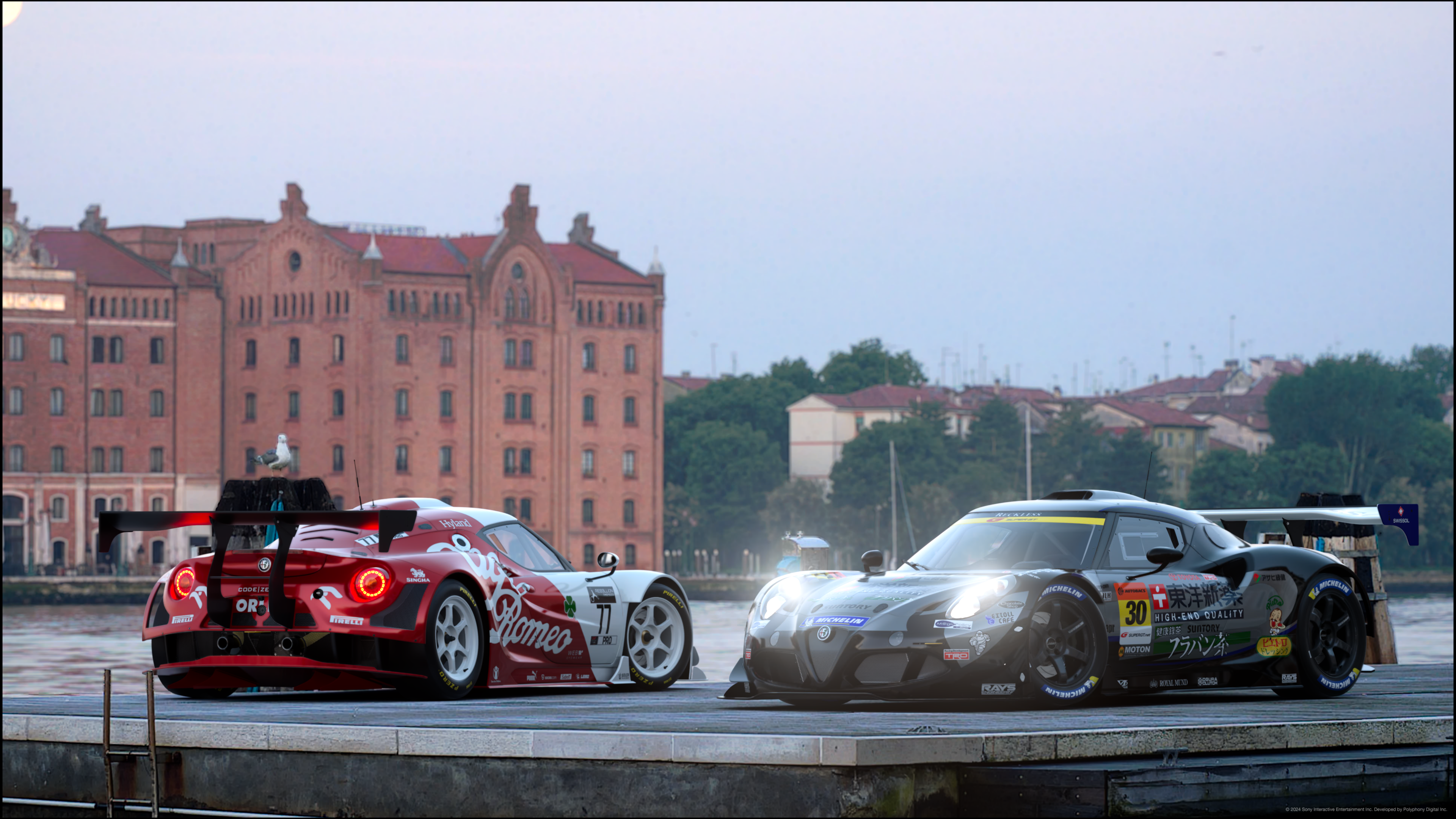
GT7 W64: Alfa Romeo 4C Gr.3

The short–lived Alfa Romeo 4C was probably too small a car to serve as the basis for a GT3 racecar in real life, but Gran Turismo's rough equivalent of said GT3 category, Gr.3, has accommodated so much more eccentric a racecar than a puffed out, ballasted up 4C, making it look downright at home. But where in the hierarchy does the sole car wearing the storied Alfa Romeo badge stand in Gr.3?


#supergt #2005 #reckless

The first thing that strikes an onlooker with a 4C Gr.3 is, of course, its comparatively tiny size, even with the flares and bulges. Being a rear mid–engined, tiny sports car, it's almost a foregone conclusion that the 4C would serve almost a Lotus Elise like niche in Gr.3, being the extremely lightweight, but severely underpowered surgical knife of a car that would compete against the bigger goliaths with reckless agility and unreal frugality, but take either a quick look at the Balance of Performance tables or a 4C running amongst its peers, and that seemingly foregone conclusion quickly fades away: the 4C is only the 9th lightest and the 16th least powerful car in the zany Gr.3 category with v1.48 Mid–Speed BoP applied, rendering it rather prone to being lost in the shuffle when it comes time to pick a meta car. For a supposed cornering car, it has a surprising ability to sniff unsuspecting rear bumpers: my GT500 NSX struggled to rein in the 4C in the wake of the latter's miniscule slipstream around Grand Valley, and Alex's 4C set a faster lap in clean air than my F1 GTR aided with some slipstream... around Monza. The 4C also has a strong top end possibly owing to its lack of drag, making it punch above its weight on tracks that explore the speed limits of Gr.3 cars.


But that is not to say that the folks at Polyphony Digital will give up that illusion of an agile car that quickly: the 4C has a front end so sharp and responsive that it seemingly reacts more to a driver's brain waves rather than their hands. With a full rearward brake bias of +5, weak ABS, and downshifting as aggressive as the caricature flares of the 4C, its rear end comes around just a slight bit under hard braking into a corner, transitioning over seamlessly to the intuitively progressive turbocharged engine when it comes time for propulsion to carry that momentum. Of course, as a short wheelbase RMR car, the 4C will wear its rear tyres out more than its fronts—about twice as fast on the outside from my time flogging it around Sardegna A—but the 4C's personality doesn't change all that much even as its tyres wear down, being mainly limited by front grip. It's only in extreme wear cases, at about 10% life left on soft tyres, does the 4C start becoming squirrely. In terms short and sweet like the lifespan of the production car, the 4C a delight to toss around corners in spite of its spec sheet.

...if the course fits the car well, that is.


Looks can be deceiving, and the tiny RMR sports car is hardly the ideal cornering Gr.3 machine. To illustrate, I'll be comparing it against the car that has been the closest thing to being my go–to car in Gr.3, the 2017 Porsche 911 RSR, and I took both cars out onto the qualifying Time Trial of last week's Daily Race B at Maggiore GP. The 4C is just a bit more prone to power oversteer out of corners, and the fictional car is violently allergic to kerbs, grass, and sausages, with the whole car seemingly surrendering all semblance of grip and control and going completely limp the moment there's an imbalance of traction on one side, often resulting in a rather embarrassing meeting with the inside barrier at a perpendicular angle. Tracks that necessitate heinous track cuts or kerb riding, such as Maggiore and Dragon Trail, might as well be minefields for drivers in a 4C, while the 911 simply wafts past these road imperfections as though a gentle, passing breeze.


While the 4C gives drivers neck–snapping initial turn–in, it doesn't have the same turning ability of the 911 at the same speeds, and it's much less communicative when approaching said limits, resulting in a confidence inspiring, if not frantic turn–in, only for the steering wheel to suddenly feel like it has hit a brick wall mid rotation. The 911, while not as ferociously responsive initially, is much more gradual and communicative with its grip limits to me, and have I mentioned the 911 turns more at the same speed? All this is most evident at high speed sweeping corners like turn 13 of Maggiore, the deceptively scary right kink leading onto the home straight of the West End Layout with minimal runoff area. It's a flat out corner in the 911—but there isn't much wiggle room in the racing line if the turn is to be taken flat. The 4C has without fail, asked of me to lift for the turn, even if for a barely noticeable moment and a tiny smidge, and this is even with as perfect a line as I could manage. I had considered the possibility of the gung–ho 4C being faster at that point, or just having its downforce more biased to the rear, but the 911 and 4C share identical downforce values according to the game, and the 4C similarly asks me to lift much more for Turn 8 than the 911; the final left hander in a complex of corners before the gentle chicane leading onto the back straight.


While the svelte 4C isn't nearly my top pick for Gr.3, it is nonetheless a solid option if the track suits the car, even more so if the event heavily rewards frugality with tyres and fuel. And, hey, that's a lot more than what can currently be said about the brand's real life racing efforts in F1. That's got to amount to something, right?