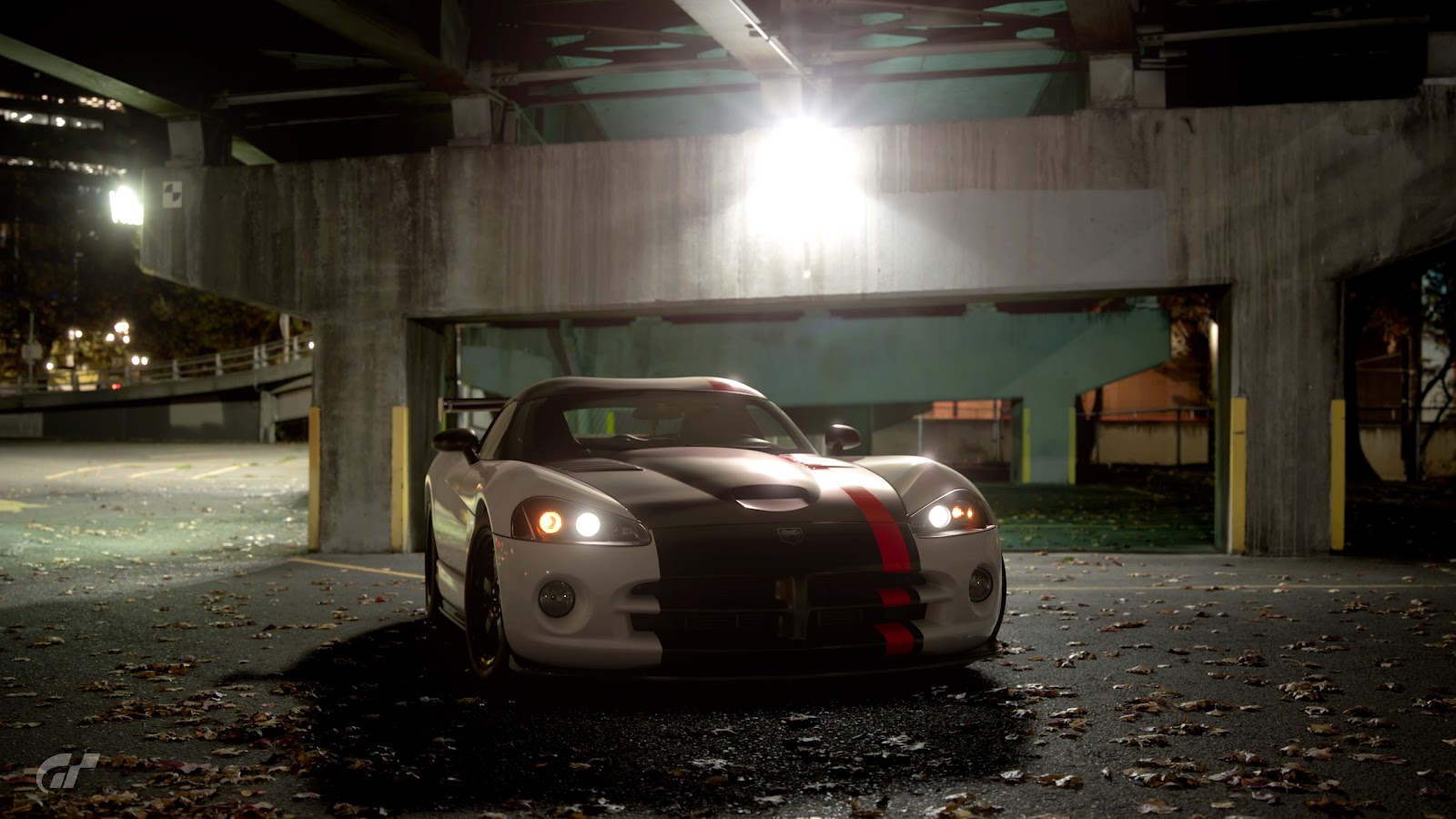
Friday, 24 March 2023

W225 Ford Mustang Mach 1 '71

So, this would be where you might be expecting a 1971 Mustang Mach 1 review, but I've a small confession to make: I was a slight bit distracted the past two weeks, and not just because I was bedridden by a nasty flu virus, either.
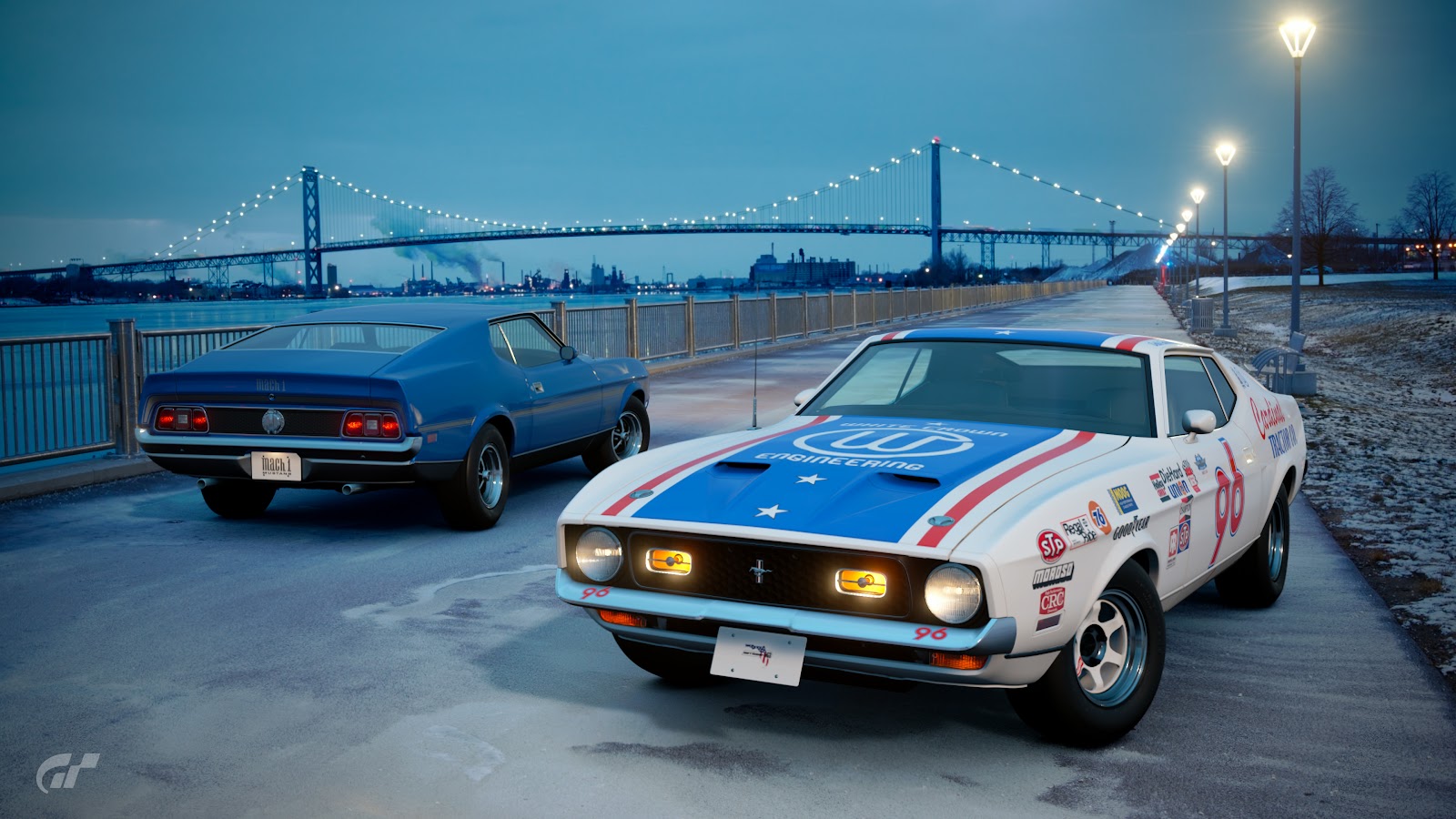

Dale Earnhardt 1978 Nascar W.C.S by Hurricane-O63 livery link (GTS | GT7)

You see, we here at Car of the Week are finally moving on from Gran Turismo Sport to Gran Turismo 7 at the end of this month, and quite frankly, I'm lamenting the switch. The open lobbies that we host races with may finally be of acceptable quality in GT7, but it's still a downgrade from those of GTS'. Not to mention, as many threads may have already told you, the force feedback of GT7 is still sorely lacking, even in comparison to the dull and simplistic model in GTS. Many elite and even casual players don't seem to have issue with it, but I guess I'm in that unfortunate pocket wherein I'm good enough to notice, but not good enough to compensate for/ bypass and ignore it entirely. Whatever the case may be, the might as well be nonexistent FFB is something I'm personally struggling immensely to get to grips with, even with daily practice. After all, how do you practice for having less information? Slides in particular are impossible to feel coming, much less correct from, because I don't know if the front tyres have hooked up or not. As such, I don't even know if I'll be good enough a driver in GT7 to feel comfortable giving out opinions about cars, and I'm feeling extremely insecure about it. And I'm supposed to be the one running the whole damn show? Oof.


While not as egregious as the almost complete lack of FFB, the braking in GT7 feels odd to me as well. Stock cars with their OE brakes won't even lock their wheels on a dry, level road anymore, even if you slammed the brake pedal to the floor. To be fair, it's not as if the cars in GT7 stopped any better; they just seemingly have more longitudinal grip and weaker brakes. It makes the friction circle feel more like a friction oval, and it's so unintuitive to figure out where the limits of grip are if I slam the brakes and don't bring the front tyres to their limits, meaning I don't get a feel for where their limits are on braking zones into corners. Plus, it means that cars that have "personality stock" in how raw they are without aids like ABS, such as Vipers and AE86s, lose a lot of the challenge that defines their character, and that's just a bummer.
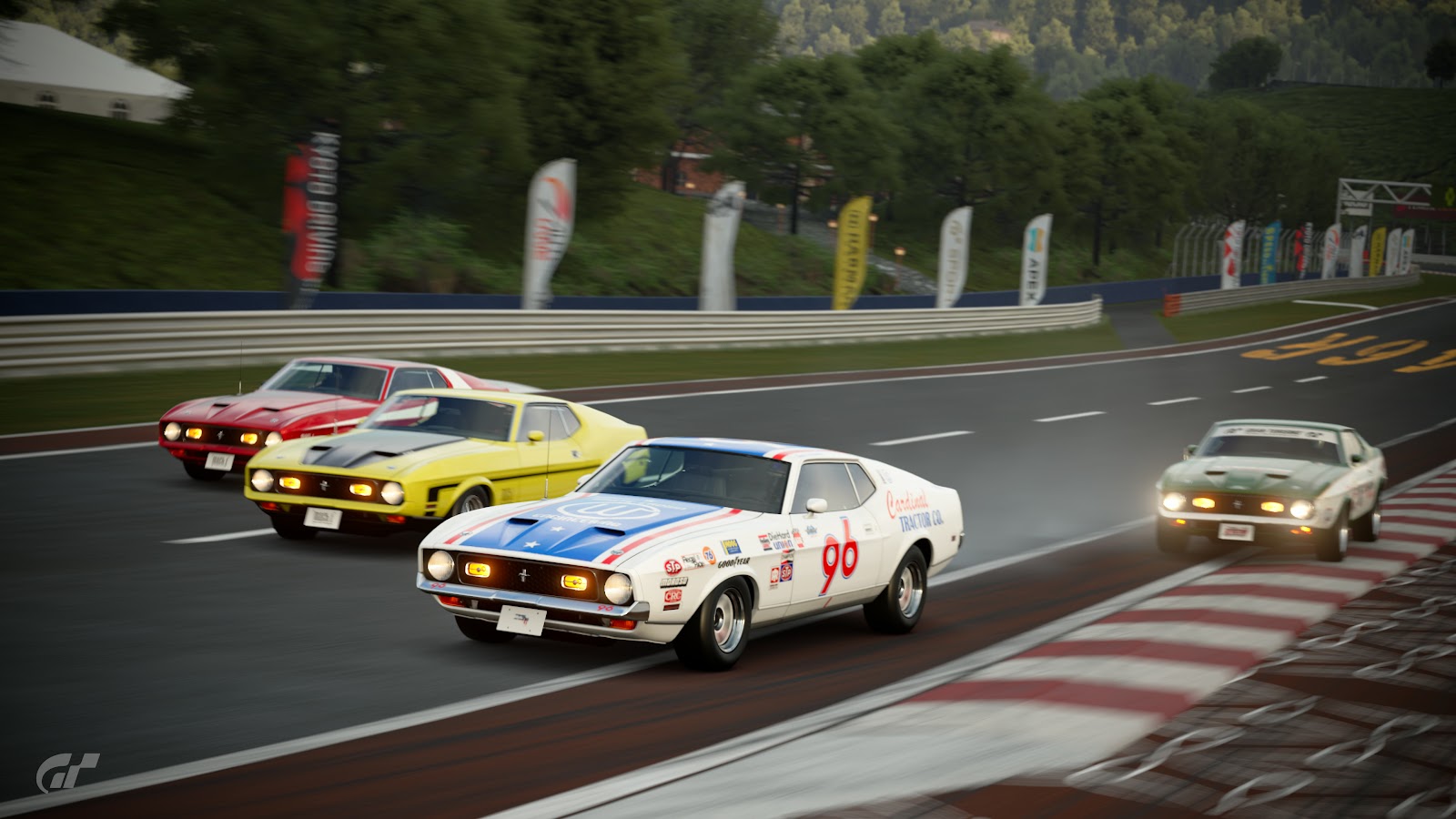

All told, I much prefer the driving feel of GTS. It's not perfect, but it's intuitive. Maybe the issues I've listed above will be adjusted in future patches of GT7, but I highly doubt they'll be addressed as they feel like intentional choices. It's been a few months since I've read of any physics or FFB adjustments in this year old game. Makes me think PD are happy with where the game is.

So, what in god's name does any of my old man waving a cane at the clouds have anything to do with the 1971 Mustang Mach 1 back here in GTS? Well, it's the third to last car (or fourth?) we're driving here in GTS COTW, and I'm very, very glad that I got to experience it before we leave GTS, because I don't think it'd be half as good to drive in GT7.


It's a classic muscle car, and so large, defining parts of its recipe have already been set in stone: It's cheap, packs a HUGE NA V8 up front with pathetic specific output figures, rear drive, a 4 speed gearbox that tops out at the quarter mile, and an equal thirst for fuel and blood. To expect anything even semi–decent from a recipe like this would be almost like expecting discount store rice balls to act as antidepressants, but lo and behold, Don Don Donki's rice balls give me some much needed justification for life's ceaseless suffering, and I might have fallen equally in love with the Mustang Mach 1 two weeks ago.


I'm not sure how common this feeling is among better adjusted people, but do you ever get the feeling of instant confidence when you take your first corner in a very good car at sane, pedestrian speeds, so much so that the car almost seems to be mocking you, chiding you for having the audacity to doubt it, all while making you feel like you're immediately missing out by not dancing with it at the bleeding edges of its traction? Over the course of the three years I've played pretend reviewer, I've felt this sensation maybe four times: in the 981 GT4 CS, E46 M3, the AE86 twins, and the R53 Cooper S. Then, out of nowhere, this 1,615kg (3,560lbs) clunker of a pony car suddenly ups and joins that list of elite cars just from me steering out of Big Willow's pit lane during race day, and thankfully, this promise of greatness is not one that can be faked; the car made good on that promise throughout the rest of race day.


It's a rather soft and heavy road car, and an antiquated one at that, so of course it moves about when subject to even mild gs. But, while I was expecting a Leaning Tower of Pisa stapled onto a floating island in the middle of a Tsunami levels of instability, what I got instead was a very well mannered and obedient race horse, one that is old fashioned, but measured in its movements and refined in its demeanour. It never once felt sloppy, or lashed out in a way I did not expect; everything it did, was because I told it to, from the brakes locking up to the car spinning out.


Braking for a corner in a '71 Mustang is, dare I say it, akin to braking for a corner in a modern Formula 1 car, wherein you have to initially fully stomp on the brake pedal at speed, and as the downforce bleeds off the car, you slowly ease off the brake pedal to account for that loss of grip on the tyres, lest you lock up the wheels. I'm not saying that a '71 Mustang has that kind of speed or any kind of downforce, but it does have disc brakes at all four corners, shocking for a muscle car from the '70s, and the braking technique in the pony car is not at all dissimilar to what I just described: full brake, and as the discs quickly find their bite on the bias ply shod steelies, ease off the pressure to prevent a lockup. The tyres are wonderfully communicative under braking, and I often find myself drawing very consistent skid marks with the inside tyre of a very slightly off neutral braking zone lap after lap, just to assure me that I'm right there at the bleeding edge of traction where the Mustang wants me
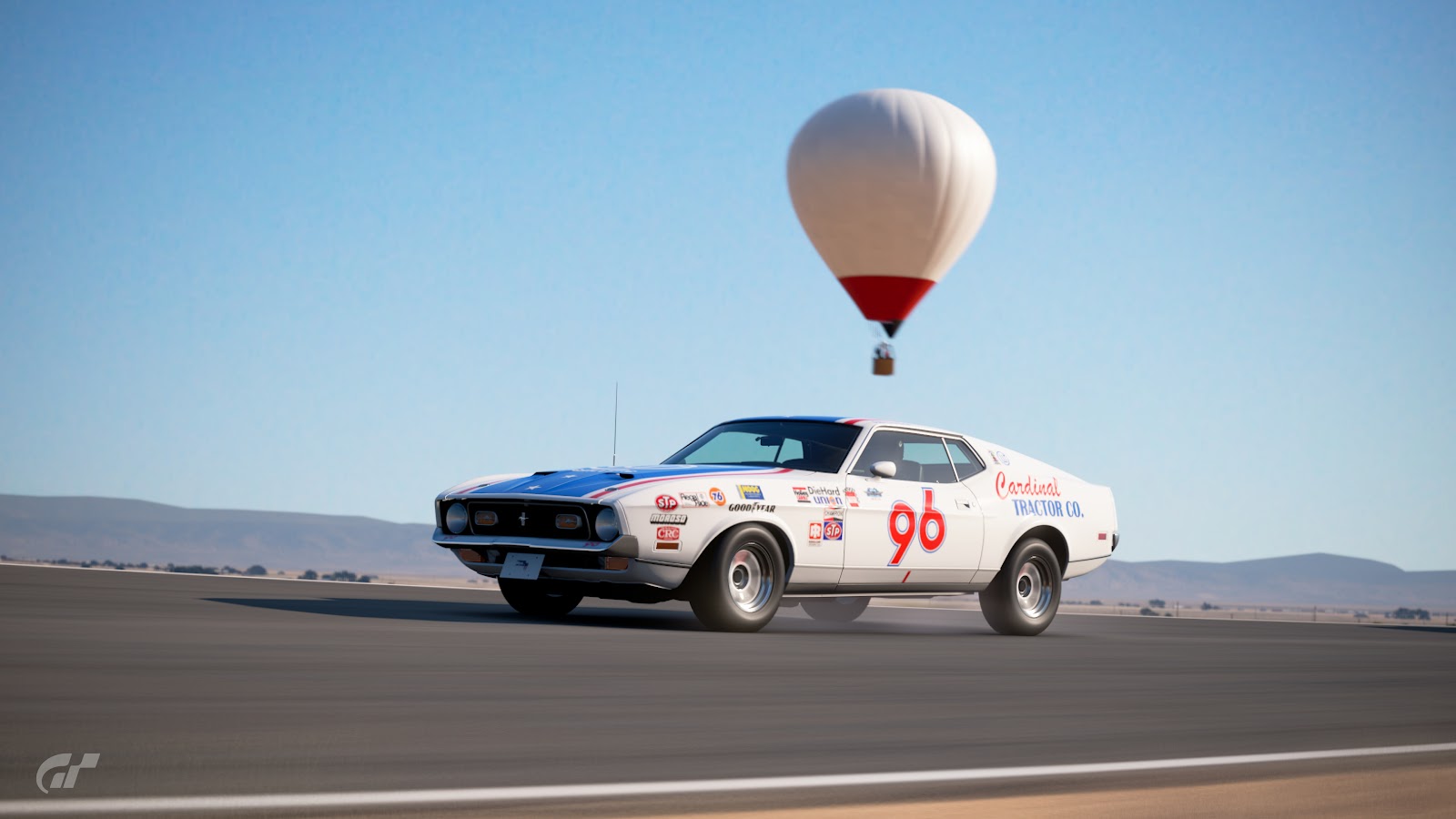

And hey, it's a classic muscle car, and so part of its charm is in the fear it instills in the driver, isn't it? Just because it's communicative and cooperative doesn't mean it's not scary; you still need to have your wits about you to survive a drive in the thing, but that's exactly what makes a drivers' car a drivers' car, isn't it? It's scary not in a "chased by a serial killer" kind of way, wherein there's no control over the situation, but rather, it's a "horror video game" kind of scary, wherein you intentionally scare yourself just for a controlled high; I'd even go as far as to argue that one hasn't truly lived if they hadn't experienced the self inflicted horror of going over the horrendously inconsistent braking zone into Laguna Seca's Corkscrew without ABS, going over blind crests and disruptive rumble strips, all while having to make minute steering adjustments while under hard braking. And if one hasn't truly lived without that experience, then I daresay that there's no other car I want to experience it with than the Mustang Mach 1, because it has just the right amount of speed to scare you, but at the same time, it also has impeccable communication and poise to never make the task feel unfair or unapproachable.


While you have to modulate the brake pedal just to prevent a lockup under braking, you'll have to be much, much more gentle with it when turning the car into a corner, because over stressing the front tyres doesn't cause them to simply give up in a puff of smoke; on the contrary, they will overwork themselves into flinging the nose of the car into the corner with enough furor to instantly swing out the similarly stressed rear tyres, and if you happen to be in the peaky powerband of the Cleveland 351 V8 engine when that happens, then you've got yourself a surprisingly potent drift car, all without the crutch of the handbrake! In a slide, the job of communicating to its driver transfers from the tyres to the steering wheel, with the steering wheel notably lightening up when grip is lost, the 7.0L NA V8 is more than willing and able in its powerband, and the car never being truly beyond the driver's control or intuition. While I've never found drifting intuitive in Gran Turismo games no matter the control scheme, the Mustang Mach 1 in GT Sport is a car that I seemingly subconsciously break sideways just so I can have the joy of proving to myself that I can not only hold a slide, but recover it as and when I want. It's just a car that makes me want to play endlessly against my better judgement!


As a whole then, the Mustang can be a scary car to drive quickly, but that's just due desserts for what I'd like to think is willfully playful driving. If you respect it and pay deep attention to how you handle it, the Mustang will very much reciprocate by being one of the most well behaved, communicative, and capable sports car—not just of its era, not just of its class, but of all the carefully curated list of enthusiast picks present in this game, including the likes of RX-7s, Integras, 911s, and Corvettes. It's a car that can be well–behaved when you want it to, and let down its mane when you ask it to at the drop of a riding helmet, and it's an extremely darling communicator no matter what you put it through. In other words, it ticks all the boxes of a great sports car.
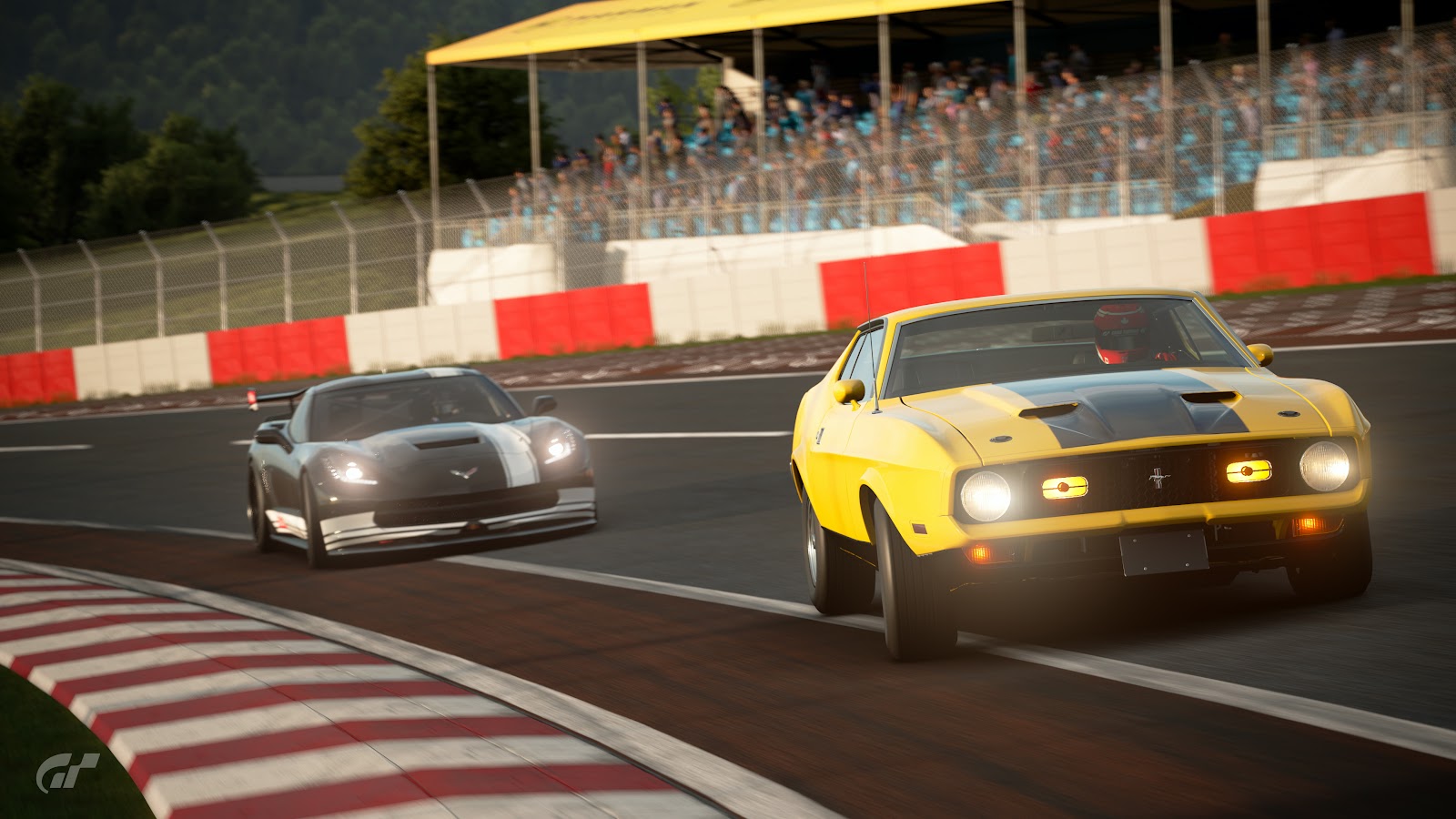

Does it have its flaws? Oh, for sure. Its four speed gearbox tops out at a mere 182km/h (113mph) on a level road in clean air. Because of its low top speed, I often find myself trying to grab a fifth gear that isn't there, and when I got too used to camping at its limiter, I bounce off the 6,000rpm redline in third because I'm dumb. Its complete lack of top end does make even one–make races frustrating, as you can often smell the blood in the air from a competitor who messed up a corner ahead of you, but you'll only gain on them for a second or two before the both of you are topped out at the magical 182km/h, as though the Mustang was a 90s Japanese car, and if you're leading, you don't really get to extend the gap much with your sick skillz. Needless to say, against anything else with more top end and even comparable power, the Mustang is a dead horse in the water. It also has the thirstiest 302HP (225kW) I have ever seen in my life! It's not surprising, given that the peak power of its humongous 7.0L V8 lies just 500rpm away from redline, and the seemingly sawn–off gearbox of the car keeps the engine obsessively badgering its limiter. But hey, that just means that the car gets lighter that much faster over the course of a race, no? I call that a tactical disadvantage.


I'm aware that, in real life, the 1971 Mustang Mach 1 probably isn't anywhere near as sublime to drive as it is in the game. Its suspension is probably a lot more soggy, its steering rack might resemble a wet noodle more than a steering rack, its brakes most likely only work part time, and the car will most likely explode when the steering wheel is tilted more than 0.5 degrees to the right. Hell, I'm willing to bet it doesn't even have 200HP at the crank, given how Americans are so obsessed with gross horsepower at the time. But you know what? I went into this week with lower than zero expectations, and I walked away not only pleasantly surprised, but retroactively wanting more. Not that I could've known it two weeks ago, but the 1971 Mustang Mach 1 is all the sendoff I need for Gran Turismo Sport: it let me lock its brakes, it let me slide it around, and it'd even have let me have close knit battles with my friends if I found the balls to trust it during race day. None of that is currently possible with GT7, and I'm glad that I had to have this very, very special experience with the Mustang before we moved on from this game.


I mean, it's not like we're literally going to test another 7L V8 4 speed gearbox drift car in the next two weeks, are we? That's just ridiculous, don't make me laugh!

Saturday, 4 March 2023

W224.2 Amuse S2000 GT1 Turbo

Power House Amuse is, without question, one of the premier tuning companies in Japan, and the Honda S2000 is still widely regarded today as one of the best sports cars ever made. Suffice it to say then, that the Amuse tuned S2000 GT1 Turbo is something to behold, but what makes it truly special is that it might well be the company's magnum opus.


Quite a thing to say, isn't it, when you consider that Amuse doesn't shy away from much: they'll prep Chasers, GT-Rs, and even Fits for a variety of situations, be it a winding mountain pass or a paved racing circuit, even clinching some records as they go. As the sole representative of Amuse in this game, the S2000 GT1 Turbo seemingly encompasses that spirit of versatility as a true jack of all trades, and perhaps even a master of some. An Amuse backed S2000 wearing a very similar body kit, dubbed the "S2300 GT-1", battled the RE Amemiya μ Boost Up 7 in the final round of Hot Version's 2006 round of the "Strongest Legends of the Mountain Pass, Decisive Battle of the Demon Lords" tournament, handing the Amemiya FD its first loss and ultimately battling it to a dead heat—quite the feat, considering the Amuse was down on power to the FD, packing "only" 320PS at that time, which would almost double by the time it appeared in 2010's Gran Turismo 5 in the form we know it today.


Even back in the car's 2006 appearance, the car was already sporting its trademark fully red interior, seemingly designed for a colour blind person or literally Satan himself. It's WAY too loud for my tastes, but the fact that it hasn't been gutted completely to reduce mass truly sets Amuse apart from most other tuner shops. When I said that the S2000 GT1 was a Jack of all trades, that included daily driving on the street as well! What I especially love about the air–conditioned hellscape that is the GT1's interior is the boost pressure gauge: It's a display consisting of seven–segment LCD readouts that closely resemble the car's original digital speedometer still present in this car, making it look almost like an OE item. It's even synchronised with the speedometer's refresh rate! I don't know why, but it's little geeky things like that that get me, and no one expects these charming quirks in a serious business, all out time attack car.


Rather than stripping the interior of creature comforts, where Amuse has shaved mass from the car is in the body panels; they've replaced pretty much every panel with the stuff of woven black magic that is carbon fibre, to the point where the only panels that resemble the stock car are the doors and A pillar. So effective was this closetry transformation that, despite the car carrying heavily reinforced drivetrain components under its hee–YUUUGE widened body, the car weighs in lighter than a stock S2K at a mere 1,120kg (2,469lbs), a fact that's even more astounding when you consider the fact that Amuse hasn't gutted the interior, the most obvious place to trim fat from a time attack car. But then again, would you expect any different from a company obsessively anorexic enough to make a street legal R34 lighter than its GT500 counterpart?


It's past this point that the story gets a little blurry, and not just from all the tears from the passing of the company's founder, Tanabe Hideki, before he could finalise this S2000.

So far, the only legitimate looking information source I could find detailing the S2000 GT1 is Dino Dalle Carbonare's article on Speedhunters, in which it is stated that car's engine and drivetrain were reinforced to handle more power, and that the F20C engine, stroked out to 2.3 litres, could take a turbo to take things further, but no matter how hard I looked, I can't find a single instance of the car in real life pumping out the 616HP that Gran Turismo games claim it has, nor could I find a single car rocking that distinctive bare carbon bonnet with the ridiculous V–shaped vent in real life. In that same article, it's stated that the plan was to then hook up that 550HP turbocharged F20C engine to a sequential 6 speed gearbox, replacing the stick shift the car had retained up to that point. In–game, the car's description claims it has a 7 speed sequential, while in gameplay, it has a 7 speed manual. The exact specs of this car just seem all over the place, and I have no idea which is accurate, or if there's even an S2000 that exists in this state of tune. I can't imagine anyone kitting out their S2K to look like this to be a shy individual, either.


I opine though, that no S2000 should have come with anything close to the 616HP we wound up getting, wide body kit or not.

The most obvious sign of this is the gearing of that seven speed gearbox: the ratios in practice feel completely unchanged from those of a stock S2000's, which put out a mere 250PS (247HP, 184kW) in its most powerful AP1 generation. 2nd gear is barely good enough for 100km/h, and you'll be sniffing the limiter of 4th just going over Japan's self imposed speed limit of 180km/h (112mph). Those are short and sweet ratios for a 247HP car, but giving these ratios to a carbon draped, semi slick shod, fire breathing, 616HP capable winged beast is like giving Usain Bolt a wheelchair, thinking it'd help him go faster in the same vein it helps poor Sally get around better, when in actuality, it just slows him down. To give you an idea of what it's like in practice, you'll be redlining 6th gear at the end of Mountain Straight on Bathurst, and shifting up to 7th well before the timing gantry roughly halfway down Conrod Straight. Ironically, because the ratios are set up for a car with much less power and speed, they actually fit Tsukuba to a T, but the car as a whole feels suffocated by any track that lets it stretch its legs less than Spa, i.e. most racetracks in the world. Drivers of the GT1 Turbo will have to shift as if they've just landed a starring role in a Fast & Furious movie just to get to the shops and back.


Suki Honda S2000 2Fast2Furious by partage_osmotic livery link (GTS | GT7)

As such, lugging the car out of tighter turns is almost a necessity simply to survive, much less take something resembling that of a racing line. One would think that turbocharging the nuts off a 2.3L engine to eke out 269HP per litre from every atom of its deeply tortured soul would induce turbo lag akin to streaming free porn on public Wi-Fi, along with a power curve sharp enough to skin paint off the car's mostly carbon fibre bodywork, and even modern GT500 race cars like the 2016 Raybrig NSX that have similar specific output numbers are no exception to that trend. While that mortifying spot where you get all of that 616HP does lie just 1,000rpm away from the car's redline of 9,000rpm, the power curve that builds up to that point is surprisingly linear and useable, and there is no perceptible lag at all when punching it from mid range. It really is a blessing that the engine is so miraculously receptive of being lugged, given the horrifically short gearing on this car.


The main reason why I say this car ought not to have come with as much power as it now has is, of course, its handling. Based off the first generation AP1 S2000 judging by its non–LED tail lights, the stock car wasn't even offered with the option of traction control, and I haven't come across any mention of the car coming with an aftermarket TCS in my trawl through the internet. So, to reiterate: more power than a GT500 machine, very similar gearing to a stock S2000, and (most likely...) NO TRACTION CONTROL. There is lots and lots I can praise about the handling of the car, such as the downforce actually preventing the car from catching air at high speed spots where most production cars with its power figures would have lifted, how it's one of the very few, if not only road cars in GTS to not come default with Sport Hard tyres, instead coming with Sport Softs, and how its wide body, strong brakes, and soft tyres all work in conjunction to make this car one of the very few road cars that can actually stop well from speed. While all that is true, it somehow feels disingenuous to properly mention because all I'm thinking when behind the wheel is, "HOLY SHIT, HOLY SHIT, HOLY FUCKING SHIT!" from trying to keep the car from spinning out. It's a good thing my reviews are in written form, because I don't know how much usable footage I'd have from all that constant swearing if I had to review this in video. It's not just me, either—everyone present during race day, regardless of skill or assists, were having incident after incident with the car. It simply has way too much power for its own good.


And don't even think any of its 616HP even needs to come on for the car to break sideways! On hard braking, the car gives a very eerily distinct, yet impalpable sensation that the rear end is a hair trigger away from breaking sideways, almost like I was getting gaslit by a car. Turn the steering wheel too hard in this state, and the laden front tyres completely out–grip the unladen rears, swinging out the rear end violently without any of the 616HP even coming into play, and that's just ultra counter–intuitive as someone who hasn't spent the last fifty years driving exclusively 911s. According to Dino's article, the car wears 265/35R18 Bridgestone Potenza RE-01R rubber at all four corners, and you could argue that this is personal preference, but it baffles my broken mind how one could give 616HP to a FR car and not stagger its tyres. Even Vipers, world renowned for their mortifying handling and immense power, come with narrower tyres up front and thicker rubber in the rear to prevent this exact scenario. And no one at Amuse thought an FR car with 1.82kg/HP needed this? Maybe this tail happiness under braking is intentional to help the car get rotated in a tight track like Tsukuba, but I've always found it impossible to drift in this game with its wonk as hell tyre model, and thus that tail happiness on turn–in is just disruptive and hazardous in my hands.


A very capable car demanding a corresponding level of skill from its driver isn't much of a knock against the car; if anything, it's more of a knock against the driver for not being able to match their car's capabilities. But does the Amuse S2K GT1 Turbo have to be this difficult to drive? What better way to find out than a comparison test... against a bona fide GT1 racing car?


No, I don't claim to be the most sane person in the room, but at least hear me out, okay?

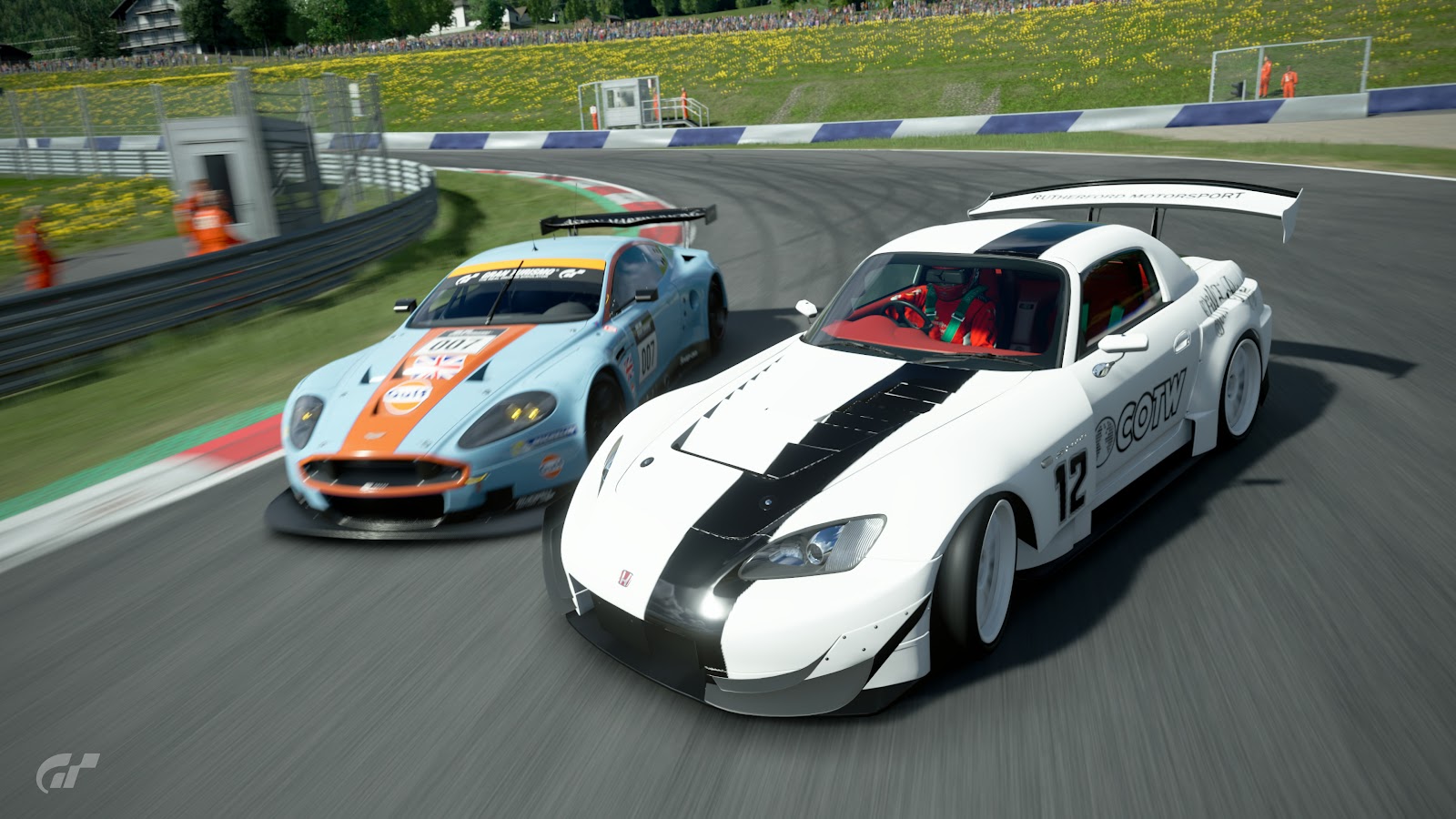
On paper, I have made every attempt at disadvantaging my Aston Martin DBR9 GT1 in this test: I've downgraded from the full racing slick tyres the car originally came with to grooved Sport Soft tyres to match the compounds shoeing the Amuses, and did NOTHING to the suspension to compensate. The racecar is originally a set of titanium balls lighter than the tuner special, weighing in at 1,100kg versus 1,120kg (2,425lbs vs 2,469lbs), and rather than ask Vic to lower the minimum mass requirement to run the comparison car stock like I always do, I thought I'd just bring on board my own set for once to increase the Aston's mass to 102% to let it clear (and negligibly outweigh) the minimum mass requirement set to the Amuse's 1,120kg. As for the power, the racecar is shockingly less powerful than the street legal thing you can buy and drive on public roads: 600HP versus 616, and with only six forward gears to work it with in comparison to the Amuse's seven forward, zero chill cogs.


In short, I was running an overweight, underpowered, and maladjusted racing car against the tuner special, and I still beat the fastest Amuse by ~3 seconds a lap around Red Bull Ring despite that. Even on gimped road tyres the car was never set up for, the DBR9 put down power a lot cleaner and a lot more linearly than the S2K. It stopped better, it turned better, and thanks to the seamless shifting of the sequential box, I actually had a slight advantage on the straights as well despite the power deficit. The Aston just felt better put together and nowhere as clumsy as the Amuse, while doing everything the S2K could do better. Hell, this entire paragraph was so dry and "duh" even I felt bad for writing it. Almost as bad as I felt for my unsportsmanlike act of bringing a racecar to a street meet.


All of which leads me nicely to the simple point I took a rather convoluted and bloody route to make: I don't like the S2000 GT1 Turbo, simply because I think it went too far for a street car.

Despite looking like it'd fit right in with a field of GT500 cars, the GT1 Turbo doesn't even have anywhere near the levels of downforce a GT1 car has, and that to me just feels like a bad tease. I'll admit to being spoiled silly by the suite of race cars in this game, but that's also the biggest reason why I don't like the GT1 Turbo: it looks like a poser. And, forgive me for saying this, but I think the GT1 kit looks ridiculous on the S2000. I can easily tell the DBR9 is a DB9 from a quick glance, but the GT1 Turbo hardly even resembles an S2000 from some angles. Even though its interior is intact with creature comforts, I wouldn't want to be seen on the streets rocking a car that looks like this. It sacrifices ground clearance, ride quality, the purity of an NA engine, the accessible handling of an S2000, its inoffensive looks—in essence shedding most of its identifying qualities—just to chase a goal it's never going to attain. A street legal car just isn't going to perform on the same level as a racing car. And because of that, the more they strive to look and perform like a racecar, the more they look like posers to me, ironically enough. And no, this is not just an issue the Amuse S2000 GT1 Turbo has—I feel the same way for every tuner car out there.

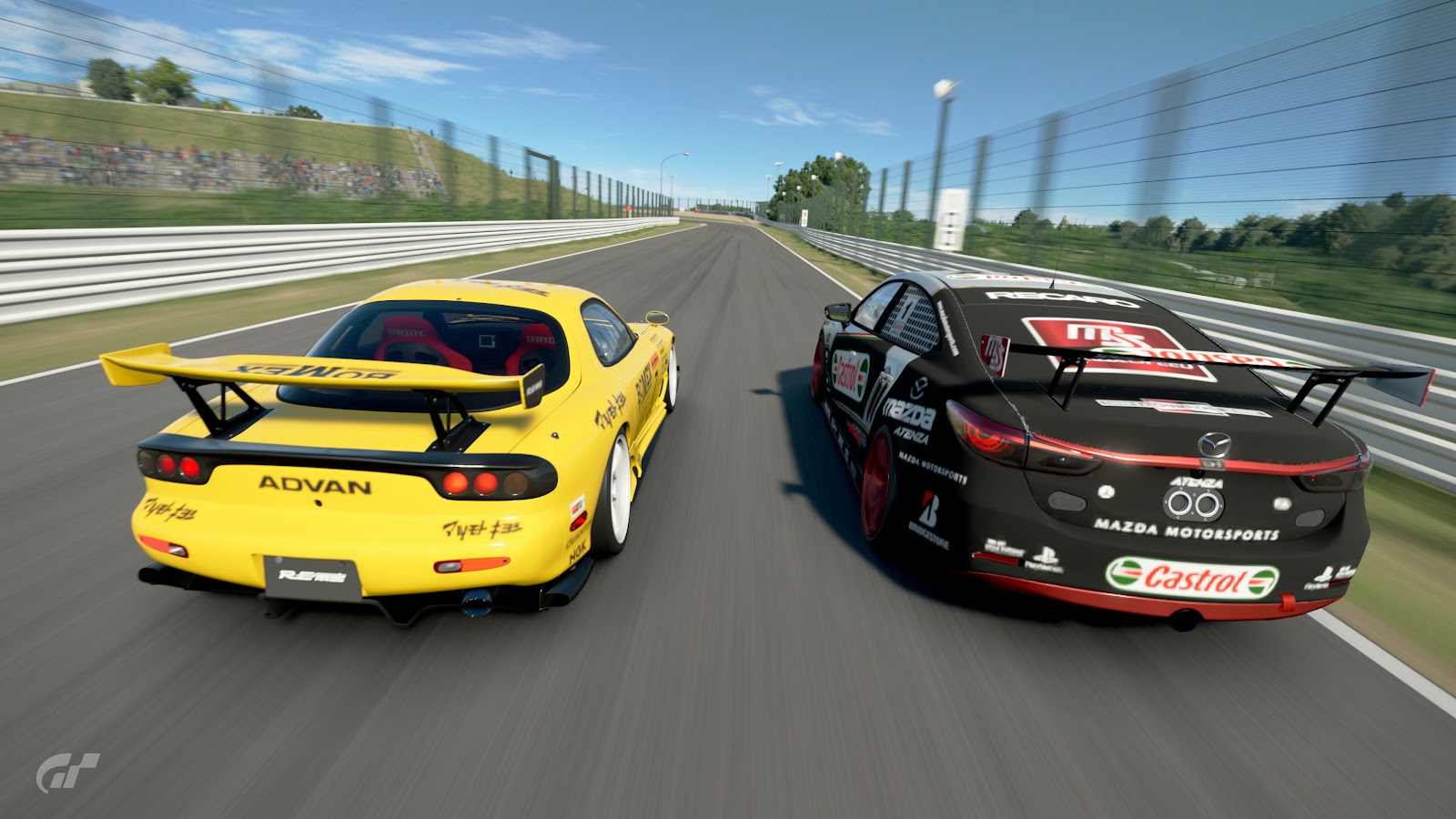
(The Amemiya FD vs Atenza Gr.4 comparison from last week is the exception to prove how awful the latter is, don't @ me.)


I don't want my road cars to try to be a race car, in the same vein as me not wanting my racecar to come with sat nav and seating for five, because neither is ever going to come close to being the other, and the harder you try to bridge that gap, the more compromised the car becomes, ending up almost as a parody or a caricature of the thing it's trying to be. There are good things about a road car to appreciate too, you know? I like being able to go over speed humps not worrying about destroying a front lip or shredding my underbody. I like having some semblance of fuel economy in them. I like being able to park my car and walk away without demanding the attention of everyone within a 50 mile radius. I like my S2000s slow. I like them when I can push them. I like them looking inconspicuous. I like their impeccable balance. I like them when they aren't threatening to put me in a wheelchair every time I brake a bit hard. I like them when I'm not afraid of them. And if the price to pay for all that is going slow? Pfft, it's not even a choice worth deliberating in my head. If I want to go fast, I'll just go drive a racecar instead of trying to make my road car handle like one, failing miserably.


I like my tuner cars to build upon the base car's strengths, curb a few of their faults, and make it even more enjoyable to drive while keeping its character intact, like the aforementioned RE Amemiya μ Boost Up 7, or even the Amuse S2000 R1 that was in previous games. If you're going to put this insane amount of work into a car to radically transform it beyond all recognition, what difference does it make if all that effort went into a Honda S2000 or a Proton Saga? They all just become soulless, uncontrollable racecar wannabes.


I suppose if you're into role playing or cruising lobbies in these games, the Amuse S2K might make sense; you pay Porsche GT3 money for something much more unique, packing performance that far eclipses anything you can buy in a showroom staffed by people in suits or anything carrying roof lights. I can definitely see a highway cruise with friends being a blast with it. If you're looking to cheese N class or road car events, this car is completely unbeatable... IF you can handle it. Me personally? I'm steering WAY clear away from this thing and praying instead for the R1 S2000 to make a comeback from previous games.

Monday, 27 February 2023

W223 Mazda Atenza Gr.4

So, I'm coming back from a month–and–a–half hiatus after my Logitech G29 wheel broke, and while now armed with a slightly more upmarket Thrustmaster T300RS, I'm still coming to learning the ins and outs of the new hardware, and so when presented with the liberty of picking this week's car, I knew that I had best pick something I was already familiar with. Something that's easy to get to grips with and forgiving if mishandled. And if it also happens to be readily available in the Brand Centrals of both GTS and GT7, that'd just be the cherry on top of a cherry cake. Does such a car exist?


Ladies, gentlemen, and everyone else in between, the Mazda Atenza Gr.4: the car that's been with me throughout the entirety of my two–year tryhard journey into the game's eponymous Sport Mode, during which I had only signed exclusively with Mazda. Needless to say, I'm very, very familiar with how this thing drives.

You wanna know what else I'm familiar with? Losing. A lot. With this car.


Now, don't get me wrong; with the current Balance of Performance setting it at 103% power and 99% mass, the Atenza looks menacingly quick on paper, being just the third most powerful Gr.4 car behind only the GT-R and Veyron. It is also slightly lighter than average, being 11th lightest in a field of 28—not too shabby at all for a car that drives all four of its wheels, and utterly insane for a third most powerful car in its class. However, the Atenza only enjoyed these stats near the end of the game's support, when Mazda suddenly became an official partner of Gran Turismo and introduced the RX-Vision GT3 to the game. Prior to that, the Atenza Gr.4 had always languished at 104% power and 100% mass—that's right, this abysmal Atenza you see before you today? That's with the power of politics buffing its longevity and cornering speed. Can you imagine how dumb and blindly loyal a person would have to be to Stan for Mazda before this political buff?


With numbers like that backing it, it ought to be a wonder and a half how the Atenza Gr.4 isn't a top contender in its category. As is customary with cars that have strong straight line shove, the Atenza isn't that apt when the roads twist and meander. While possessing a slightly improved 60:40 weight distribution over the road car's 63:37, it's still massively front heavy by racecar standards, especially when it feels like it's centre of gravity hasn't been lowered any, as though the Gr.4 car still has a big, tall, heavy diesel block underneath its aggressively perforated bonnet. What this results in is a car that, while beginner friendly and difficult to upset, is in the same vein markedly more unwilling to slice into corners and bite apexes, even in comparison to other front engined cars in its category like the RCZ, much less mid engined supercars with their low, svelte bodies. Drivers will have to exert notably more effort into fighting the wheel to push the heavy nose of the car into the apex, and the Atenza very much feels like an FF car to drive, wherein the front end does all the work and the rear end simply follows with no opinions or objections.


"Big deal, that sounds like a typical trade off for having a speedy car in the straights, what makes an Atenza as awful as you make it sound?", you might be thinking at this point. What makes the Atenza TRULY awful is that it pays more than the due price for its straight line speed, but it still gets overshadowed by the GT-R when a power focused track arises. And so what we end up with is a car whose entire point is eclipsed by many other cars in its category that can beat it at what it does best and do more, such as the GT-R and the FF menaces. In fact, if there's one thing the Atenza might do better than any other car in Gr.4, it'd be eating tyres... in a category with FF cars.


Don't ask me to explain it, because I have no idea WHY THE HELL the tyres on the Atenza go off as quickly as they do. All I can tell you is what it feels like behind the wheel: as if the mechanics didn't have time to properly align the suspension and decided instead to just coat the tyres with a layer of liquid glue to give the requisite grip. Once you hit the track, the first few corners feel incredible, almost in disbelief that a sedan chassis can handle this neutrally and immediately, but near the end of the lap, when the tyres have shed all the glue, the massively cambered tyres not only offer zero grip, but also start to aggressively autocannibalise, forcing drivers to alter their driving even before the end of a 2 minute lap—and don't go assuming I'm talking about races with insane wear rates like 10x or something; I'm talking about just plain ol' 1x. I think I've taken wanks longer than the tyre life of the Atenza Gr.4.


At this point, I don't even know if there's really any point to rag on the Atenza Gr.4 any further. Yes, there's more. In the interest of completion, I shall also complain about the the entire drivetrain of the Atenza Gr.4. I'm not sure what kind of engine PD put into the Atenza for Gr.4 competition, but whatever ended up taking the place of the road car's diesel engine is more rotary than a rotary is a rotary—the nondescript 2.2L Inline 4 is so awfully peaky that, even when shifted at redline, clicking in the right paddle feels less like upshifting a car and more like disassembling a running engine. Compound this with the fact that the in–game tachometer flashes for an upshift way too early at roughly 6,900rpm when fuel cut is at 7,500 means that the game will shift the car way too early if left in AT, which means that players who opt not to shift for themselves will suffer a massive disadvantage—enough to lose several positions off a standing grid start. You can immediately forget about any race that requires you to save fuel as well, since short shifting completely asphyxiates the peaky car. So obscene is the power drop with each upshift that I've even come to memorise at which exact speed in km/h to make upshifts in the Atenza Gr.4: DON'T, 122, 156, 196, and 235. Because it has gears wide apart from each other and a peaky engine, the Atenza will hazardously bog at low speed scenarios, such as launching from a standstill and coming out of the asinine chicanes of Monza, and that is such a crying shame since the AWD ought to have been such a weapon in propelling a car out of these low speed sections past its 2WD competition, especially when absent any aerodynamic grip. If the Atenza is going to be so terrible at these low speed sections where AWD would make the most sense, why is it saddled with the mass of having AWD? Give it the OP straight line speed of the FFs or the tyre life of an FR and take away it's AWD then!


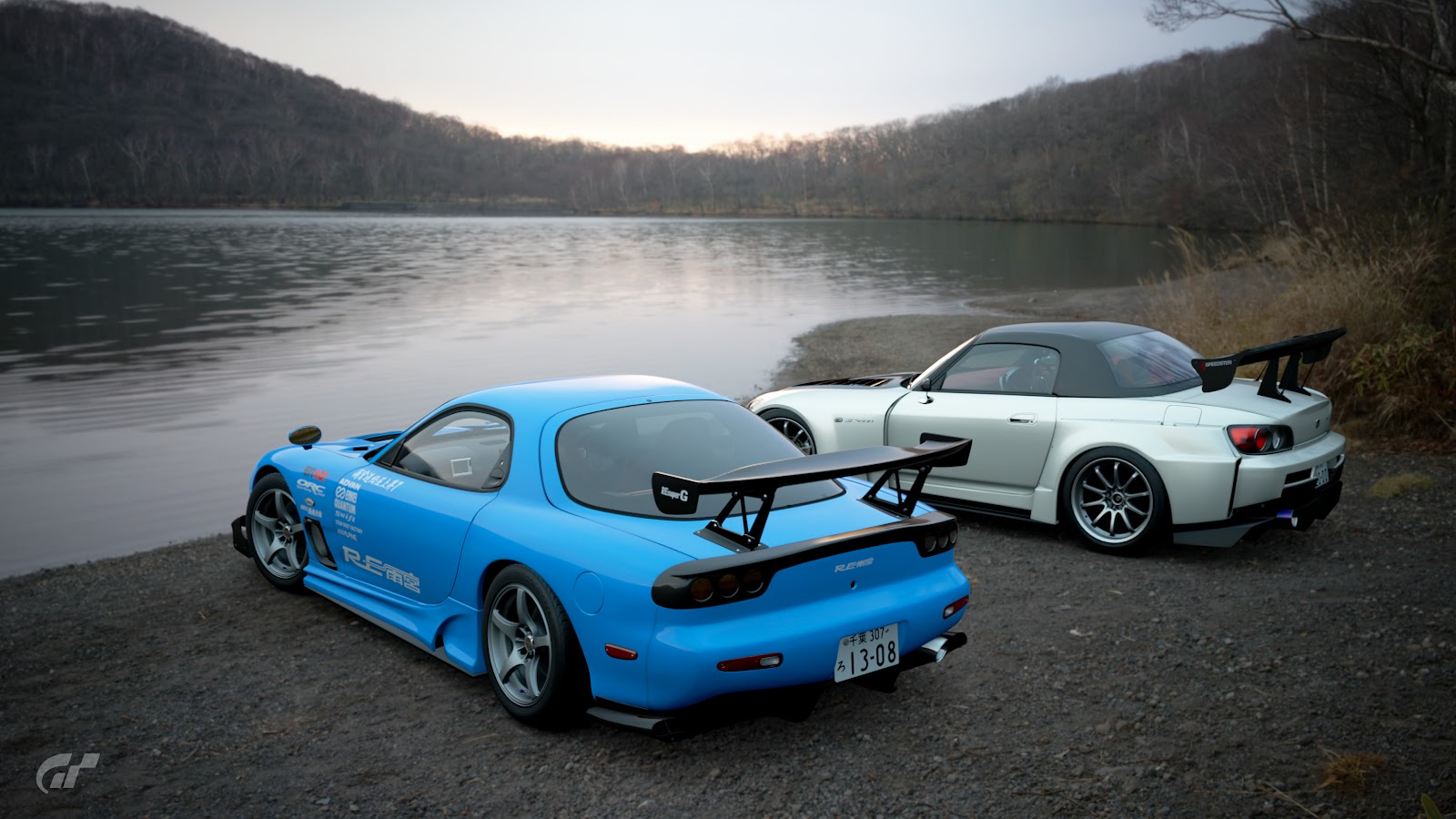
Overall, the Atenza Gr.4 is a perfect catastrophe of mismatched parts that almost looks intentionally awful: comically bad tyre wear, only slightly strong acceleration, rather weak turn in, horrifically peaky engine, and overall just good for nothing. It's almost hard to believe that a group of professionals have come together to create this bespoke, built to spec racecar in a liberating virtual setting without any logistics or costs to hinder them. In fact, I'm even going one step further in my slagging of the Atenza Gr.4: I think an independent tuner in real life could build a faster, more cohesive Mazda out of a small shop in Chiba. I think that the RE Amemiya Boost Up 7, primarily built to attack winding mountain passes, is just a set of Racing Hard tyres away from sticking it to the purpose built racecar on the latter's home turf: a smooth, wide open racetrack.


Re Amemiya FD3S JGTC by Not1Name livery link (GTS)

The tale of the tape goes as follows: even without the boosts afforded to the Atenza by Bias of Performance, the Amemiya FD is still slightly down on power, measuring in at 367HP (274kW) versus the Atenza's showroom condition 393HP (293kW). However, the Amemiya is a whopping 150 kilos (308lbs) lighter than the Atenza at 1,240kg (2,734lbs). The big story in this fight however, isn't in power and mass, but rather, in the gearboxes—the Amemiya FD is saddled with a 5 speed stick with an overdrive 5th gear, and it's going up against the Atenza's straight cut sequential 6 speed racing unit. Oh, and the Amemiya FD has been noted by many of us here at COTW—myself included—to be a twitchy demon of a thing to wrangle around a racetrack. And so what we end up with here is a showdown of two extremely different cars each based on a production Mazda; of power and stability versus free spirited agility. Factory versus private. But which one comes out on top?


The Boost Up 7 feels to me like it has been set up to take these Racing Hard tyres by default, because its characteristic nervousness at its limits has been almost completely stifled by the full racing slicks, and any twitchiness that remains can be very quickly caught and easily corrected with just a quick flash of counter steer. What hasn't changed at all is how much of a joy Ama–san's creation is to drive; the aftermarket street brakes hold their own against the slotted racing discs of the Atenza thanks in no small part to the latter's unwieldy heft, and when I turn the steering wheel in the 7, it feels as if the car as a whole rotates around my bum, in sharp contrast to the sensation the Atenza gives of having to fight the front end, which in turn has to fight the rest of the car simply to turn. And while similarly optimally shifted at around 7,500rpm, that is a mere piddling mid range in the Wankel Rotary's rev range, with the Boost Up 7 redlining at a hair–raising 8,500rpm. Its punchy mid range torque and ample headroom in the rev range not only lets the RWD road car out–launch the AWD racecar, but it also let me hang onto a lower gear if fast approaching a braking zone instead of forcing me to shift and waste crucial time, a luxury that is beyond even fantasising about in the Atenza.


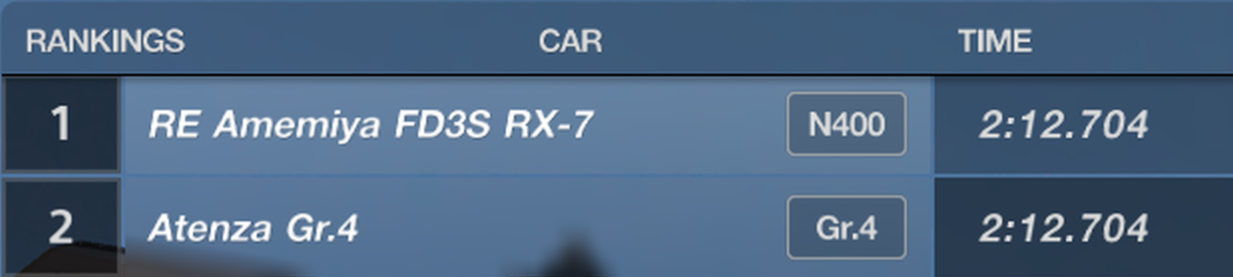
In the end, I had a hard fought battle with all of the Atenzas, lag spiking one into the shadow realm (sorry Rob...) and beating all but one when the chequered flag dropped at the end of the four lap sprint. Losing to Vic isn't very telling; it's like saying the sun rose this morning. And so I thought to run the two cars at 100% power and mass on racing hards at Suzuka again, and uh...


I got the exact same time for both cars, down to the thousandth of a second.

So what's the point of all this? Why compare two cars that are built to do very different things? That'd be like saying that an F1 car is quicker than a Group B car; they're built with different budgets, goals, and rulesets in mind. What I aimed to demonstrate with my very elaborate stunt is that Mazda desperately needs a much better representative in Gr.4 if it's to have any legitimate chance of making it onto the big stage with the likes of Porsche and Toyota—and that it has easy access to much better alternatives that would be much more suited to serve as a base for a racecar. Imagine if RE Amemiya built a GT4 RX-7. How awesome would that be? Granted, the FD RX-7 is an ancient dinosaur in the automotive industry, but that hasn't stopped the 458 or Evo X from representing their brands in this game, has it? Surely the RX-8 would qualify as a homologation model? Hell, if Mazda is fine with fictional cars taking the stage, why not the Vision Coupe, a newer concept that bowed two years after the RX-Vision? Hell, if we can have an RX-Vision GT3, why not also an RX-Vision GT4?


The Atenza Gr.4 is just inexcusably bad, and there's very little reason I can see as to why it hasn't been fixed yet or replaced completely. Maybe Polyphony Digital has just given up on Gr.4 as a whole, I dunno. When was the last time we had a Gr.4 race at a World Tour event, anyway?

Monday, 20 February 2023

W193 Viper SRT-10 Coupe '06

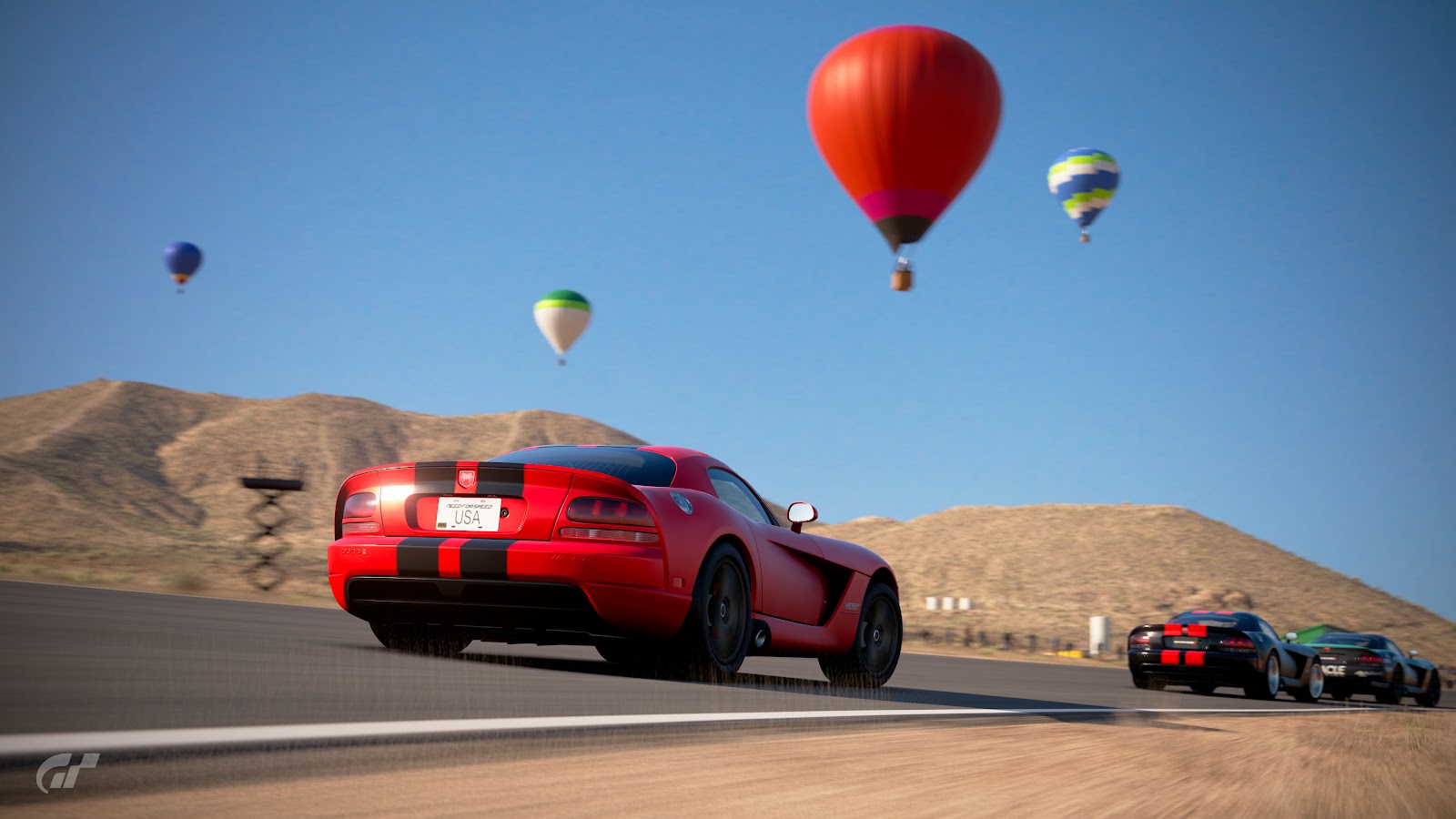
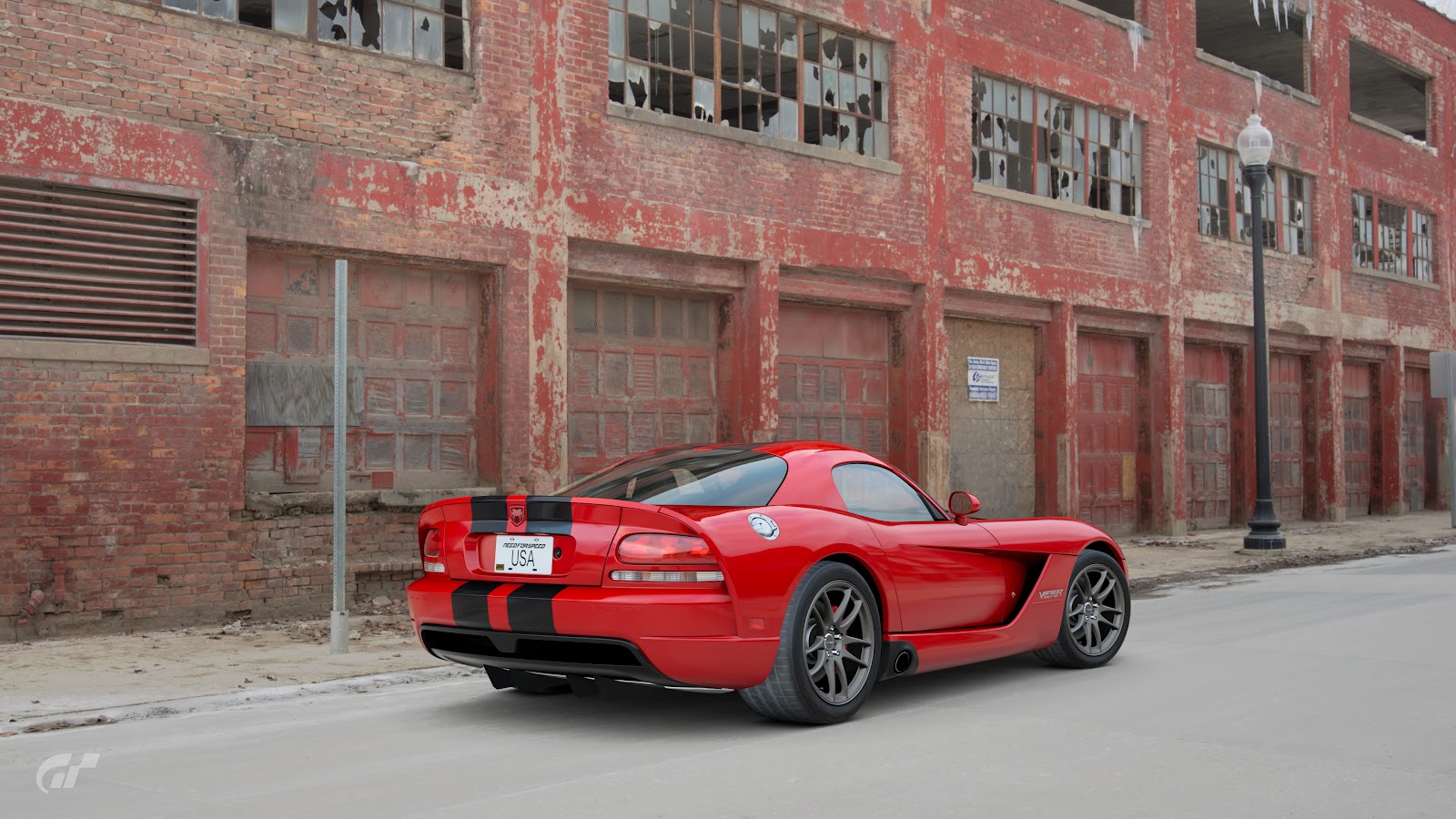
Now, I've been known to be a bit cynical and critical of a guy, but put a Viper, any Viper, in front of me, and I'll simply reduce to a puddle of giggles and good vibes, because "ooh sick styling macho aggression super fun colour combos!" In case it needed explicitly spelling out, I'm a bit of a sucker for Vipers, even the least noteworthy trim of the least noteworthy generation of them, such as the 2006 Viper SRT-10 Coupe.


Old habits die hard, and perhaps that's why I like Vipers as much as I do. Just to get my usual cynicism out of the way real quick, Vipers are terrible cars by almost any metric. Attempting to daily a Viper is as against common sense as trying to shave your balls with a chainsaw; I mean, you can try if you want, and certainly no one's going to try to stop you if you do (because you're clearly too far gone for mere words to bring you back), but there are way, way more sane, apt, and ergonomic tools for the job. As far as performance goes? Well, it's got power and torque, and uh... that's... about it.


This is especially true because for some bewildering reason, players of this track focused racing game weren't given ANY of the track focused ACR models of the Viper, almost as if we're expected to take this air con and carpet equipped digital Viper to do our grocery shopping and pick up our kids from school. As such, we have "only" 508HP (334kW) to shove around 1,565kg (3,450lbs) of snake, with none of the aggressive aero, flashy carbon fibre, and adjustable springs of the ACR to help. Be that as it may, though, it's still a Viper. It still does Viper-y things.

And Vipery things are terri–effing–fying.


Yes, objectively speaking, the third gen Viper SRT-10 Coupe is more powerful and lighter than its predecessor, the already scary 2002 GTS Coupe, by 60HP and... 9lbs, but don't let that fool you into thinking it's any easier or better to drive in any respect. It's still quite a porker by 2006 standards, and bringing the snake to a slow still requires quite a lengthy straight. This is especially so because it still lacks ABS, meaning that a lot of how well it stops is down to driver skill and how quickly they can suss out the physical sensations of the car and the road, how well they can modulate the brake pedal, allocate the friction circle, and the gentleness with which they ease it into an off–neutral braking zone. As you can probably already surmise, that's a lot of variables that ABS usually zaps away like magic, and with such an amount of variables to handle unassisted by computers while also missing the physical sensations of the real world, it's difficult to find any consistency in the braking performance of the Viper in the game, even when braking for the same corner on a different lap in the same run. I mean, you could just leave ABS enabled as is the default setting in the game, but that'd be like asking your wife to go to a sperm bank for a kid to call your own; I have the thing, I worked hard to get it, it's mine, of course I want to do it by myself, the way it's meant to be done, damnit! Why would I have gone through all the trouble of getting the thing if I'm not going to enjoy it myself? If this is how my queen wants me to see and treat her, then by god I will!


Once you've come to a slow in the Viper, you'll have to actually turn the steering wheel for the corner. The horror! While the 2006 Viper is (barely) lighter than the 2002, it feels heavier than its predecessor when its steering wheel is pulled off centre. This can be explained by the fact that the 2006 has 1% more of its weight over the front tyres at 49%, in comparison to the 2002's 48%. It may seem trivial in writing, but that 1% difference means that the 2006 Viper has more mass over its front tyres, despite being the lighter car of the two. Weight distribution is one of those things where I feel that even a whole percent isn't a fine enough unit of measurement, and I wish car reviewers in real life and games alike would start including decimal places when presenting that stat. Small rant aside, the 2006's front end is perceptibly more inert and less willing to slice into an apex in direct comparison to the 2002 car, and it's not like the '02 was an Elise under its snake skin to begin with; both cars lose a lot of definition in the steering wheel work to the softness of the suspension up front, and I never feel like I know what the cars are doing, where the front tyres are, or exactly how they'll react to my inputs. While I'm fine with that in the '02 because I feel that the package as a whole worked well enough, being presented with the same ambiguity and yet more unwillingness of the '06 starts to get a little frustrating for me to deal with.


Admittedly, that may be because I've over 1,000 track kilometres on my '02 Viper, often bringing it to comparison races in previous weeks, and thus I'm more used to it, but my point of the '06 car being more unwilling to bite still stands: I feel like I've to slow the '06 car more for a corner and set it up for a turn more deliberately than the '02 car if it's to bite the same apex, which causes me to have to slow earlier for a corner, bleeding over complications into an already complicated slowing procedure as mentioned before.


Once past the elusive prey that are apexes however, the '06 absolutely comes into its own; it's both more manageable and playful than the '02 car, which I've repeatedly described as wont to break your bones the moment you break its grip. Not only is it faster out of corners with its massive 60HP advantage, but it loses none of the stability and assuredness in putting down that extra power of the older snake! More than that, it adds a level of playfulness and controllability out of corners that is completely nonexistent in the '02; you can powerslide it out of corners if you want! You can control and hold a slide! The third gen Viper has a naturally aspirated V10 as all Vipers do, but it has been enlarged to 503 Cubic Inches in displacement in this third gen model, and I'm quoting the Imperial units because I think the heads of us sane metric folk will explode if that ridiculous statistic is converted into sensible speak—eight point freaking three litres! While 508HP is still pitifully little to show for all that displacement, the real story is in the veritable plateau of torque from near idle that lets the Viper pull eerily like an EV from almost any rev range below 6,000rpm, no fuss, no questions asked. In other words, it's a car that almost begs to be hooned even in stock form. I was not at all surprised to learn from Vic that there's a team that runs this particular generation of Vipers in Formula Drift, which his car takes after.


After the precarious chore of setting up the Viper for a corner, finally being able to give it the beans approaching a straight really gives that cheeky sensation of "Heh! This is where the real fun starts!" I think what we traditionally consider a "fun car" is a car that has to be fun all the time, be it rowing through the gears, revving the engine, attacking a corner, or even when driving to the shops and back. A more well–rounded package, if you will. The Viper's delivery of its fun is a lot more like that of a roller–coaster or horror game: it starts slow, with a lot of waiting, anticipation, and dread. It then slowly ramps up and then crescendos in a short, unsustainable high, all the thrills and andorphins smashing you in the face to the point of asphyxiation in a condensed instant, and then it's back to the slow lull that sets up for the high again. When these highs and lows are carefully crafted, paced, and delivered, it can absolutely be just as entertaining as a whole, and so I think a lot of what makes a Viper fun depends on what tracks you're driving it on, and how they distribute and pace the lows of braking, rotating the car, and not dying, and how that balances with the high of getting on the power. It's obviously going to be miserable around Tsukuba, and no car is fun around Route X. I think something more mid to high speed like Laguna Seca and Big Willow is where the car feels most enjoyable, at least to me.


Having a Viper is what I imagine owning a nuke must be like: you like having the power. You like having the unspoken, silent, and implicit fear of onlookers at the sight of you and your posession, along with whatever respect comes packaged with the Venn Diagram. And yet, no one in that position of unbridled power really ever wants to actually prove that they have the power, much less use it, as they themselves don't know what horrific side effects said power may have, because they themselves cannot control said power. And so most, if not all of the enjoyment comes from the stares and awe of those whom you chance by on the street as you roll up with a nuke on wheels, known only as a "Viper". And that in itself sounds like a hell of a lot of fun, something I'd very much like to try experiencing. In the many weeks after we ran this car, I often find myself fantasising about the luxury of nonchalance when driving; very specifically, of being in a moonshot overdrive 6th gear on the highway, and then simply stabbing at the NA V10 for that instantaneous torque to pass somebody going too slowly. I like having the option of downshifting with the 6 speed gearbox, but not having to do it. It's so fundamentally different from driving an automatic gearbox, even if I'm not actively shifting either car. It's just endless affirmation and constant theatre, and it makes me ultra sad that I will probably never get to experience that for myself in real life.


Because I as its driver have a very healthy fear of it despite the virtual divide, driving the 2006 Viper hard on the track in a video game oddly evokes a very familiar feeling of driving in a dense city during peak hours that is my real life job; you don't really have much of a say in how fast you can go, as the pace has already been set for you; all you do as a driver is to simply keep the car going within the space given to you, chugging it along at a predetermined pace. Just as is with driving in a congested city, driving a Viper hard on the track often often means that driving "slowly" and patiently within said limits is just as fast as, if not faster than trying to be gung–ho and forcing the issue. You ever meet an inexperienced and hot headed driver on the streets who evidently can't read the situation or see a little further ahead? They weave in and out of traffic, cutting everybody off in their obnoxiously loud car, while trying to get to their destination as quickly as possible. Meanwhile, you let them do their thing while you drive safely and responsibly, only for you to line up right next to them at the next red light, mentally thinking to yourself, "why hello again, fancy meeting you again here, thought you were in a rush?" That's oddly what it feels like trying to drive a Viper fast on a track; push it too hard to do something it plainly does not want to do, and it will bite off a limb of yours at minimum. It decides how fast it wants to go, and you simply sit in the space it graciously allocates you and think to yourself, "it's okay big guy, you go when you feel like it", and trust that it will be done. What I've found to be just as quick and efficient, while being way safer and less stressful, is to almost under–drive the car, not pushing its limits, and oftentimes I found that such reserved driving let me keep up with my peers trying to find and push the limits of the car. It's a car that's faster at 8 tenths than it is at 10.2 tenths, if that makes sense. The Viper's handling limits are as absolute as a red light, or a collection of idiots perfectly blocking all lanes doing the exact same speed as each other. Getting close to these limits is a nauseating task, and exceeding them is a costly and painful prospect. Despite what 508HP and 725.2Nm (534.9lb-ft) of torque might tell you, the driving experience of a Viper really teaches one patience and weighing one's options before executing them, because, to quote the snarky Vic, "When it comes to Dodge Vipers, regardless of which one you drive, one thing is constant. You're one slip up away from it turning around and biting."


And that's exactly why this piece has taken me so long to write, because so much of what I say about a particular Viper applies to any Viper. They're cars that have ardently stuck to a formula, "only" improving upon it through the generations instead of completely changing it. In any other context, that might sound lazy, inert, and narrow–minded, but some of the best cars we've known are exactly like that, such as the Mazda Roadster and Honda NSX. That is to say, I believe simplicity is the single greatest ingredient in a sports car, and you don't get much simpler than a big F–off NA engine driving the rear wheels of a 2 door coupe through a six speed stick. We as enthusiasts say we want manual gearboxes. We say we love big NA engines. We revere RWD as though a religion. The Viper gives us all of that, but for some odd reason or another, nobody seems to want one, and we let it die as a result.

...all of which leads me very nicely to the last road going Viper in this game I haven't reviewed, the 2013 Viper GTS. Time to fix that before we move onto GT7, I think!


Dodge Viper GTS (15th A.E.) by GTP_RACECAR livery link (GTS)

It's a Viper, so you already know what you're going to get: long hood, short deck FR, manual gearbox, absurd power, and terrifying handling. But, the final generation of the Viper has a big change mandated onto it: it now has ABS and traction control to go along with its air con and locking doors! The question is, have the electronic nannies neutered and de–fanged the Viper?

Hah! As if!


Crude and rowdy Vipers have always been a nostalgia capsule on wheels. While the original Viper that debuted in 1992 was a throwback to the AC Shelby Cobra of the 60s, the final Viper that bowed in 2013 feels like a throwback to cars just a decade past, perhaps a testament to just how fast we advance as a society nowadays that even throwbacks to a decade ago can be worth dollars and cents when marketed to. The 2013 Viper, with the begrudging addition of basic electronic aids, really reminded me of some of the last manual supercars of the early 2000s, such as the Audi R8, SLR McLaren, and, dare I say it, my childhood dream car, the FD RX-7, in that it is only you as a driver in control of the car, and not much else. Modern supercars have become inaccessible not just in terms of price, but also in how utterly and absurdly convoluted their computer assisted handling has become, chasing numbers in ways I simply don't understand as a driver; I haven't liked a single modern supercar we've tested, because I as the driver always felt like the only part of the equation that didn't understand what the package as a whole wanted to be and do. In these early 2000s supercars, and indeed the 2013 Viper, I never once felt that. The cars were an open, blank book, into which I could write my own story and infuse with my style. I never once felt that slap of, "no, that's wrong, stop doing that, WTF man, that's not how I'm meant to be driven, how do you not know that?" that I always get from modern supercars.


One car from the early 2000s it does not resemble however, is, ironically enough, its own older sibling, the 2006 Viper Coupe I wrote about earlier. While I've described the on track driving experience of the '06 car to be akin to a roller coaster ride, the '13 car has much more proportionate capabilities, cutting out the lull and wait of the roller coaster and making it so that the car is even more fun, all of the time! In other words, the '13 Viper is a car I genuinely enjoy tackling corners with. Unlike the '06 car that is clearly bottlenecked by its own mass, I never once got that feeling that any one component of the car, be it the brakes, tyres, suspension, mass, or powertrain, was the limiting factor in the '13 car. The whole car felt cohesive, well balanced, thought through, and put together with the love for driving in mind. And that's usually praise I reserve for underpowered Japanese crap boxes from the 80s and 90s.

So, it drives well then? Is it not scary anymore? And why do I compare it to an FD RX-7, a handling messiah, of all things?


It's a weak conclusion to draw from just having three of the five generations of Vipers in the game, but I feel as if Vipers have slowly gone from plain terror to playful horror as they evolved through the decades. All of them are still scary, but their brands of horror are different... if that makes sense. If an early Viper did me in and someone in the afterlife asked how I wound up there, I highly suspect the answer will be, "I dunno, the car just got away from underneath me". In the final Viper though, I very much think I would be beaming as I reply, "I pushed the Viper too much and it finally bit me back. 10/10 would do it again." The 2013 Viper GTS may have absurd power and electronic aids, but what it doesn't have is stalactite stiff suspension or the downforce to mash it into powder, which are nothing short of requisites in the sickeningly popular hobby of car manufacturers nowadays: chasing numbers.


What that translates to in practice is that the rather soft Viper isn't nearly as immediate to respond to the every twitch of your extremities as one might expect from a modern performance car, but still has good cornering speeds once its weight shifts fully and hunkers down on its gargantuan tyres, given that it doesn't try to railroad its driver with hand–holding understeer like most modern supercars. It's almost surreal to feel weight shift in a modern supercar, and the Viper very much necessitates that its driver be acutely aware of that weight shift and manage it, lest all that travelling weight snaps and spins out the car—something that most manufacturers don't have the balls to subject their customers to. Because the Viper engages the driver and gives them the tools to play with it however they please, it doesn't feel like it's forcing me to drive in any given way, with some real flexibility, playfulness, accessibility, along with all the associated dangers of such a package, and is an intensely engaging drive because of it, almost as though it were an enlarged RX-7 or S2000. It even has a perfect 50:50 weight distribution to that end, despite packing a humongous 8.4L V10 up front!


But, in the middle of horsing the snake around, one has to remember that, ultimately, this is a car with 640HP (477kW) and weighs 1,556kg (3,430lbs), and there's probably a good reason why cars with the power of the Viper GTS aren't set up like the Viper GTS. In an FD RX-7, if you slid it, you could catch it, and with only 300HP, the speeds you'll be doing means that the slide builds up slower, the less grippy tyres let go with more transition, and you'll have plenty of opportunities to catch it. In the Viper, you can still play with it, but the speeds you'll be doing will be so much faster, and the fatter tyres let go with much less warning, and thus you have to catch it that much faster as well if you want to poke it for fun. Doesn't mean you can't, it just means you had better be on it like a hawk if you do, and that's a lot more than what can be said for most modern supercars, one of which we tested very, very recently, which has left such a bad taste in my mouth I'm having to wash it out with the Viper.


Yes, of course it's a terrible car. That's... almost the point of a Viper. But it doesn't pretend to be anything else. How else do you think a Mazda Roadster can get away with having only 120–ish HP for three decades? People who buy it know what it is, what it can do, and what it can't. You don't buy a Viper because you want to be able to slice into a corner with Cayman GT4 levels of poise, balance, precision, and control; you buy a Viper because, lol, it's a Viper! It will never give that feeling of cohesive dancing on the knife edge of adhesion a lighter and more poised sports car will give. The numbness of the Viper in the corners means that it gets all its pace on the straights. It is a sheer display of dumb brute force, and not even the "bludgeoning someone to death with a hammer" kind of dumb brute force, because that would imply a knowledge on how to correctly wield and utilise a hammer to one's mechanical advantage. Rather, the driving experience of a Viper is more akin to a "fill a sack with hammers and then throw that sack around to bludgeon others into submission" kind of dumb brute force. Instead of trust and understanding, the relationship one has with a Viper is rooted deeply in fear and respect, of self restraint and knowing one's limits. And yes, because of this, it might be out–duked in the corners by other cars of its era. But come the straights, and the Viper simply sails past with no fuss. Sometimes, it's the simplest solutions in life that are the most elegant. Sometimes as an adult, when life gets the better of us, and things fall apart in our hands in spite of us trying our best, it's really reassuring to have a simple solution to make it all go away at the end of the day, be it a loved one, alcohol, or a Dodge Viper. The Viper, in its own odd brand of benevolence, can give that sense of relief... sometimes.


As a grown–ass adult who pretends to test cars and critique them, what really resonates with me about Vipers aren't its paint choices and stripe options, nor is it the specs and numbers of the car. Rather, it's that sense of brutal honesty that really strikes a chord with me. The Viper isn't afraid to piss people off. The people who make it know it isn't for everyone. It's coarse, it's in–your–face, but it's also brutally honest. It's precisely that honesty that I find so refreshing not only as an adult in a nigh–dystopian society, but also in the automotive industry as well, with brands chasing trends and selling us electric SUVs pretending that that's always been their passion and forte. That honesty is exactly what I strive for in my writing. I don't have to kiss ass because I'm not writing for any purpose other than to have fun myself, and if others happen to enjoy it as well, then that's just a nice bonus. I would keep writing even if nobody read my crap, because it is my escape, much like the Viper is an escape from the trends of the industry and the harshness of reality. It is something that makes zero sense on paper, but I keep coming back to it, akin to junk comfort food after a hard day in the office; I know it's not good for me, but it just works and I don't know why! It speaks to my inner child so fluently and eloquently that I can't help but to be bewitched by it and continually chase after it. Part of why this piece has taken as long as it has to come out is that I keep going back to the Viper, and by extension, to this piece. It's very hard for me to find a strong conclusion to draw for this piece of writing, partly because I never want to be done with it. The Viper is just a big part of my life, and it's hard to find a point where I can tell myself, "enough is enough, just cut it here and pump it out already!"


I want to feel like a kid again. I want to be able to throw away every responsibility and just act like a child once in a while. I want to have a car that I take one look at and start giggling at the absurdity of it all, and I want to do this for decades on end. Aside from two specific dream cars I've idolised since childhood, no other car acts as a gateway into that world as proficiently as a Viper, and all I have to do is to look at it for it to bring me places. Maybe that's why it doesn't need build quality or ergonomics.