Tuesday, 24 November 2020

Car of the Week - Week 111: Toyota GR Yaris 1st Edition RZ"High performance"

Due to some horrifically debilitating issue that was only vaguely described to me as "instability", Car of the Week offices have cut down in operations for this week, and apologise for any inconvenience caused. To translate, their entire server room caught on fire this week, and the closest thing they've in their offices that resembles an extinguisher is leftover champagne from their celebrations of actually getting a PS5. They do not apologise for ALL for the inconvenience surely caused to their employees, whom they still expect to churn out a review by the same deadline. That means no affluent flights around the world to run the car around in hot blooded competition nor videos of such racing, no professional photographers, much less editors. No fanciful hotels, and certainly no car sourced for me to review. This means that I have to go buy it for myself... and actually take care of the thing — by my man child self — so that it might be worth something when I flip it after the review.

Despite appearances, this job isn't very profitable. In fact, sometimes, I pay to work. It's good incentive to either get on Vic's driving level to draw in crowds and sponsors to spray brand names all over your car, become the de facto advertising arm like Nismo and his Twitch channel, or just... you know, write better reviews that others actually want to read. But hey, this is fun worth paying for, and cars like this week's is what my old, retired, condescending butt suffers months for to get a chance to sample: this week, we're testing the Toyota GR Yaris 1st Edition RZ"High performance". No, there isn't a space between the "RZ" and the opening quotation marks, nor is the "p" in "performance" uppercase. Yes, I checked and double checked. I don't know if the car is supposed to be "High performance", or if the people in charge of naming it were tasked to put on a "High performance".


...oh my god, I think I can actually see where people are coming from when they tell me I'm overly condescending in my reviews.

Upon my arrival at the GR Yaris launch event at Fuji Speedway in a Taxi, I was led to the paddock area, where a bunch of creatively designed Yarises (Yarii?) sat in the dark, already donning liveries bearing the names of some of my colleagues who couldn't be here. Someone else — I'm not sure who — has set aside a plain body car for me true to my MO... in non factory standard pink.


The staff's response to my outburst of "ITTAI NANI ZAA FAKKU, KORE WA?!", was that it's apparently a very popular colour on the Yaris, especially among the younger, tech savvy demographic of Yaris buyers, whatever correlation technology has with a flat pink paintjob in the even flatter corporate answer I was given. Also, I'm not sure if they've been made aware, but I'm semi retired now? Acting young isn't my sort of thing, and I'm certainly no spring chicken by racing driver standards, physically or mentally. Because of my age, I've absolutely no idea why kids would suddenly fawn over a pink Yaris. I suppose it does make it easy to find this otherwise nondescript box of a car in a parking lot, which apparently is enough to qualify it as being "technologically advanced". And there I was thinking cars today are getting too complicated for their own good.

Because of how fast these things were selling, every car on exhibit has been spoken for, and so it was either drive this accursed pink Yaris, or not do my job properly for the second week in a row. My balls weren't just in the figurative vice; they are, against all conventional laws in the known universe, rapidly losing mass as I sized up my exhibitionistic cage this week.


The GR Yaris is Toyota's first car to feature a performance oriented AWD system in 20 years since the Celica, coined the GR-FOUR, and offers drivers three options for centre torque split depending on the drive mode selected: 60/40 F/R in Normal Mode, 30/70 for Sport Mode, and, very oddly, 50/50 for Track Mode, when I could've sworn the industry lingo for that was, "don't". The GR Yaris is built as a homologation model for Toyota to enter the WRC, and I can already hear the shockwaves generated from one of my colleagues' throbbing erection all the way over here even before he publishes his review, even though I've only had mixed feelings about homologation model cars so far, much to my chagrin (believe me, I want to like things). It will be hard to disagree with him this week though, as this production car packing amenities such as air con, stereo, requisite safety equipment, kiddy youthful stuff like Android Carplay and smart ways to get into the car (whatever that means) weighs in at a sports car humiliating 1,290kg (2,844lbs), and I gotta say, that really restored a little bit of faith in humanity that we can still get a car this light in 2020. For some context, that's just 50 kilos (132lbs) more than a GT86, while packing 70HP (53kW) more and AWD.


To help achieve that anorexic figure, the GR Yaris shares barely any body panels with the base car, and even unabashedly boasts bare carbon fibre parts assembled in Toyota's Motomachi plant, famous for being the plant where the LFA was assembled. On the GR Yaris, the black woven magic is most prominently on display as the single piece roof panel (which looks more like marble than CF, but eh, I'll trust that no one will take a prank that far). The chassis may operate on logic that seems more suited for a Mr. Bean show than motorsports: sawing a Yaris into two aft the front doors, and then gluing a sawn off C-HR at the rear to form a 3 door hatchback with a much widened rear track over the base Yaris, but the whole package works surprisingly well stylistically, and if Master Driver Morizo is to be trusted, should work even better on the track. That's right: the CEO of Toyota, Toyoda Akio, otherwise known as "Master Driver Morizo", had more than an obsessive amount of time behind the wheel of the car when in development phase, and thus personally signs each "First Edition" GR Yaris on the windscreen. However, when I checked my pink car, there was no signature on it. Of course I asked about it. Apparently, there was no way Toyoda-san was putting his signature on a pink car, and if he's known by the kids as the most "hip", "trendy", "straight fire" and "boss autofocus (whatever those mean)" of CEOs, then it just proves that my views aren't outdated or overly condescending.

I groan and stretch out to my body to break the tired, slight hunch I've had this whole time looking at the car, cracking a few bones in the process. Time to make me feel young again then, eh Yaris-chan?


On a wide open and smooth track like Fuji, it was immediately clear that the GR Yaris is as close to a racing car as modern rules and regulations will allow; it's taut, immediate, darty, light on its feet, and responds wonderfully proportionately and immediately to your extremities' every twitch. It rarely puts a wheel wrong on the track, as there are no perceptible electronic nannies or pretentious engineers who think they know the best way to drive to veer this carbon shroud monstrosity off the strict racing line; only the 268HP (200kW) that it has, an immensely capable AWD system, and the driver's clumsy, aging foot. However, I did notice some slight pushing understeer under trail braking, which is perhaps to be expected given the front mass bias of this hatchback chassis and AWD. There seems to be a certain way to coax it into biting a corner, and I'm sure Impreza or Evo owners will know what I'm talking about. Me personally though, I'm not used to driving AWD cars, and thus struggle with hitting apexes in this thing, and I've had to compensate by braking earlier than I perhaps need to. The brakes on the GR Yaris does slow it down exceptionally well, especially when coupled with the drag of a hatchback shape, and braking points are almost on par with GT3 racing cars, which made for a particularly easy drive around Fuji, especially with that accursed first corner following a near 1.5km straight.

The GR Yaris' seemingly paradoxical combination of light mass, AWD, and shocking power to boot means that acceleration out of low speed corners makes this thing a true pocket rocket. In the few hours of spirited driving I've had in it thus far, I never got used to how fast the GR Yaris gains speed out of a corner; it surprises me still from time to time, and I still understeer out of corners as a result, not because the suspension is floppy or the tyres weren't up to the task, but because I'm an ex racing driver and not a rocket scientist with a laptop: handling rocket launches is WAY beyond my pay grade and JD.


The only time it will attempt to yank itself from your grasp is if you ask it to, because this car, in track mode with 70% of the torque going to the rear, will swing its rear out on you if you're abusive with your feet, all without ever touching the handbrake. Even then, it's always a quick flash of counter steer away from returning to the straight and narrow. Rather than a fault of the car, I get this distinct impression its set up that way for either a driver way more skilled than I, or to just enable the car to slide better on dirt. You can certainly predict and control it, as even when the car starts to slide, it never ever once felt like it ever gets away from under your fingertips and toes, as the car maintains some composure while always being communicative, up to and way past its limits. You certainly feel the centre differential locking up and causing the front wheels to go as well if you... *ahem* encourage it a little mid slide, allowing for some hairy moments of all wheel drift if you're skilled enough. Make no mistake, this is a driver's car, way more so than most pretentious "sports" cars.


As brilliant as the car is on a paved racetrack, it only truly comes alive on a narrow winding mountain pass with bad road conditions. There, the rally car roots of the GR Yaris really began to shine and become apparent: the car sailed over very pronounced bumps and never once gave me a surprising moment, as the car maintains composure and control over every undulation, dip, and rise in the road. The extreme front mass bias on the GR Yaris makes its the aforementioned tail happiness a scary inevitability rather than a slap on the wrist for overly aggressive driving on narrow, rapidly twisting mountain roads, as the featherweight rear end will step out without fail under most downhill braking zones if you've even a slight lock of steering applied under braking. While I was quietly lamenting the lack of a fully adjustable centre diff before taking delivery of my car, I don't think I would've set any more torque going to the rear even if I did have the option, as the car is right on the verge of being a nuisance in Sport Mode*, which is exactly how I like my cars to handle. It will certainly require years of driving RWD cars on the limit and precise pedal and wheel control on these roads to properly rein back in this 3 door hatchback before you smack head first into a wall, but this just means you get to (and have to) slide this thing round corners. Because I don't drift, I can't tell you how well it drifts, and so I defer you to the British Toufu delivery driver colleague for that matter, though I do have this oddly vivid dream that a certain Kiwi was sliding it round Tsukuba as well. Does that not belong in a review? Ahh well, I suppose my editor will edit it out if it doesn't.

*I don't actually know if it's in Sport Mode. Feels like it with how tail happy it is.


As I close out my first week of ownership with a GR Yaris, I'm feeling... oddly conflicted about it. Usually, with cars, my brain tells me I shouldn't like something my heart loves, but with the GR Yaris, it's the exact opposite: my brain tells me I should love this thing and praise it like the second coming of your preferred deity, but I'm just not feeling it in my heart. I consciously recognise that it's everything a sports car should be, and the talent and passion of the people behind it is clear as day. It's properly lightweight, has just the right amount of power, does not care about 0-100 times, practicality, or fuel economy. It is properly special, crazy, and limited. It even has a six speed stick! It's fun to drive! It would make an FD RX-7 or R34 GT-R sweat around any given track! I legitimately think that this is the single best enthusiast's car you can buy new today, and that you'd have to be a medically certifiable loon to feel otherwise. But it's just... I don't know if after this week, I'll wake up one morning and go, "you know what? I would REALLY want to drive the GR Yaris instead of my FD RX-7 or 981 GT4".


For a while, I wondered if I still had a pulse. I wondered if I should still be doing this job if I can't fall in love with a GR Yaris. I wondered if there was something horrifically wrong with me. And then I took my FD out on the same roads as I had the Yaris, and I immediately smiled. I immediately felt special. I was seated so low to the asphalt I could smell it. The impeccable balance the FD had was so much more fun to work with. The effortlessly silky smooth whine of the Rotary Engine kept telling me emphatically I was truly in something special and unique, and despite the 13B having told me that for a good portion of my life, it never once got old. And when I parked it back and locked it up, I couldn't help but to look back at it and smile like the kid I had been when I first saw it. Thrice. And I think it helped me realise why the Yaris just hadn't done it for me.


It could've been properly balanced. It could've been set lower to the ground. It could've been something designed from the ground up to light your senses on fire and be the best toy money could buy, instead of being a Frankenstein thing cobbled together to be capable. It could've had a truly unique engine. It could've stuck out in your shopping mall's parking lot even without a garish paintjob. It could've been something you took ONE glance at and immediately want. It could've been the car that spoke to that 10 year old kid inside me. It could've been the A90 Supra. It could've been the GT86. It could've been an MR2. All this passion, all this engineering, could've went into the body of a properly balanced sports car, but it didn't.


Toyota is capable of being so amazing, yet they just always seem to miss out on that last 5 or so percent of making something that is truly must-have, no ifs, not buts, no second thoughts. And I suppose the GR Yaris is Toyota at its purest and best. You could say that the GR Yaris is Toyota's essence distilled and saturated into a car. And that car is a three door hatchback. I want it, but I don't know if I want it. Every time I look at it, I see Toyota at their indisputable best in decades, perhaps even ever, but I also get the contradictory feeling that it could've been that much better. And it's such a bummer feeling to have when you look at your sports car.

I really am overly condescending and there truly is no joy left for me in this world. I'm sorry, my FD. I know you're tired. But you can't retire yet.

I apologise for my old man tastes and rambling, and also for my indecision about the car. I hope no one was expecting this to be a proper review.

Saturday, 7 November 2020

Car of the Week - Week 109: Alfa Romeo 4C Gr. 3 Road Car

The madmen. They've gone and done it. We're finally testing an Alfa for the first time in COTW.

I've never really gotten the appeal of Alfas, or understood how they haven't yet gone bankrupt. Their cars supposedly have such "soul" and much "passion", but to the uninitiated, they're just cars that break silly and break often. There's even a saying in the car community to sum this up that goes, "You can't be a true petrolhead until you've owned an Alfa". The gist of the saying is that, by owning a car that was as horrifically and unbelievably prone to breaking as though designed by the Italian cousins of Edward Murphy, you'll experience the most distilled and purest of automotive joy, as your hands will never be clean and you'll always be late for work or stranded. Or just begging for help on Alfa forums. That's the essence of the joys of motoring, isn't it? Such soul! Much passion!

I honestly can't even tell if the saying is a joke, or if it's actually meant to be taken seriously, as a way to romanticise pain and hardship and for Alfa owners to justify to themselves that they've made a good purchase. Or maybe they just want attention. I don't know. And I don't want to know. But alas, either by the blind loyalty of the extremely niche market of rich petrolhead masochists or some black art sorcery support system I'm not privy to, Alfa Romeo is still in business today, and this week, I'm blindfolded, gagged, whipped, and half kicked, half pulled by the leash of my employment contract obligations into the dungeon of despair that is Alfa ownership for a week.


Somehow, I get a feeling that this wasn't the car the masochists have adorning their bottomless pits of pain when they recite their memes with dipsticks embedded in them.

For starters, the car didn't explode when I pressed the engine start button. The wipers work, as do the lights, and the wheels haven't fallen off at the daunting parking lot speeds of 10km/h! Rather than the car, it was the person, i.e. me, that caught a bad case of the Alfanxiety Romeouminate the moment I read that we're testing an Alfa Romeo and broke down this week, missing the meet and hence why this review in isolation. It's contagious, apparently. And its transmissible through text. But hey, employment contractual obligations.

To ensure that I'll have at least ten combined minutes in motion behind the wheel this week to formulate an opinion worthy of your money, the unerring and frighteningly effective mechanics at COTW have made every reassurance that the car will work as intended, making sure every wire is as securely connected and protected as being put into a straitjacket, every body panel is as persistently part of the car as a scar, and the engine will be as incapable of dying as someone who's selfishly told that suicide is selfish and not a solution, no matter how much they want to. But, perhaps due to their obsession with the mechanical and electrical components, something in the interior did manage to break unnoticed: the seats on this particular press car are completely stuck in place like a bad coping habit, because being not quite right is just part of the Alfa DNA, just as depression can be. It's amazing how elevated and refined an art form hiding pain and personal flaws can be.


Sitting in an Alfa to me is akin to walking into a modern art gallery: I don't understand the appeal of any of it. I'm sorry, but if you've to explain to someone what your art means and why it's important, your piece of art has failed to move people as intended. For Alfa Romeo, that last sentence is often more literal than figurative.

The original 4C is a car that, like other Alfas, I didn't really understand. I had an opportunity to quickly test drive the Launch Edition once, and I found it to be way too rear happy under any circumstance and lacking in front end grip, resulting in both under and oversteer, sometimes simultaneously. This was not helped at all by how rough I found the gear changes from the DCT to be. If you're going to make a tiny, lightweight, expensive, problematic, highly compromising, focused sports car, at least make it fun to drive, maybe? Offer a manual, perhaps? I hear the 4C's styling has such "soul" and much "passion", but it's not like the Elise, Cayman, and A110 are particularly awful to look at. Overall, it's an immensely capable car, one that I appreciate for existing as an alternative to the Cayman (I do sometimes try to be unbiased, I swear ;) ), but I'm admittedly not a fan of these rear mid engined short wheelbase cars with souped up econobox engines. With a tune, perhaps it could be something really special, but do you really want to open the aftermarket Pandora's Box with a car that's already so prone to going wrong even when everything is within the manufacturer's scope of normal use?


So, what's changed in this "Gr. 3 Road Car" from the base 4C? Well, a rather handsome body kit which just so happens to generate downforce, for a start. Unsurprising, given that the road car borrows more than heavily from the Gr. 3 race cars that Alfa enters in FIA-GT's Gr. 3 category. What hasn't been carried over however, is the shadow scraping ride height of the racing cars, resulting in a horrifying wheel well gap accommodating enough to hide all your problems and feelings in, comically destroying the svelte proportions and menacing stance of an otherwise serious business looking car, along with any hope of controlling airflow under the body in an act of self sabotage. The turbo with an engine attached to it to was already boosting to within millimetres of it the Inline 4's life in the stock car, but here, boost has been further upped to a gasket shredding, casket teasing 1.5 Bar (21.7psi), to produce 330kW (443HP) and 447.8N⋅m (330.3ft-lb) from the 1742cc package, and specific power ratios that would make a Rotary Engine judge in jealousy.

On the inside, the road car borrows from the racing car a very helpful rear facing camera and a aftermarket looking screen used exclusively for the rear view, jutting out of the dash where the air con vents should've been, because who needs air con in a road car? And if you're thinking of ripping it out, don't. The rear window has been sealed shut by a dark, opaque wall, much like a heart in response to a trauma in the past, meaning that dinky, disruptive, air con robbing screen is your only rear view aside from your side mirrors.


Highly irritating and completely baffling is the gearbox of this Gr. 3 Road Car: it uses an automated manual operated by the stock car's paddles, which were used to shift a rather brisk DCT auto in the stock car. "Oh, you want a manual in a 4C? Here, have a manual in a 4C. What are you upset about now? We gave you exactly what you asked for!" So, counter-intuitively, shifts in the G3RC take several times the duration of the DCT in the stock car, or what an average driver can manage if they were just given three pedals and a stick, while somehow being rougher still when shifted mid corner. I've shifted vans faster and smoother than this gearbox changes gears! As a result of being fitted with a shit gearbox that feels lifted right out of the early 2000s, you have to drive this thing like a manual with auto rev matching to get the best out of it; you have to manually lift off the gas and gently roll back into it mid corner to prevent the rear end from jerking loose, and I'm almost certain manually lifting helps the revs drop faster for a quicker upshift. Trust me when I say that whatever pace advantage you might have being able to left foot brake in this two pedal setup is more than negated by the utterly disgraceful and insufferable shifts of this thing. I know I just whined about how the 4C doesn't have a manual option, but this alternative is so much worse, it's borderline offensive. Feels like an autistic kid trying to change himself to adapt and fit into a world he doesn't understand, and I can't even tell if it's done out of spite or a genuine effort to better themselves.


And it's such a shame, too, because the reworked ratios in this shit gearbox are brilliant and complement this engine so well, being short, peppy, and ensuring you always have revs and torque for every situation. Not that the engine really needs much coddling; one of the highlights of the stock car was its engine, which made peak torque at a near idle 2,000rpm, and pulls all the way to the redline of 7,000, making it a joy to wring on a track and easy to use on the streets. With the increase in boost in the G3RC also came a shifting of the powerband towards the upper range, and redline has been increased to a a therapist worrying 8,500rpm. Peak torque in the G3RC comes in only at 5,500rpm as a result, and the engine still likes to have its naughty little neck wrung, resulting in an engine that has an ample powerband for the track, but becomes a little irritating to work around at pedestrian pace, especially with that farce of a gearbox. The powerband is so linear and predictable in both these cars that it truly felt like an NA at times, and lag was minimal.


The original car's highly irritating handling vices, such as the pushing understeer on turn in and tail happiness everywhere, have been almost medicated and numbed out completely. In fact, aside from the very similar engine noises and largely intact interior, there is absolutely nothing at all from behind the wheel that resembles a 4C. The car has bulked up markedly in dimensions, increasing in length and width by 350.5mm and 81.3mm respectively (13.8in, 3.2in), while being dropped 5.1mm in overall height (0.2in). Wheelbase looks to have been increased as well, though I wasn't given the exact numbers, nor did I bring a ruler for a test drive. To really rein in the tail happy car, tyres have been upsized as well for both the front and rear; might as well, right? Given the flared bodykit?


All this sounds wonderful for performance, but once I got onto the track, I felt somehow more frustrated driving this beefed up G3RC than I did the stock car: the differential was set up astoundingly tight, and when coupled with the chunky rear tyres, understeer was very pronounced, especially on power. I was constantly trying to fight the differential to meet the apex on turn in and stay on the road for corner exit, much to the dismay of the front tyres screaming in agony, and you can tell the completely unassisted steering of the 4C was not meant to wrestle itself like this. Because I was always fighting the differential, the car was very prone to snapping in an instant between chronic understeer and severe acute oversteer, without much warning or leeway in transitioning and modulating between the two. Add to the fact that this car SOMEHOW gained a not-even-funny 370kg (816lbs) over the EDM 4C, and you have a driving experience that is completely unrecogniseable from the stock 4C. I mean, what the hell even? Is it the god awful gearbox? Are the flared fenders made of Osmium? Was the road car BoPped too to be as uncompetitive as its racing car cousins? Or has it been binge eating on comfort food to mourn the end of the 4C's production?


At the end of the day, it's a mid engine sports car. It's not terrible; it's capable in the right hands. It's still light by today's standards at 1,320kg (2,910lbs), and is plenty powerful for its mass. It looks good. But... who is it? What gives it its own flavour? What sets it apart from the oceans of other mid engine sports and supercars? What does it say or do differently than anyone else? Only that it's an Alfa? The problem is made even worse now that it has grown in size — and mass, to be your cookie cutter Cayman with a quarter of its charisma and reliability. I never liked the original 4C much, but this just feels like it has tried too much to change into something it never should've been, either willingly or otherwise, and is worse off for being less distinct and expressive as a result. The only interaction you'll have with it is fighting: fighting the differential on the track, fighting the wheel, and fighting the automated manual at town speeds and at every upshift. And unlike the red Italian rear mid engined 2 door supercar with chronic understeer making around 450PS that has chunky rear tyres, wonky shifts, and a steering wheel I've to wrestle at every turn from last week, there was no epiphany to be found in mastering the 4C G3RC. There is no reward to be had for getting everything just right on the track in this car. You simply coexist with the car in the best of times, and have a messy fight with it at its worst.

And what are you fighting for, anyway? It's never fun. It never made me smile. It doesn't communicate with me. It's just a car with no character. The more it changed, the more it threw away what made it unique and special, and now the only thing that's left of it is a fast car with a stupid gearbox, broken seats, and a lousy diff. And no, being constantly problematic and ill isn't a character trait.


No matter how debilitating an illness is, you can't let it define you as a person. You want to be the guy that likes to write as a hobby because it helped him get through tough times, not the guy who's always brooding and condescending in writing because of his past. You want a car to be an involving, cooperative, communicative, fun to drive, and unique experience, that then tends to require a bit more justifiable attention on and off the track, rather than the car that always breaks down that might be capable if it made it onto a track and didn't then decide to Irish Whip you into a barrier at the slightest push to get to know it better.


Because if being sick consumes you to the point where it becomes your only identifiable trait, who would you be if you were cured? What would you then be known for? If you let it define you so much, do you even want to be cured? Would it be a scary thought to lose your one defining trait? And that's why an illness can never be allowed define someone, no matter how debilitating and all consuming it may be. And that I feel is what has happened to the 4C Gr. 3 Road Car: it thinks that being pretty and constantly broken is all it needs, and it's almost comfortable and used to being the sick kid, expecting you to bend to fit its expectations and be loved regardless rather than come to a compromise for both sides. There was never any communication, and the power in this relationship is too skewed to one end. And I realise you can't force someone to talk to you if they don't want to open up, even if you've every intention to get to know them and help. Or maybe it has so many problems, it doesn't even know where or how to begin conveying it. Well, I guess I'll help it a little. By ripping it a new one.

I never was any good at dealing with crap like this.

Friday, 30 October 2020

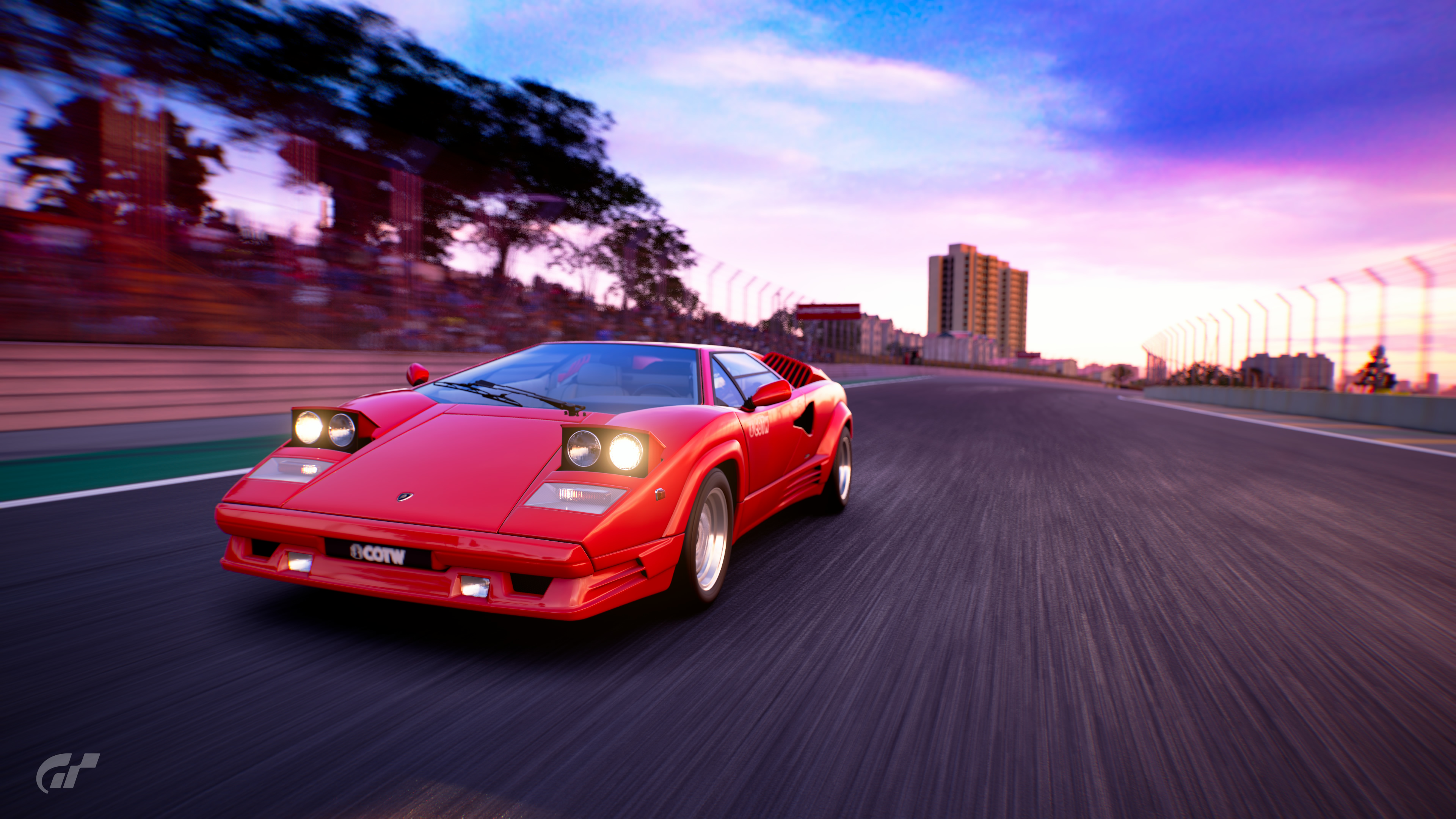
Car of the Week - Week 108: Lamborghini Countach 25th Anniversary

"Please try to be nicer this week", she finishes off her lecture by saying.


This week on Car of the Week, we've gained a surprising lot: A roof and seatbelts, for a start. Locking diffs, radial tyres, and as a bonus, the engine was even in a sensible location! Lamborghini! Sensible! I guess the train of thought was that, even though the Porsche 356 from last week had almost every ingredient to become an al dente coffin, it was missing the most important spice in the recipe:

Power.

"For the last time, nobody at COTW is trying to kill you. Some of us enjoy your presence here", Esther the Editor reaffirms. "If it's any assurance, this week's car was chosen — and provided by — a very rich fan of COTW. Higher management hasn't spent a cent this week endeavouring towards your demise — if you crash it."

"IF?!"

"Well...", she begins, a hint of cheeky smile flashing across her face. "Just don't crash, then", she regurgitates what higher management told me last week with a barely stifled laugh.

"Flip off...", I retort in resignation as I fumble around for the downward facing button that opens the scissor doors of the Countach. I'll admit, despite my usual barbaric language and the indignity of having to grope a door panel for a button, I felt like a rock star simply because of the cool way the cool car opens its cool doors, as though the automotive equivalent of a middle finger. "Screw you, I'm going into my Countach", is what this car proclaims for you every time you open its doors and get in it.

As I reach my fat old arm up for the upward swung door from a seated position, I spot Esther leaving. "Hey!", I shout. "Don't you want to know more about the car?"

"Hmm? No, I have no desire to be in the vicinity when you're operating this dangerous piece of machinery".

"So you admit this is a death trap!"

"I said no such thing."

I slam the door shut downwards in anger, and the resulting slamming sound made me immediately regret it. I hope I didn't break anyth- Esther's walking towards me. Why is she walking towards me. WHY IS SHE WALKING TOWARDS ME?! Did I break something?

I wind down the pathetic bottom half of the window, which only opened halfway. Oh god, I broke the window, didn't I?

"I trust you", she leans in and tells me through the mailbox of a gap, before turning and leaving just as quickly.

Winding the power window back up and shutting her leaving silhouette out, I explain in my head to an imaginary Esther in the passenger seat. The Lamborghini Countach should need no introduction; even if you're not a fan of cars and don't know its name, you most likely are familiar with its unmistakable silhouette. It was the poster car of many kids and adults in the 70s and 80s alike, and not only defined its generation of supercars, but also pop culture as well. You've seen it in video games. You've seen it in movies. Even a manga simply titled, "Countach". If asked to picture a vintage supercar, this shape is probably what first comes to mind for most. Not only that, it went a long way in solidifying Lamborghini's identity as the wilder, crazier, unhinged rival to Ferrari.

https://gta.fandom.com/wiki/Infernus#Grand_Theft_Auto:_Vice_City
https://youtu.be/evA3_NV7cPM
https://myanimelist.net/manga/19156/Countach


It's a death trap. That, along with its iconic styling, is widespread, common knowledge.

"Please try to be nicer this week", she says. Bah. The saying, "never meet your heroes" is coined almost specifically to describe this car. It may have been the bedroom poster child for boys everywhere at one point, but the very few who did manage to have lives lucky enough to subsequently find themselves in the driver's seat of one of these things will unequivocally tell you how garbage the seating position is, requiring you to actively twist your legs to reach the pedals. Annoyances like the how the fuel gauge is directly behind your right hand on the steering wheel, how hopelessly rubbish the windshield wiper flopping about in the wind is, only swinging up to half of what's in front of you as a driver, how negligible the rear view out the rear "window" is, and, of course, how utterly uncontrollable the damn thing is. The whole car reeks of negligence, apathy, and thoughts of "eh, good enough". "Does this part work? No? Is it falling off the car? Can we be sued for this? No? No? Eh, good enough."


As kids grew up, they never stopped looking at the Countach, only except instead of a lofty fantasy to aspire to, the Countach is now what you'd find in textbooks as the cliché example of "show over go", which would explain away many of the car's ill thought out designs, as well as the famously useless rear wing that the owner of this car had not opted for. It was a very different time with very different priorities. About the only thing that really mattered was how it looked, how it sounded, and how much power it had. And it has power. This thing I'm told has 455PS, passionately belted out through a 5.2L NA V12, which was enough for a claimed (emphasis on "claimed") top speed of over 200mph. In a car weighing 1,490kg (3,285lbs) with a drag coefficient of 0.42? Yeah. You work that out yourself.

Given all this power, of course the sensible thing to do was to test this "200mph" car in a suffocatingly tight and technical racetrack like Interlagos, such that when things go sideways, forensics might still be able to salvage some teeth to ID your extra rare body, so that the owner of the car can sue the appropriate family members for the total loss of their 500k USD car. And while every Countach came factory standard with the rare feature of instant on site cremation in the event of a crash, no amount of high octane fuel or batteries exposed to the rain can burn away the shame of being "that guy" that crashed a priceless collectible special anniversary edition of an iconic supercar, even if simply driving one required balls the size of testosterone fueled bulls.

https://youtu.be/WVp5a38WT_0?t=467


It took all of Senna S in the pit lane to dissuade all my fears of uncontrollable snap oversteer, as even at pedestrian speeds, I was having to fight the understeer from its enormous 345 section rear tyres and the tight differential. With only 225 section front tyres to rotate the car, this has got to be the single most disproportionately staggered tyre setup ever put into production. And with no power steering to help you, there really is no getting the rear end to come out without doing very, very naughty things to it, like misusing certain sticks or high speeds, where the car might just become aerodynamically unsettled enough to give you a hint of a slide.


The highly irregular pit lane of Interlagos dumps drivers onto a rather sizeable straight leading to the second of only two good overtaking spots: Turn 4. As with any good overtaking spot, there's hard braking involved from quite a speed leading into a tight corner, and this required the brakes of the Countach to come into play. At full tilt, you'll be braking for corners just before you even reach the first distance markers for these turns, placed 150m before the bend; rather jarring if you've long since been accustomed to driving GT3 and GT4 racing cars these distance markers seem to be tailored to. The brakes are "eh, good enough", and it's considered anorexic by 2020 standards in our ever fattening world. What I think is the cause of the horrific stopping distances of this car is that it has horrendous understeer on turn-in, requiring a lot more speed to be scrubbed off, and that there's only so much you can ask of economy sedan sized 225 section front tyres when it comes to slowing down, let alone juggling turning and stopping.


That said, because there's only 41% of the Countach's weight over the front tyres, the car stays shockingly flat through corners, displaying confidence and assuredness that, dare I say, made me think this is what a racing car would feel like if there was a class below GT4, ran on street tyres. Corner exits however, expose just how freakishly soft the damping is on this car. What this results in is... you guessed it: unrelenting understeer on power. The problem is at such a comical scale in the Countach that even lightly brushing your feet over the accelerator pedal sends this car jerking outwards, the magnitude of which is enough to make a modern hot hatch blush, making throttle management with your foot an exceptionally precise and precarious feat of labour. For the sort of driver that envies the thought of understeering and having to lift on Interlagos' home "straight" if a proper racing line isn't taken, there is no other car than the Countach for you.


The Lamborghini brand famously began as a tractor business, only starting their automotive venture as a rival to Ferrari after Ferruccio Lamborghini took issue with the clutch of the 250 GT, and that DNA is still very apparent even in the company's third full production car; the gear ratios are impeccable, yet the gear changes themselves make me feel more like a farmer than a racing driver. First gear is good for 96km/h (59.6mph), and second picks up right where it leaves off right in its peppy, ample powerband with gusto, something Porsche really should take notes from. However, 2nd to 3rd has a significantly larger leap in ratios, and the car is horrendously reluctant to change up from 2nd. To give you an idea of how long it takes for the revs to drop from 2nd to 3rd and how hard it is for the gated dog leg stick shift to slot down into third, this review has been specifically and meticulously formulated, trimmed, and controlled in length such that the time it takes to read it at the rate of an average Joe is closely matched to how long it takes to go from 2nd to 3rd in the Countach, and the dryness from my lack of writing talent probably makes your average Joe just as reluctant to get through it as the stick in the Countach is to slot into gears.


So far, everything I've described has been merely a regurgitation of common sense: the Countach is a terrible car to drive. At this age with the internet and many wannabe celebrities propagating the same crap over and over, there isn't any wonder, any surprises left in the world anymore, is there? We all already know how every car handles, don't we? We've already subconsciously placed cars in a rigid hierarchy in our heads, and start arguments when someone else's opinion doesn't line up with what we think we know, right?

Well, yes and no.

I had expected this thing to be an unruly, snappy, tail whipping bull before having driven it. Against my expectations and common sense, this is a bad car for the exact opposite reasons. But, as I drove the car more and more, the bigger surprise subtly began to emerge: I could not stop driving it. I drove it round and round the desolate track, trying to improve my times, trying to improve my lines, trying to get to know the nuances of the Countach better, and, yes, I even enjoyed having to fight it at every turn, at every gear change, at every off centre pull of the wheel, at every interaction I had with it.


The car may be unruly and uncooperative, and ergonomics may be an entirely alien concept to it. But while the car is difficult to get into physically, it was surprisingly inviting and easy to get into mentally. It sucks you into its own immersive world and makes you play by its own rules, what with its dog leg gearbox, long braking distances, lack of ABS, off centre pedals, horrendous power understeer, and having to short shift it. Stepping into the Countach then, felt like crossing over into a separate reality, a very different time. You don't drive a Countach like a car; you Countach a Countach like a Countach forces you to Countach it. It's not a car you can simply bring conventional expectations into and drive reactively based on said expectations, but rather, like any foreign country, the Countach is best enjoyed when you leave all expectations at the scissor door and go in only with an open mind to learn about its customs and try to go along with their ways of doing things, in effort to understand it more. It forces you to be fully awake, grabs your full dedication, and demands pre-emptive knowledge of how to drive it in the way it wants to be driven. It's a car that always challenges you to be sure of what you're doing and resolute in what you ask of it, as there truly is no taking back bad decisions in this car: it will not adjust its line mid corner if you cock something up in the bullfight against this car. And my god, it makes for a very, very compelling cartoon character, the likes of which you will never again see in today's climate, even from Volkswagen Lamborghini themselves.


If you manage to adapt to its rules and understand how to goad it into doing things you want it to do however, it becomes an incredibly engaging, communicative, stable, and dare I say, able car, one that never went back on its word or betrayed the trust it earned in me without me realising it, all while it belts out the most passionate and iconic of soundtracks right behind you, and endless call to attention to your every achievement and, indeed, your every mistake as well. If you extend the courtesy of making the time, dedication, and mental space for it, it becomes an engaging, communicative, rewarding, and adrenaline filled affair, not unlike an actual fight. It makes every interaction with it its own special event, as though you really were bullfighting in the presence of an audience, as though both you and it were stars performing on a stage. It never stops being a theatre of drama. Taming it, even getting it to trace just that beautiful line in any bend, is a hard fought victory worth celebrating. This car truly is an event, a theatre, in and of itself. And because of that, it's special. It's... fun.


I was so engaged, so absorbed, so mesmerised by the driving experience of the car, I began to choke the engine with hard g loads on low fuel levels, which was the only indication I had that I should probably stop in the pits for a refuel, seeing as the fuel gauge is flipping useless in this car. Finally coming to a stop in the pits, I wiped away the tears in my eyes from all the excitement, and the planet cried along with me as the car with the 120â„“ fuel tank drank its fill. I went out again, came back again, went out again, and had another drinking session with the car in the pits. When it came time for my fourth refill, Esther dragged me out of the car, slammed me to the asphalt, ripped off my helmet and stuck a bottle of water straight into my teeth, which was the only reason why I stopped driving. I mean, the tyres were shot to hell and back too, but pshh.

An autopsy of the tyres revealed that I had burnt through more than half the tread depth of the bespoke Pirelli P Zero tyres for the front, but only about a fifth of the rears, proving just how hard the fronts have to work to rotate the car, probably not helped by the fact that I had been making them scream in every braking zone with the absence of ABS. Hey, at least that means that the car remains stable even when the tyres go.


During the weekly meet, the aftermarket ABS system installed by the owner (singular) of these cars (plural) were all switched on, out of respect for our fellow friends and colleagues on the racetrack. Believe it or not, I actually think fitting ABS onto the Countach made it worse to drive; the front end goes completely numb, and the understeer makes trail braking a largely fruitless task. Even with ABS, I found myself pumping the brake pedal still, because that seemed to be the only way I could get the nose of the car to bite an apex. I had to almost let off the brakes entirely, let weight slosh over to the front outside tyre, turn to get the nose pointed somewhat towards the apex, and then brake semi-hard again once it does hook up, before repeating the process to meet the apex. You essentially have to trail brake twice back to back for every corner entry just to get the car to roughly nail an apex.


I never liked these aftermarket ABS systems, because I always find them too binary; you're either stopping, or turning, and it's difficult to modulate and transition between the two. It robs all feeling, feedback, and control from the car, and it only makes me marginally faster in the Countach. I find that I can actually trace a neater, smoother line without ABS, and honestly, I think the Countach meant to be driven with that fear and responsibility of, "it's all in your hands. Brake late if you dare" mentality. Putting ABS on a Countach only makes me complacent and lazy, and I paradoxically overshoot corners more with ABS than without, simply because the car isn't grabbing my attention and threatening me the same way as before. Just as ABS being mandated on all production cars hasn't reduced the number of traffic accidents, ABS doesn't make you any better a driver in a Countach, nor does it make the Countach any better to drive. For a car like a Countach that asks of you everything you have to give you the most immersive of experiences and theatre, for such a special car with so much to say, fitting ABS onto it is akin to censoring it, and I'm willing to go as far as to say that it positively ruins this car. It's meant to be driven. Drive it. Yourself.


The reason why I love cars and reviewing them is because cars are the perfect mix of the logical and the intangible. The cold, hard, engineering facts moving people in an organic way. There's no denying the Countach is, logically speaking, an awful car, even if you physically fit in it while being paradoxically strong enough to drive one. Even like minded petrolhead friends of mine don't seem to like it that much when we got together for our weekly races. But... I don't know, I just feel a special connection with this car. I can't explain it. Against common sense and widespread knowledge, I really like it. It really clicks with me. This car really surprised me with how much I enjoyed it, and sparked some wonder back into my jaded mind.

Older cars (not too old) are all very special to me, because cars nowadays aren't allowed to suck anymore. They all have to be luxurious, safe, (somewhat) economical, and fast. No one today would pay supercar money to suffer like they would in a Countach. As a result, they all feel so... samey. They've no character. They barely have an identity. This right here, is something special, and it's an experience everyone who loves driving ought to sample at least once in their lives.


Maybe I just have a thing for cartoon character cars that have huge NA Lamborghini engines producing about 450PS that need to be short shifted, have stick shifters, gigantic rear tyres, weighs about 1.5 tons, have no driver aids, spiteful ergonomics, and a reputable appetite for murder. I know I definitely have a thing for pop up headlights. I love the Countach, whatever the reasons may be, most of which I can't explain well.

See, if editors and higher ups weren't constantly pressuring me to "be nicer" in my reviews, this conclusion might seem less fabricated and suspicious.


https://www.lambocars.com/countach/countach_25th_anniversary_specifications.html

Saturday, 24 October 2020

Car of the Week - Week 107: Porsche 356 A/1500 GS GT Carrera Speedster '56

To err is to human.

I don't expect any sympathy from anyone when I say this, but reviewing cars is hard. The old adage of "never meet your heroes" is well known and often propagated, yet, when the time comes to step on some toes in the name of journalism, many are put off by the fact that the dream cars they spend their entire lives idolising, lusting after, chasing, believing, sacrificing for, and that shape their lives is a load of crap. There seems to be no way of expressing discontent and disappointment - even rationally with supporting evidence - on the internet: someone's going to be upset by having their idols go through a mud facial under a boot in a review. I'm not above admitting that I may have made mistakes in my review; my day job was being a racing driver, and writing is only a hobby. And so it's not entirely inconceivable that I've expressed my disappointment in a few cars in the wrong way, and some higher up in COTW saw it fit to punish me for it.

Why else would I be subject to a fate so utterly despicable, inhumane, senseless, and cruel as being forced to race a Porsche 356 and be publicly humiliated like this this week?


I also don't expect any sympathy from the internet when the higher ups of my very fun and well paying job with a mostly flexible schedule tell me to flexibly bend over a table for some well paid fun. The sensible thing a sane person in a sane world would do would be to report it to HR and perhaps sue their employer, but this is a very, very different world, hence why the sensible thing to do for me is to bend over said table and ask what I should scream and how I should scream it. You may not guess it from how much I complain, but I really love my job. At the time, I wondered who it was that I had offended in my previous review; was it the childlike Ferrari? Supra fanboys? Stuck up BMW drivers? Mustang boomers? People who never drive cars at their limits and therefore can actually like the NC1 "NSX"?

https://www.gtplanet.net/forum/threads/car-of-the-week-week-107-porsche-356-carrera-speedster.381420/page-66#post-13260879

"Yes, I do love racing dangerously! Oh daddy, give it to me raw, please! I don't need racing harnesses, seatbelts, roll cages, fire extinguishers, or even common sense-" *slapped* "Oh, airbags and locking differentials are just added mass! I love the older type of tyres, brakes, and such fine, precise footwork trained by driving without ABS! Such strong, heavy, muscular rear ends, swinging back and forth like a wrecking ball! Why yes, I do love it so when I can't see where I'm going and what I'm doing when I have a chrome, glaring metal rod at eye level! Being unable to see makes all my other senses perk up and the whole experience that much more enjoyable! Really!"

The answer, as it would appear, was me critiquing the (lack of) safety measures in the previous week.


To cover the scars on my body, I will at least have my fire retardant racing suit, and to cover my irreversibly scarred ego, my racing helmet with a mirror finish visor. Oh, and because safety is first and foremost, a personal responsibility, I'm also... fitted, with the very technologically advanced safety feature of a very strong suggestion to "just don't crash, then". Beyond that, I have a useless looking... hoop, over the rear seats that serve gosh knows what purpose, and a bucket seat to hold me in place; not even the crotch belts you get at dodgy traveling carnival rides to prevent you from going eyes first into the windshield frame in the event of a crash. And GT3 RS owners have the gall to whine about having straps for door handles.

I sigh as I lean forward - unrestricted by any seatbelts - to turn the key stuck right into the flat dash of the Porsche 356, invoking a sound somehow both mechanical and organic, as though you can hear the car physically draw breath when idling. Fuel Injection has long since wholly replaced carburetors in the automotive industry - evident by how I can't even spell the word without spellcheck - but driving so many old cars in COTW has really made me appreciate the sound of a carbureted engine breathing mechanically. The Flat 4 engine purrs irregularly far, far behind me, the vibration of which jittering the key tag to match the state of my nerves. As I completed the tyre warming parade lap, I took my second to last place on the grid, lining up against five other 356 Speedsters on the oddly dry British morning, essentially forming a 6 million USD pendulum set in some obscenely rich and masochistic kid's needlessly complicated physics experiment.

"Just don't crash, then", I guess.

To err-

*lights gone green*

is not an option.


The Porsche 356 is a rear engined car without locking diffs, modern springs, radial tyres, disc brakes, ABS, TCS, AWD, rear wheel steering, or advanced aerodynamics to help mask its inherent flaws like a modern 911. It therefore handles precisely like anyone would expect: it's an inconsolable tail wagging monster, and driving it at speed is incredibly frustrating. I mean, I don't know what else I'm supposed to tell you.


That really could've been the end of the review, but apparently it's not enough nowadays to just point out what should be common sense; I have to explain in detail why common sense holds true, like the kid in physics class that has to prove a theory in the textbook, and I'm surprised I wasn't in a school uniform prior to or during the race. I suppose then, my job this week is to provide you, dear reader, with the novelty and comical juxtaposition of driving this 64 year old car at its bleeding edge limits, and maybe survive enough to bring you some footage as evidence to supplement my argument of common sense, which, if not for word count padding to fill the page like any school assignment, can be summed up simply by, "it sucks".

Kore de ii, sensei?

We really are all slaves our entire lives, regardless of jobs, aren't we?

You have to be sure to apply some throttle to shift weight over to the rear before you turn too hard for any corner, as otherwise the rear end will swing out. This makes setting up for a corner vastly different from conventional wisdom, as instead of full brake, partial brake and partial turn, engine brake and full turn, gas right before apex, and turn gently out, it's instead: full brake, engine brake and slight turn, slight hint of gas while waiting for weight to return to the rear and turning not too hard, and then hell for leather gas and hope you don't understeer too wide on corner exit.


While the comparatively heavy rear end of a RR car being a moody mess is common knowledge by now, what often gets drowned out by that is how soft the front springs on rear engined cars have to be to allow for weight transfer over the featherweight front end, already being pulled up by the see-saw effect even at a standstill. What this softness translates to in hard driving is that there is an incredible amount of squat under braking, which causes the rear end to become unhinged, and the understeer on power is quite hideous even with just 108PS. It's not at all an uncommon occurrence for a driver to viciously and violently snap between chronic understeer and apocalyptic oversteer several times in one bend, never being able to find that knife edge balance of neutrality in this toggle switch of a car. If you're at home and wondering how driving this car feels like, it'd be like trying to hold a light switch perfectly in the middle between on and off; it's flipping impossible because the switch just wants to snap to either side, just like this car just wants to snap between under and oversteer. Of course, this usually results in a passionate meeting with another competitor, or just a wall if you're feeling particularly responsible and self isolating. Safety is, after all, first and foremost, a personal responsibility.

N-NANI?!

DOITSU DORIFUTO?!

There might be an argument to be made for a tail happy car being fun to drive, but I can assure you that this car is not at all fun to slide. Applying the throttle to shift weight over the rear after they break loose does a grand total of jack all, as the open diff means all the power will be sent to the inside wheel, which will be lifted so much it struggles to even generate smoke, much less do any slide adjusting, drift holding work. Given that it's impossible to drift or correct the car when it goes sideways, you have to make every effort into ensuring the car never breaks loose to begin with; a tall task given that even turning the wheel hard on full throttle makes the impatient rear end want to overtake the front. The only option you're therefore left with as a driver is to "just don't turn too hard", and I guarantee you every racing driver will be as happy to hear that as, "just don't crash, then".


Well, why don't you just stop a Tsunami by standing right in front of it and politely asking it to stop, then? Because that's exactly what trying to correct a slide in this thing feels like. It's going to happen, and there isn't a damn thing you can do about it. The best you can do is to just brace for and make room for it to minimise casualties when it happens. Or, you know, you could drive really slowly - that works too in the sane world.


The car, especially for something conceived in the late 1940s, has a surprisingly aerodynamically slippery looking teardrop shape to it, with an implicit, striking beauty from its simplicity not found in cars today, with minimal protrusions and creases, exuding such a sense of slipperiness that it could almost make one feel velvet at their fingertips just by looking at it, even with the factory's flat paint, and especially when bathed in metallic paint like Rob's car. This teardrop shape however does unfortunately mean that the edges of the car, where the tyres are, are narrower than the width of the body at its centre, where you sit as a driver, and this width disparity is immediately obvious when you see the tyres from an angle that looks towards the centre of the car, so much so they look inset.


I really do wish the rear wheels can be set wider apart for more track and stability. As it is, precisely placing this car a unique challenge as well: on wide open racing tracks such as Goodwood, you'll want to make the most of the road width by running your tyres right up to the edge of the asphalt, which overhangs your car body over the grass. On walled in corners such as the very creatively named "The Chicane" on Goodwood, or even urban tracks, the definition of "making the most of the track" changes, as now the limiting factor isn't your tyre placement, but instead making sure you don't hit the wall with the protruding body of the car.


While the 356 looks vastly different from anything else Porsche has ever produced, there are some instantly recogniseable bits of DNA that has very prominently survived to the modern day, such as the twin bug eyes popping out of its surprisingly sleek and smooth body, and a flat engine that is, for reasons beyond my limited imagination, overhung out the rear. The gearing on the 356 also feels familiar to me as a proud, loving owner of a 981 Cayman GT4, in that 1st gear is in Stuttgart and 2nd is in Singapore. The gauges of the 356 too, show promising DNA that Porsche has knowingly built upon, being large, clear, and easy to read at a glance... provided that the sun isn't at an angle that strikes the chrome highlights of the dials, windshield, or steering wheel such that it casts a glare, which is an eventuality as unavoidable and dangerous as the rear end of this car stepping out, given that that the Speedster has no roof, and no tinted rear windows to filter out sunlight or high beams from other drivers from blinding you in your mirror.


A rather amusing overkill touch on the tachometer is that the rev range is separated into colour coded zones to tell you where the engine makes optimal power, exactly like you would find in modern diesel buses, except it really doesn't take being Lewis Hamilton or Ernst Fuhrmann to figure out that if you want good things to happen with this engine, rev the nuts off this NA 1.5L Flat 4 engine. While the tachometer suggests anything from 4,000rpm and above is useable, ideally I'd say you want to be above 5,000 for it to really feel like it's doing anything, and it really comes alive only at 6,000. Official specs claim that max power of 108PS happens at 6,500rpm, and peak torque of 123N⋅m happens at 5,000rpm. I know I just said this engine is lifeless at anything below that, but with how horrendously long the throws are, each gear change takes about an eternity and a half, and it might be faster to just lug the 840kg (1,852lbs) car around a track than to row it across with frequent gear changes, despite its canoe shape suggesting otherwise.


While I try to be of firm opinion in my reviews as much as is possible, I really do hesitate to critique historic cars. And with the Porsche 356 being the marque's first mass produced car, it's all the more precarious a task to critique it. I get that the first time is always special, but just as is getting bent over a table, there's no practical use for a RR layout: the rear seats of this thing are useless and the frunk is largely taken up by a spare tyre, anyway. Critiquing this car and holding it to modern standards and expectations is akin to asking your grandpa to work a 9-5 job and call into question his outdated views: it's entirely pointless. He's earned his respect and right to be who he is, and he knows it. The best you can get out of him is to sit down and calmly listen to his stories, how things were back then, and perhaps learning a few things from him, never talking back or challenging him because you're dedicating time to give him to talk, with quiet knowledge that his views and methods have worked for his time but may not today, and just nod along with him.

Before you ask, this grandpa car still kicked my butt when I challenged it in a rental Demio.

And that I feel is largely the same with classic cars as well: you have to dedicate a lot of time and resources to their upkeep, and once you look past their very glaring faults like the engine and its stupid placement, and stop heckling it to go fast, that's when I feel that the strengths of this car really comes to light. Despite me complaining about the massive squat under braking, the suspension of this car is surprisingly taut, darty, and responsive. It also handles bumps and road imperfections really well. It has a really good 160mm (6.3in) ground clearance to make travel room for its aforementioned soft front end, meaning you never have to worry about scraping like you would a modern supercar. The car may evidently be old, but it doesn't feel nearly its age when I was behind the wheel. Had the engine been put in a more sensible place, this would be right up there with the Mark I Golf GTI with how enjoyable it is to drive. On a wide open road in a T Shirt, shorts, with a small enough driver and just the right weather on just the right day, I think this would be one hell of a stylish, enjoyable cruiser, with its ever delightful engine never being rude or obnoxious, while still oozing character. Despite the word "Carrera" in its name, I never once felt comfortable with this car when driving it near its limits, and I would never want to race this again.


Rear engine cars is a stupid idea that never had any practical application, be it on the road or for the racetrack, and I genuinely believe the 911 is a dinosaur of a car kept alive by the... *er-hem* enthusiasm of its fans, and bleeding edge technology that would've done more in a mid engined car. I can excuse the 356's rear engine layout because, come on, it's 1948. People didn't know better. But the important part about mistakes is that you learn from them, and make your future actions better than your past mistakes. Every Porsche that changed the game since have been mid engined; the 959 in 1986, the Boxster in 1996, Carrera GT and 2004, the 918 in 2013, and even the 911 RSR was finally forced to sensibly relocate the engine before the rear axle in 2016. And if Porsche can keep making mistakes to this day at the behest of their fans with the 911, then I should be able to keep ruffling feathers with my reviews as well as long as I'm still enjoying my job. If you don't like them, there are always other reviews, just as I've a Cayman GT4 in my garage instead of a 911.


I'm not apologising for a word I wrote, and I'd take more than bending me over a table to change my mind, because unlike when I was bent over the table, I actually felt something in the car that failed to get me killed.