Monday, 27 February 2023

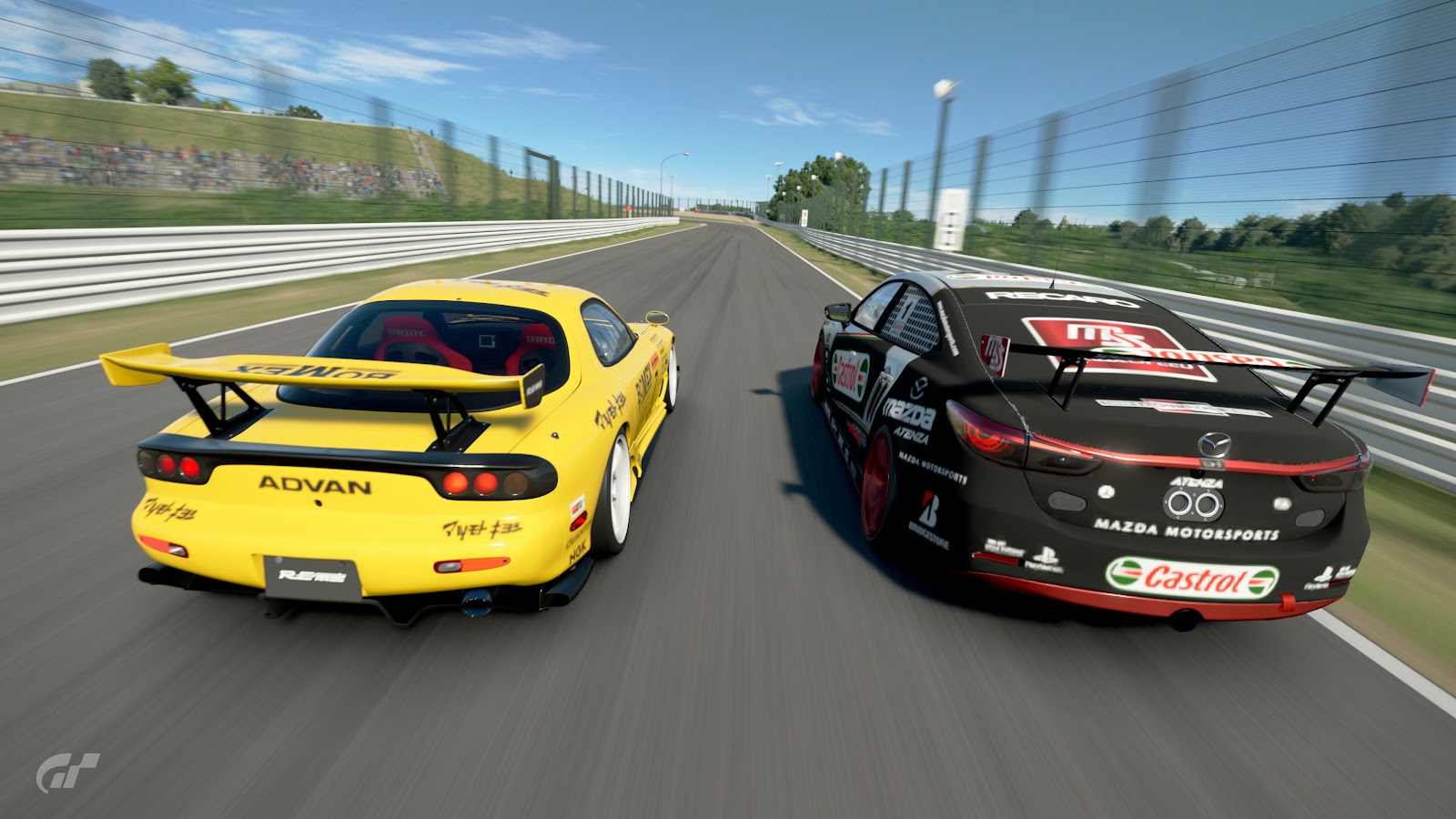
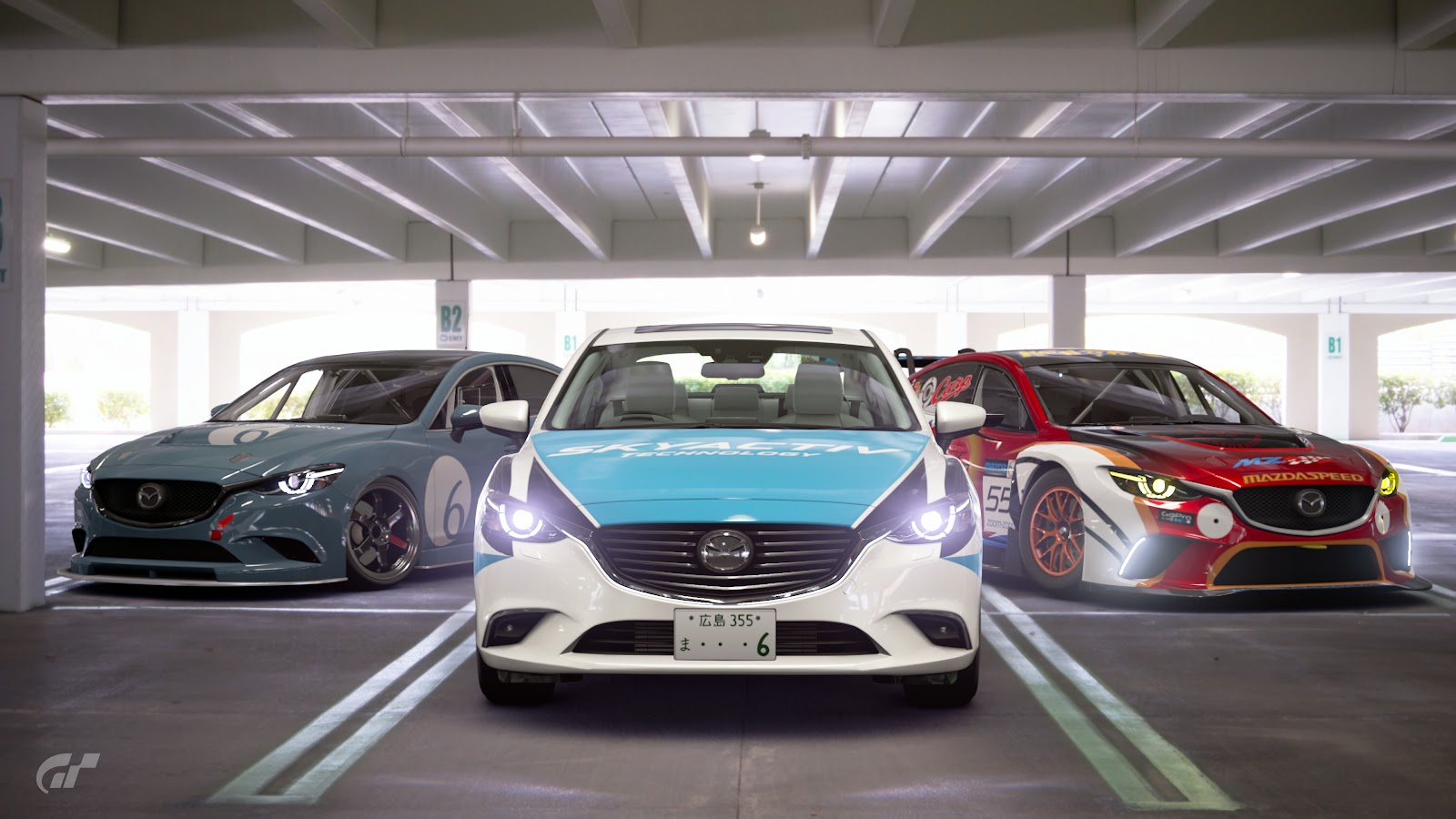
W223 Mazda Atenza Gr.4

So, I'm coming back from a month–and–a–half hiatus after my Logitech G29 wheel broke, and while now armed with a slightly more upmarket Thrustmaster T300RS, I'm still coming to learning the ins and outs of the new hardware, and so when presented with the liberty of picking this week's car, I knew that I had best pick something I was already familiar with. Something that's easy to get to grips with and forgiving if mishandled. And if it also happens to be readily available in the Brand Centrals of both GTS and GT7, that'd just be the cherry on top of a cherry cake. Does such a car exist?


Ladies, gentlemen, and everyone else in between, the Mazda Atenza Gr.4: the car that's been with me throughout the entirety of my two–year tryhard journey into the game's eponymous Sport Mode, during which I had only signed exclusively with Mazda. Needless to say, I'm very, very familiar with how this thing drives.

You wanna know what else I'm familiar with? Losing. A lot. With this car.


Now, don't get me wrong; with the current Balance of Performance setting it at 103% power and 99% mass, the Atenza looks menacingly quick on paper, being just the third most powerful Gr.4 car behind only the GT-R and Veyron. It is also slightly lighter than average, being 11th lightest in a field of 28—not too shabby at all for a car that drives all four of its wheels, and utterly insane for a third most powerful car in its class. However, the Atenza only enjoyed these stats near the end of the game's support, when Mazda suddenly became an official partner of Gran Turismo and introduced the RX-Vision GT3 to the game. Prior to that, the Atenza Gr.4 had always languished at 104% power and 100% mass—that's right, this abysmal Atenza you see before you today? That's with the power of politics buffing its longevity and cornering speed. Can you imagine how dumb and blindly loyal a person would have to be to Stan for Mazda before this political buff?


With numbers like that backing it, it ought to be a wonder and a half how the Atenza Gr.4 isn't a top contender in its category. As is customary with cars that have strong straight line shove, the Atenza isn't that apt when the roads twist and meander. While possessing a slightly improved 60:40 weight distribution over the road car's 63:37, it's still massively front heavy by racecar standards, especially when it feels like it's centre of gravity hasn't been lowered any, as though the Gr.4 car still has a big, tall, heavy diesel block underneath its aggressively perforated bonnet. What this results in is a car that, while beginner friendly and difficult to upset, is in the same vein markedly more unwilling to slice into corners and bite apexes, even in comparison to other front engined cars in its category like the RCZ, much less mid engined supercars with their low, svelte bodies. Drivers will have to exert notably more effort into fighting the wheel to push the heavy nose of the car into the apex, and the Atenza very much feels like an FF car to drive, wherein the front end does all the work and the rear end simply follows with no opinions or objections.


"Big deal, that sounds like a typical trade off for having a speedy car in the straights, what makes an Atenza as awful as you make it sound?", you might be thinking at this point. What makes the Atenza TRULY awful is that it pays more than the due price for its straight line speed, but it still gets overshadowed by the GT-R when a power focused track arises. And so what we end up with is a car whose entire point is eclipsed by many other cars in its category that can beat it at what it does best and do more, such as the GT-R and the FF menaces. In fact, if there's one thing the Atenza might do better than any other car in Gr.4, it'd be eating tyres... in a category with FF cars.


Don't ask me to explain it, because I have no idea WHY THE HELL the tyres on the Atenza go off as quickly as they do. All I can tell you is what it feels like behind the wheel: as if the mechanics didn't have time to properly align the suspension and decided instead to just coat the tyres with a layer of liquid glue to give the requisite grip. Once you hit the track, the first few corners feel incredible, almost in disbelief that a sedan chassis can handle this neutrally and immediately, but near the end of the lap, when the tyres have shed all the glue, the massively cambered tyres not only offer zero grip, but also start to aggressively autocannibalise, forcing drivers to alter their driving even before the end of a 2 minute lap—and don't go assuming I'm talking about races with insane wear rates like 10x or something; I'm talking about just plain ol' 1x. I think I've taken wanks longer than the tyre life of the Atenza Gr.4.


At this point, I don't even know if there's really any point to rag on the Atenza Gr.4 any further. Yes, there's more. In the interest of completion, I shall also complain about the the entire drivetrain of the Atenza Gr.4. I'm not sure what kind of engine PD put into the Atenza for Gr.4 competition, but whatever ended up taking the place of the road car's diesel engine is more rotary than a rotary is a rotary—the nondescript 2.2L Inline 4 is so awfully peaky that, even when shifted at redline, clicking in the right paddle feels less like upshifting a car and more like disassembling a running engine. Compound this with the fact that the in–game tachometer flashes for an upshift way too early at roughly 6,900rpm when fuel cut is at 7,500 means that the game will shift the car way too early if left in AT, which means that players who opt not to shift for themselves will suffer a massive disadvantage—enough to lose several positions off a standing grid start. You can immediately forget about any race that requires you to save fuel as well, since short shifting completely asphyxiates the peaky car. So obscene is the power drop with each upshift that I've even come to memorise at which exact speed in km/h to make upshifts in the Atenza Gr.4: DON'T, 122, 156, 196, and 235. Because it has gears wide apart from each other and a peaky engine, the Atenza will hazardously bog at low speed scenarios, such as launching from a standstill and coming out of the asinine chicanes of Monza, and that is such a crying shame since the AWD ought to have been such a weapon in propelling a car out of these low speed sections past its 2WD competition, especially when absent any aerodynamic grip. If the Atenza is going to be so terrible at these low speed sections where AWD would make the most sense, why is it saddled with the mass of having AWD? Give it the OP straight line speed of the FFs or the tyre life of an FR and take away it's AWD then!


Overall, the Atenza Gr.4 is a perfect catastrophe of mismatched parts that almost looks intentionally awful: comically bad tyre wear, only slightly strong acceleration, rather weak turn in, horrifically peaky engine, and overall just good for nothing. It's almost hard to believe that a group of professionals have come together to create this bespoke, built to spec racecar in a liberating virtual setting without any logistics or costs to hinder them. In fact, I'm even going one step further in my slagging of the Atenza Gr.4: I think an independent tuner in real life could build a faster, more cohesive Mazda out of a small shop in Chiba. I think that the RE Amemiya Boost Up 7, primarily built to attack winding mountain passes, is just a set of Racing Hard tyres away from sticking it to the purpose built racecar on the latter's home turf: a smooth, wide open racetrack.


Re Amemiya FD3S JGTC by Not1Name livery link (GTS)

The tale of the tape goes as follows: even without the boosts afforded to the Atenza by Bias of Performance, the Amemiya FD is still slightly down on power, measuring in at 367HP (274kW) versus the Atenza's showroom condition 393HP (293kW). However, the Amemiya is a whopping 150 kilos (308lbs) lighter than the Atenza at 1,240kg (2,734lbs). The big story in this fight however, isn't in power and mass, but rather, in the gearboxes—the Amemiya FD is saddled with a 5 speed stick with an overdrive 5th gear, and it's going up against the Atenza's straight cut sequential 6 speed racing unit. Oh, and the Amemiya FD has been noted by many of us here at COTW—myself included—to be a twitchy demon of a thing to wrangle around a racetrack. And so what we end up with here is a showdown of two extremely different cars each based on a production Mazda; of power and stability versus free spirited agility. Factory versus private. But which one comes out on top?


The Boost Up 7 feels to me like it has been set up to take these Racing Hard tyres by default, because its characteristic nervousness at its limits has been almost completely stifled by the full racing slicks, and any twitchiness that remains can be very quickly caught and easily corrected with just a quick flash of counter steer. What hasn't changed at all is how much of a joy Ama–san's creation is to drive; the aftermarket street brakes hold their own against the slotted racing discs of the Atenza thanks in no small part to the latter's unwieldy heft, and when I turn the steering wheel in the 7, it feels as if the car as a whole rotates around my bum, in sharp contrast to the sensation the Atenza gives of having to fight the front end, which in turn has to fight the rest of the car simply to turn. And while similarly optimally shifted at around 7,500rpm, that is a mere piddling mid range in the Wankel Rotary's rev range, with the Boost Up 7 redlining at a hair–raising 8,500rpm. Its punchy mid range torque and ample headroom in the rev range not only lets the RWD road car out–launch the AWD racecar, but it also let me hang onto a lower gear if fast approaching a braking zone instead of forcing me to shift and waste crucial time, a luxury that is beyond even fantasising about in the Atenza.


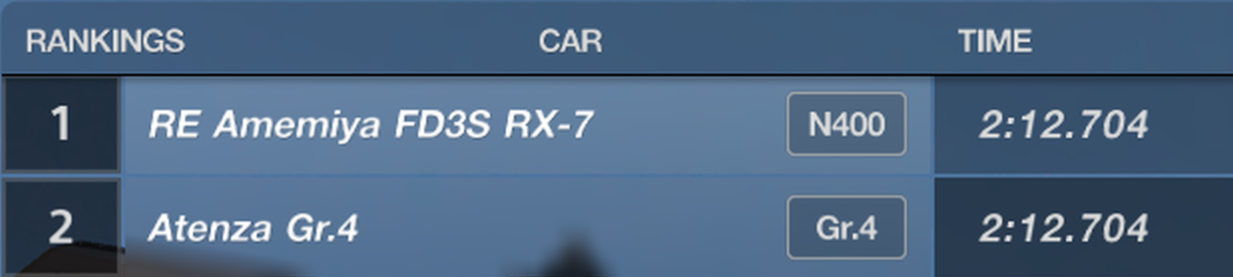
In the end, I had a hard fought battle with all of the Atenzas, lag spiking one into the shadow realm (sorry Rob...) and beating all but one when the chequered flag dropped at the end of the four lap sprint. Losing to Vic isn't very telling; it's like saying the sun rose this morning. And so I thought to run the two cars at 100% power and mass on racing hards at Suzuka again, and uh...


I got the exact same time for both cars, down to the thousandth of a second.

So what's the point of all this? Why compare two cars that are built to do very different things? That'd be like saying that an F1 car is quicker than a Group B car; they're built with different budgets, goals, and rulesets in mind. What I aimed to demonstrate with my very elaborate stunt is that Mazda desperately needs a much better representative in Gr.4 if it's to have any legitimate chance of making it onto the big stage with the likes of Porsche and Toyota—and that it has easy access to much better alternatives that would be much more suited to serve as a base for a racecar. Imagine if RE Amemiya built a GT4 RX-7. How awesome would that be? Granted, the FD RX-7 is an ancient dinosaur in the automotive industry, but that hasn't stopped the 458 or Evo X from representing their brands in this game, has it? Surely the RX-8 would qualify as a homologation model? Hell, if Mazda is fine with fictional cars taking the stage, why not the Vision Coupe, a newer concept that bowed two years after the RX-Vision? Hell, if we can have an RX-Vision GT3, why not also an RX-Vision GT4?


The Atenza Gr.4 is just inexcusably bad, and there's very little reason I can see as to why it hasn't been fixed yet or replaced completely. Maybe Polyphony Digital has just given up on Gr.4 as a whole, I dunno. When was the last time we had a Gr.4 race at a World Tour event, anyway?

Monday, 20 February 2023

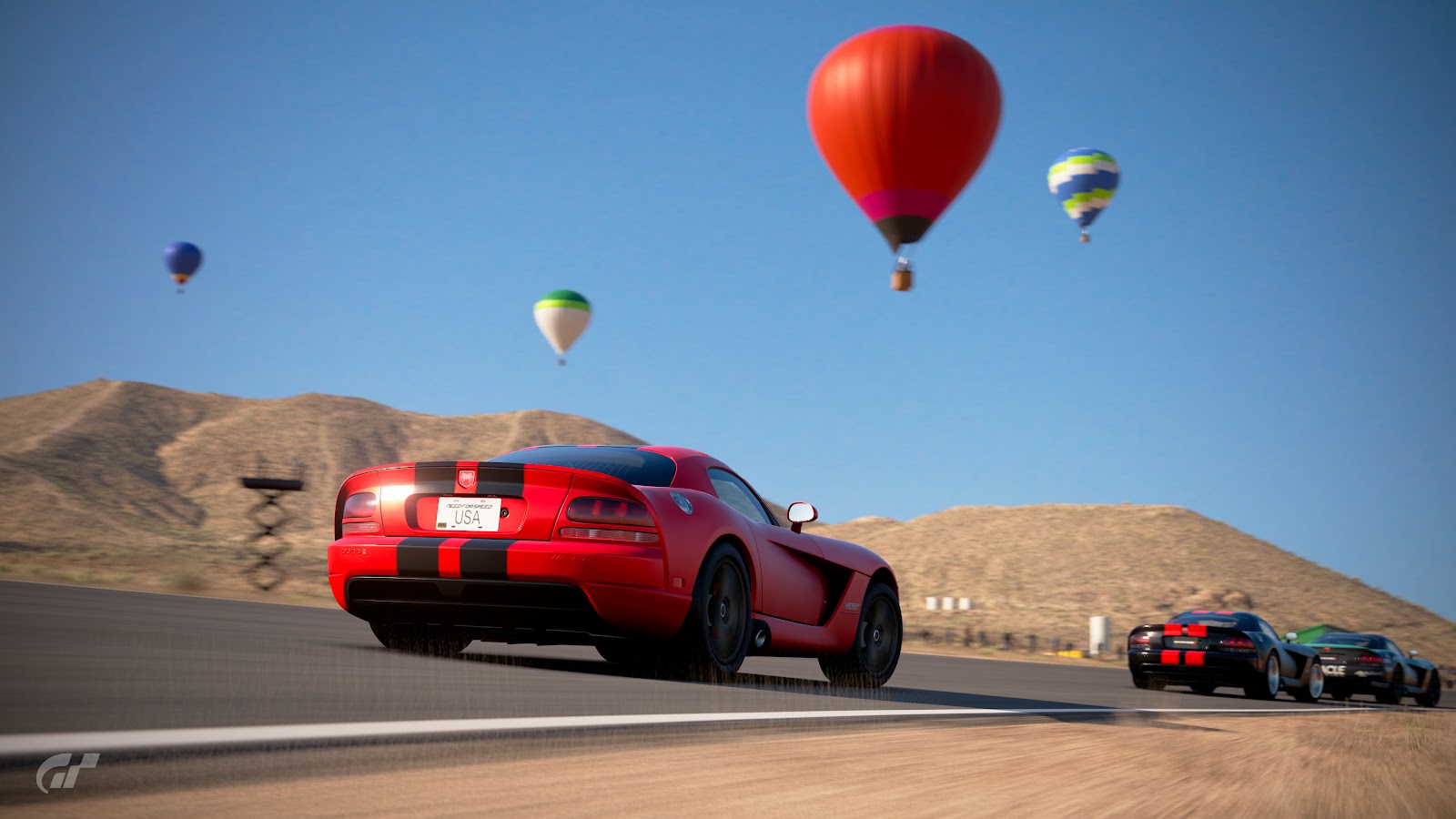
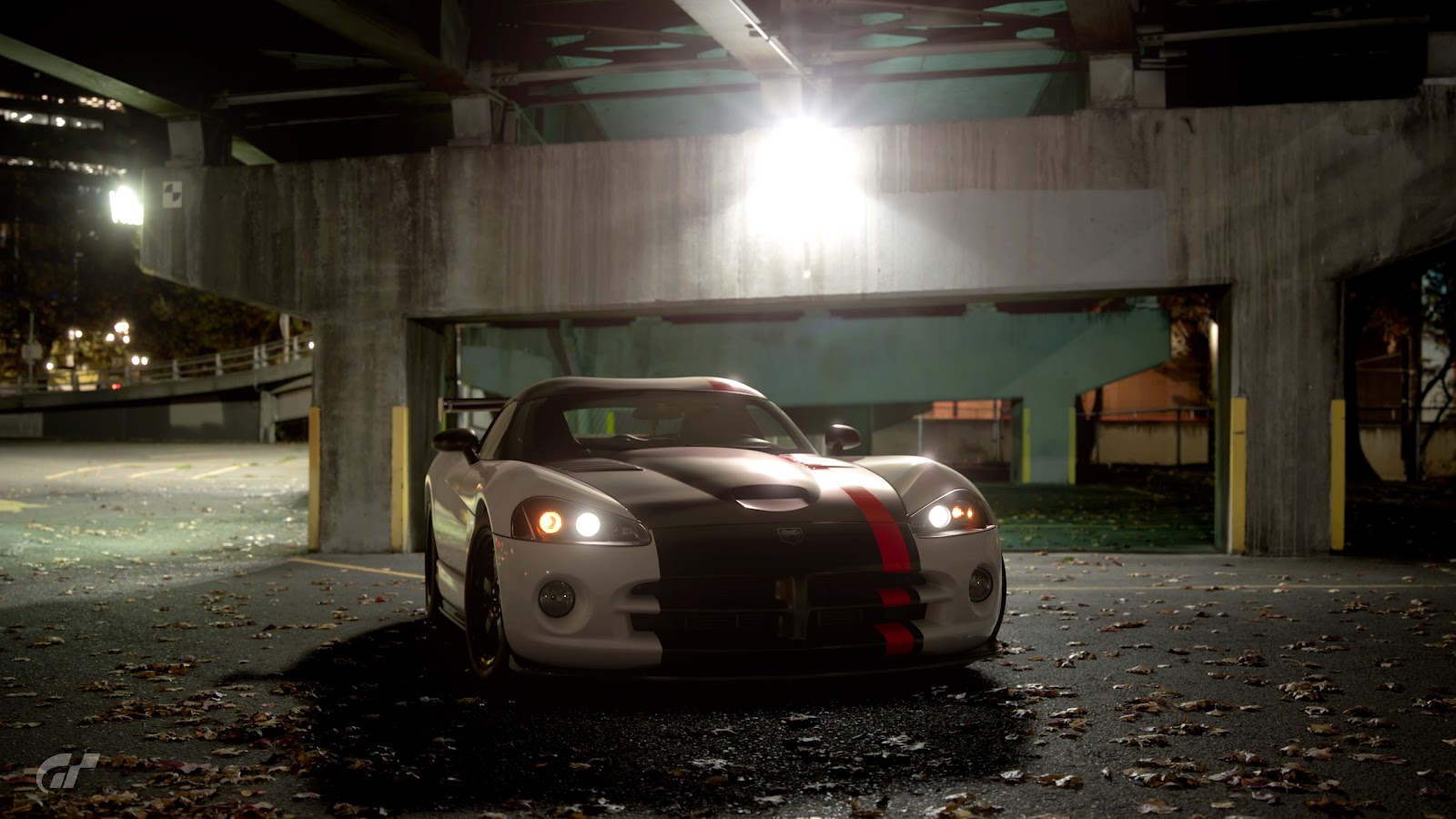
W193 Viper SRT-10 Coupe '06

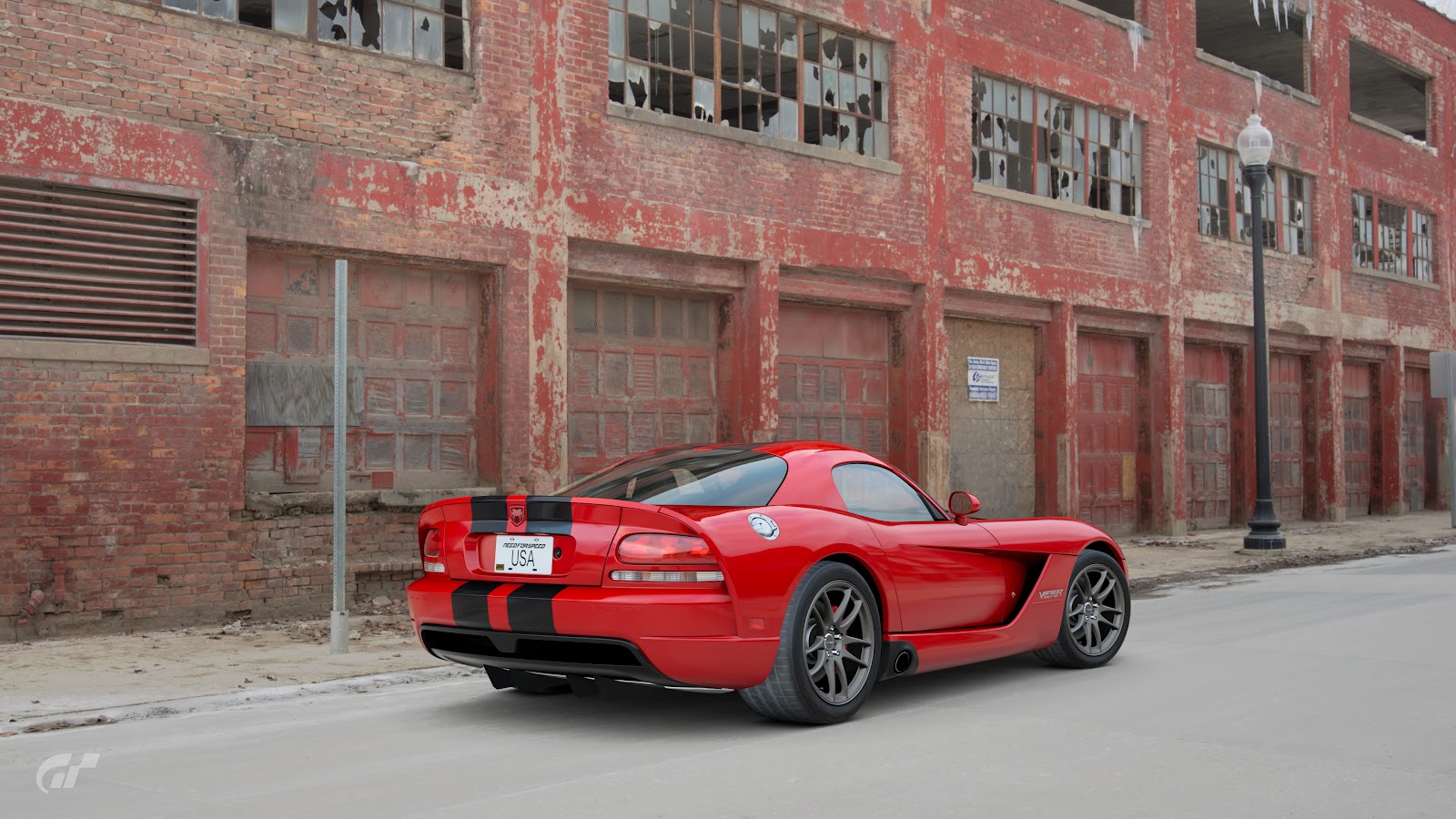
Now, I've been known to be a bit cynical and critical of a guy, but put a Viper, any Viper, in front of me, and I'll simply reduce to a puddle of giggles and good vibes, because "ooh sick styling macho aggression super fun colour combos!" In case it needed explicitly spelling out, I'm a bit of a sucker for Vipers, even the least noteworthy trim of the least noteworthy generation of them, such as the 2006 Viper SRT-10 Coupe.


Old habits die hard, and perhaps that's why I like Vipers as much as I do. Just to get my usual cynicism out of the way real quick, Vipers are terrible cars by almost any metric. Attempting to daily a Viper is as against common sense as trying to shave your balls with a chainsaw; I mean, you can try if you want, and certainly no one's going to try to stop you if you do (because you're clearly too far gone for mere words to bring you back), but there are way, way more sane, apt, and ergonomic tools for the job. As far as performance goes? Well, it's got power and torque, and uh... that's... about it.


This is especially true because for some bewildering reason, players of this track focused racing game weren't given ANY of the track focused ACR models of the Viper, almost as if we're expected to take this air con and carpet equipped digital Viper to do our grocery shopping and pick up our kids from school. As such, we have "only" 508HP (334kW) to shove around 1,565kg (3,450lbs) of snake, with none of the aggressive aero, flashy carbon fibre, and adjustable springs of the ACR to help. Be that as it may, though, it's still a Viper. It still does Viper-y things.

And Vipery things are terri–effing–fying.


Yes, objectively speaking, the third gen Viper SRT-10 Coupe is more powerful and lighter than its predecessor, the already scary 2002 GTS Coupe, by 60HP and... 9lbs, but don't let that fool you into thinking it's any easier or better to drive in any respect. It's still quite a porker by 2006 standards, and bringing the snake to a slow still requires quite a lengthy straight. This is especially so because it still lacks ABS, meaning that a lot of how well it stops is down to driver skill and how quickly they can suss out the physical sensations of the car and the road, how well they can modulate the brake pedal, allocate the friction circle, and the gentleness with which they ease it into an off–neutral braking zone. As you can probably already surmise, that's a lot of variables that ABS usually zaps away like magic, and with such an amount of variables to handle unassisted by computers while also missing the physical sensations of the real world, it's difficult to find any consistency in the braking performance of the Viper in the game, even when braking for the same corner on a different lap in the same run. I mean, you could just leave ABS enabled as is the default setting in the game, but that'd be like asking your wife to go to a sperm bank for a kid to call your own; I have the thing, I worked hard to get it, it's mine, of course I want to do it by myself, the way it's meant to be done, damnit! Why would I have gone through all the trouble of getting the thing if I'm not going to enjoy it myself? If this is how my queen wants me to see and treat her, then by god I will!


Once you've come to a slow in the Viper, you'll have to actually turn the steering wheel for the corner. The horror! While the 2006 Viper is (barely) lighter than the 2002, it feels heavier than its predecessor when its steering wheel is pulled off centre. This can be explained by the fact that the 2006 has 1% more of its weight over the front tyres at 49%, in comparison to the 2002's 48%. It may seem trivial in writing, but that 1% difference means that the 2006 Viper has more mass over its front tyres, despite being the lighter car of the two. Weight distribution is one of those things where I feel that even a whole percent isn't a fine enough unit of measurement, and I wish car reviewers in real life and games alike would start including decimal places when presenting that stat. Small rant aside, the 2006's front end is perceptibly more inert and less willing to slice into an apex in direct comparison to the 2002 car, and it's not like the '02 was an Elise under its snake skin to begin with; both cars lose a lot of definition in the steering wheel work to the softness of the suspension up front, and I never feel like I know what the cars are doing, where the front tyres are, or exactly how they'll react to my inputs. While I'm fine with that in the '02 because I feel that the package as a whole worked well enough, being presented with the same ambiguity and yet more unwillingness of the '06 starts to get a little frustrating for me to deal with.


Admittedly, that may be because I've over 1,000 track kilometres on my '02 Viper, often bringing it to comparison races in previous weeks, and thus I'm more used to it, but my point of the '06 car being more unwilling to bite still stands: I feel like I've to slow the '06 car more for a corner and set it up for a turn more deliberately than the '02 car if it's to bite the same apex, which causes me to have to slow earlier for a corner, bleeding over complications into an already complicated slowing procedure as mentioned before.


Once past the elusive prey that are apexes however, the '06 absolutely comes into its own; it's both more manageable and playful than the '02 car, which I've repeatedly described as wont to break your bones the moment you break its grip. Not only is it faster out of corners with its massive 60HP advantage, but it loses none of the stability and assuredness in putting down that extra power of the older snake! More than that, it adds a level of playfulness and controllability out of corners that is completely nonexistent in the '02; you can powerslide it out of corners if you want! You can control and hold a slide! The third gen Viper has a naturally aspirated V10 as all Vipers do, but it has been enlarged to 503 Cubic Inches in displacement in this third gen model, and I'm quoting the Imperial units because I think the heads of us sane metric folk will explode if that ridiculous statistic is converted into sensible speak—eight point freaking three litres! While 508HP is still pitifully little to show for all that displacement, the real story is in the veritable plateau of torque from near idle that lets the Viper pull eerily like an EV from almost any rev range below 6,000rpm, no fuss, no questions asked. In other words, it's a car that almost begs to be hooned even in stock form. I was not at all surprised to learn from Vic that there's a team that runs this particular generation of Vipers in Formula Drift, which his car takes after.


After the precarious chore of setting up the Viper for a corner, finally being able to give it the beans approaching a straight really gives that cheeky sensation of "Heh! This is where the real fun starts!" I think what we traditionally consider a "fun car" is a car that has to be fun all the time, be it rowing through the gears, revving the engine, attacking a corner, or even when driving to the shops and back. A more well–rounded package, if you will. The Viper's delivery of its fun is a lot more like that of a roller–coaster or horror game: it starts slow, with a lot of waiting, anticipation, and dread. It then slowly ramps up and then crescendos in a short, unsustainable high, all the thrills and andorphins smashing you in the face to the point of asphyxiation in a condensed instant, and then it's back to the slow lull that sets up for the high again. When these highs and lows are carefully crafted, paced, and delivered, it can absolutely be just as entertaining as a whole, and so I think a lot of what makes a Viper fun depends on what tracks you're driving it on, and how they distribute and pace the lows of braking, rotating the car, and not dying, and how that balances with the high of getting on the power. It's obviously going to be miserable around Tsukuba, and no car is fun around Route X. I think something more mid to high speed like Laguna Seca and Big Willow is where the car feels most enjoyable, at least to me.


Having a Viper is what I imagine owning a nuke must be like: you like having the power. You like having the unspoken, silent, and implicit fear of onlookers at the sight of you and your posession, along with whatever respect comes packaged with the Venn Diagram. And yet, no one in that position of unbridled power really ever wants to actually prove that they have the power, much less use it, as they themselves don't know what horrific side effects said power may have, because they themselves cannot control said power. And so most, if not all of the enjoyment comes from the stares and awe of those whom you chance by on the street as you roll up with a nuke on wheels, known only as a "Viper". And that in itself sounds like a hell of a lot of fun, something I'd very much like to try experiencing. In the many weeks after we ran this car, I often find myself fantasising about the luxury of nonchalance when driving; very specifically, of being in a moonshot overdrive 6th gear on the highway, and then simply stabbing at the NA V10 for that instantaneous torque to pass somebody going too slowly. I like having the option of downshifting with the 6 speed gearbox, but not having to do it. It's so fundamentally different from driving an automatic gearbox, even if I'm not actively shifting either car. It's just endless affirmation and constant theatre, and it makes me ultra sad that I will probably never get to experience that for myself in real life.

Because I as its driver have a very healthy fear of it despite the virtual divide, driving the 2006 Viper hard on the track in a video game oddly evokes a very familiar feeling of driving in a dense city during peak hours that is my real life job; you don't really have much of a say in how fast you can go, as the pace has already been set for you; all you do as a driver is to simply keep the car going within the space given to you, chugging it along at a predetermined pace. Just as is with driving in a congested city, driving a Viper hard on the track often often means that driving "slowly" and patiently within said limits is just as fast as, if not faster than trying to be gung–ho and forcing the issue. You ever meet an inexperienced and hot headed driver on the streets who evidently can't read the situation or see a little further ahead? They weave in and out of traffic, cutting everybody off in their obnoxiously loud car, while trying to get to their destination as quickly as possible. Meanwhile, you let them do their thing while you drive safely and responsibly, only for you to line up right next to them at the next red light, mentally thinking to yourself, "why hello again, fancy meeting you again here, thought you were in a rush?" That's oddly what it feels like trying to drive a Viper fast on a track; push it too hard to do something it plainly does not want to do, and it will bite off a limb of yours at minimum. It decides how fast it wants to go, and you simply sit in the space it graciously allocates you and think to yourself, "it's okay big guy, you go when you feel like it", and trust that it will be done. What I've found to be just as quick and efficient, while being way safer and less stressful, is to almost under–drive the car, not pushing its limits, and oftentimes I found that such reserved driving let me keep up with my peers trying to find and push the limits of the car. It's a car that's faster at 8 tenths than it is at 10.2 tenths, if that makes sense. The Viper's handling limits are as absolute as a red light, or a collection of idiots perfectly blocking all lanes doing the exact same speed as each other. Getting close to these limits is a nauseating task, and exceeding them is a costly and painful prospect. Despite what 508HP and 725.2Nm (534.9lb-ft) of torque might tell you, the driving experience of a Viper really teaches one patience and weighing one's options before executing them, because, to quote the snarky Vic, "When it comes to Dodge Vipers, regardless of which one you drive, one thing is constant. You're one slip up away from it turning around and biting."


And that's exactly why this piece has taken me so long to write, because so much of what I say about a particular Viper applies to any Viper. They're cars that have ardently stuck to a formula, "only" improving upon it through the generations instead of completely changing it. In any other context, that might sound lazy, inert, and narrow–minded, but some of the best cars we've known are exactly like that, such as the Mazda Roadster and Honda NSX. That is to say, I believe simplicity is the single greatest ingredient in a sports car, and you don't get much simpler than a big F–off NA engine driving the rear wheels of a 2 door coupe through a six speed stick. We as enthusiasts say we want manual gearboxes. We say we love big NA engines. We revere RWD as though a religion. The Viper gives us all of that, but for some odd reason or another, nobody seems to want one, and we let it die as a result.

...all of which leads me very nicely to the last road going Viper in this game I haven't reviewed, the 2013 Viper GTS. Time to fix that before we move onto GT7, I think!


Dodge Viper GTS (15th A.E.) by GTP_RACECAR livery link (GTS)

It's a Viper, so you already know what you're going to get: long hood, short deck FR, manual gearbox, absurd power, and terrifying handling. But, the final generation of the Viper has a big change mandated onto it: it now has ABS and traction control to go along with its air con and locking doors! The question is, have the electronic nannies neutered and de–fanged the Viper?

Hah! As if!


Crude and rowdy Vipers have always been a nostalgia capsule on wheels. While the original Viper that debuted in 1992 was a throwback to the AC Shelby Cobra of the 60s, the final Viper that bowed in 2013 feels like a throwback to cars just a decade past, perhaps a testament to just how fast we advance as a society nowadays that even throwbacks to a decade ago can be worth dollars and cents when marketed to. The 2013 Viper, with the begrudging addition of basic electronic aids, really reminded me of some of the last manual supercars of the early 2000s, such as the Audi R8, SLR McLaren, and, dare I say it, my childhood dream car, the FD RX-7, in that it is only you as a driver in control of the car, and not much else. Modern supercars have become inaccessible not just in terms of price, but also in how utterly and absurdly convoluted their computer assisted handling has become, chasing numbers in ways I simply don't understand as a driver; I haven't liked a single modern supercar we've tested, because I as the driver always felt like the only part of the equation that didn't understand what the package as a whole wanted to be and do. In these early 2000s supercars, and indeed the 2013 Viper, I never once felt that. The cars were an open, blank book, into which I could write my own story and infuse with my style. I never once felt that slap of, "no, that's wrong, stop doing that, WTF man, that's not how I'm meant to be driven, how do you not know that?" that I always get from modern supercars.


One car from the early 2000s it does not resemble however, is, ironically enough, its own older sibling, the 2006 Viper Coupe I wrote about earlier. While I've described the on track driving experience of the '06 car to be akin to a roller coaster ride, the '13 car has much more proportionate capabilities, cutting out the lull and wait of the roller coaster and making it so that the car is even more fun, all of the time! In other words, the '13 Viper is a car I genuinely enjoy tackling corners with. Unlike the '06 car that is clearly bottlenecked by its own mass, I never once got that feeling that any one component of the car, be it the brakes, tyres, suspension, mass, or powertrain, was the limiting factor in the '13 car. The whole car felt cohesive, well balanced, thought through, and put together with the love for driving in mind. And that's usually praise I reserve for underpowered Japanese crap boxes from the 80s and 90s.

So, it drives well then? Is it not scary anymore? And why do I compare it to an FD RX-7, a handling messiah, of all things?


It's a weak conclusion to draw from just having three of the five generations of Vipers in the game, but I feel as if Vipers have slowly gone from plain terror to playful horror as they evolved through the decades. All of them are still scary, but their brands of horror are different... if that makes sense. If an early Viper did me in and someone in the afterlife asked how I wound up there, I highly suspect the answer will be, "I dunno, the car just got away from underneath me". In the final Viper though, I very much think I would be beaming as I reply, "I pushed the Viper too much and it finally bit me back. 10/10 would do it again." The 2013 Viper GTS may have absurd power and electronic aids, but what it doesn't have is stalactite stiff suspension or the downforce to mash it into powder, which are nothing short of requisites in the sickeningly popular hobby of car manufacturers nowadays: chasing numbers.


What that translates to in practice is that the rather soft Viper isn't nearly as immediate to respond to the every twitch of your extremities as one might expect from a modern performance car, but still has good cornering speeds once its weight shifts fully and hunkers down on its gargantuan tyres, given that it doesn't try to railroad its driver with hand–holding understeer like most modern supercars. It's almost surreal to feel weight shift in a modern supercar, and the Viper very much necessitates that its driver be acutely aware of that weight shift and manage it, lest all that travelling weight snaps and spins out the car—something that most manufacturers don't have the balls to subject their customers to. Because the Viper engages the driver and gives them the tools to play with it however they please, it doesn't feel like it's forcing me to drive in any given way, with some real flexibility, playfulness, accessibility, along with all the associated dangers of such a package, and is an intensely engaging drive because of it, almost as though it were an enlarged RX-7 or S2000. It even has a perfect 50:50 weight distribution to that end, despite packing a humongous 8.4L V10 up front!


But, in the middle of horsing the snake around, one has to remember that, ultimately, this is a car with 640HP (477kW) and weighs 1,556kg (3,430lbs), and there's probably a good reason why cars with the power of the Viper GTS aren't set up like the Viper GTS. In an FD RX-7, if you slid it, you could catch it, and with only 300HP, the speeds you'll be doing means that the slide builds up slower, the less grippy tyres let go with more transition, and you'll have plenty of opportunities to catch it. In the Viper, you can still play with it, but the speeds you'll be doing will be so much faster, and the fatter tyres let go with much less warning, and thus you have to catch it that much faster as well if you want to poke it for fun. Doesn't mean you can't, it just means you had better be on it like a hawk if you do, and that's a lot more than what can be said for most modern supercars, one of which we tested very, very recently, which has left such a bad taste in my mouth I'm having to wash it out with the Viper.


Yes, of course it's a terrible car. That's... almost the point of a Viper. But it doesn't pretend to be anything else. How else do you think a Mazda Roadster can get away with having only 120–ish HP for three decades? People who buy it know what it is, what it can do, and what it can't. You don't buy a Viper because you want to be able to slice into a corner with Cayman GT4 levels of poise, balance, precision, and control; you buy a Viper because, lol, it's a Viper! It will never give that feeling of cohesive dancing on the knife edge of adhesion a lighter and more poised sports car will give. The numbness of the Viper in the corners means that it gets all its pace on the straights. It is a sheer display of dumb brute force, and not even the "bludgeoning someone to death with a hammer" kind of dumb brute force, because that would imply a knowledge on how to correctly wield and utilise a hammer to one's mechanical advantage. Rather, the driving experience of a Viper is more akin to a "fill a sack with hammers and then throw that sack around to bludgeon others into submission" kind of dumb brute force. Instead of trust and understanding, the relationship one has with a Viper is rooted deeply in fear and respect, of self restraint and knowing one's limits. And yes, because of this, it might be out–duked in the corners by other cars of its era. But come the straights, and the Viper simply sails past with no fuss. Sometimes, it's the simplest solutions in life that are the most elegant. Sometimes as an adult, when life gets the better of us, and things fall apart in our hands in spite of us trying our best, it's really reassuring to have a simple solution to make it all go away at the end of the day, be it a loved one, alcohol, or a Dodge Viper. The Viper, in its own odd brand of benevolence, can give that sense of relief... sometimes.


As a grown–ass adult who pretends to test cars and critique them, what really resonates with me about Vipers aren't its paint choices and stripe options, nor is it the specs and numbers of the car. Rather, it's that sense of brutal honesty that really strikes a chord with me. The Viper isn't afraid to piss people off. The people who make it know it isn't for everyone. It's coarse, it's in–your–face, but it's also brutally honest. It's precisely that honesty that I find so refreshing not only as an adult in a nigh–dystopian society, but also in the automotive industry as well, with brands chasing trends and selling us electric SUVs pretending that that's always been their passion and forte. That honesty is exactly what I strive for in my writing. I don't have to kiss ass because I'm not writing for any purpose other than to have fun myself, and if others happen to enjoy it as well, then that's just a nice bonus. I would keep writing even if nobody read my crap, because it is my escape, much like the Viper is an escape from the trends of the industry and the harshness of reality. It is something that makes zero sense on paper, but I keep coming back to it, akin to junk comfort food after a hard day in the office; I know it's not good for me, but it just works and I don't know why! It speaks to my inner child so fluently and eloquently that I can't help but to be bewitched by it and continually chase after it. Part of why this piece has taken as long as it has to come out is that I keep going back to the Viper, and by extension, to this piece. It's very hard for me to find a strong conclusion to draw for this piece of writing, partly because I never want to be done with it. The Viper is just a big part of my life, and it's hard to find a point where I can tell myself, "enough is enough, just cut it here and pump it out already!"


I want to feel like a kid again. I want to be able to throw away every responsibility and just act like a child once in a while. I want to have a car that I take one look at and start giggling at the absurdity of it all, and I want to do this for decades on end. Aside from two specific dream cars I've idolised since childhood, no other car acts as a gateway into that world as proficiently as a Viper, and all I have to do is to look at it for it to bring me places. Maybe that's why it doesn't need build quality or ergonomics.

Friday, 30 December 2022

W215 Huracán '15

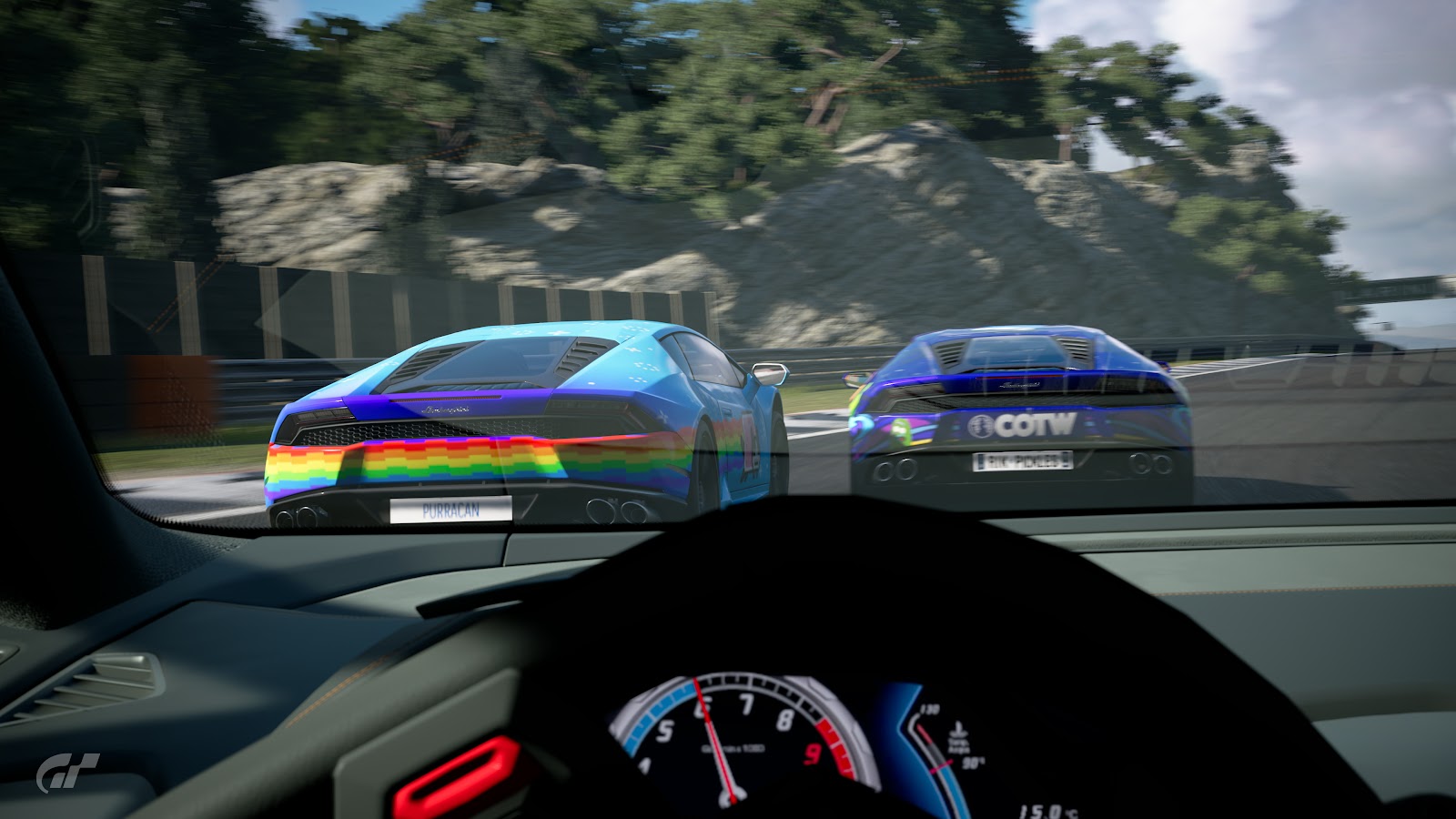
While I've come to feel little more than downright disdain toward the vast majority of Italian cars we've tested here in Car of the Week, even someone like me can't help but to find the Nyanborghini Purracan irresistibly cool. The story goes that Canadian musician deadmau5 wrapped his Ferrari 458 Italia with a Nyan Cat livery, going as far as to replace the Ferrari badges on the car with Purrari badges. Now, of course, Ferrari being Ferrari, fiercely protective of their brand image, quickly C&Ded the man, in doing so causing more damage to their image than any pair of pixelated rainbow–farting cats could. And so what's a rich man to do in this trying situation but to buy a Lamborghini and wrap it in the very design that Ferrari was so vehemently against?


https://youtu.be/kAuQJj40PJs

In essence, I think the Nyanborghini Purracan is the single coolest Lamborghini, at least in modern history, because it embodies the very spirit and sentiment that gave rise to Lamborghini as a car manufacturer to begin with: to do what Ferrari won't with a firm middle finger raised. And yes, in case you haven't figured it out by now, this livery is the entire reason why I bothered to choose an Italian car to begin with. I mean, I spent all this time making a livery for my own use, I might as well give myself the chance to actually like the car as a whole, right?


deadmau5 Nyanborghini Purracan by XSquareStickIt livery link (GTS | GT7)

Even before it gets wrapped up in feline shenanigans though, the base Huracán looks really promising on paper! It's brash styling masks a deceptively tiny car, one that can somehow house what I consider to be the idea drivetrain layout for a sports car: a big, but not too big, high revving NA engine mounted rear midship sending power to all four wheels via a close ratio 7 speed gearbox. With the blessing of Audi, this combination of the perfect drivetrain and diminutive body proved wildly successful both in sanctioned racing and production peacocking, with the Huracán GT3 scoring wins at Monza, Daytona, and Laguna Seca, and the Performante holding the (rather pointless...) Nordschleife lap record at one point. It seems to me that, despite the Huracán being the "baby Lambo", the flagship Aventador is only for showboating and reskinning into various other overpriced models, whereas the Huracán is the work bull of the brand that gets called upon when things actually need to get done. While usually the flagship car of a brand represents the very best and distilled essence of a manufacturer, it seems to me that we are yet to give modern Lamborghini a fair chance at an impression here in COTW until we've sampled its darling baby, the Huracán.


Even within the confines of Gran Turismo Sport, a game which ruthlessly distills away any sense of speed from the player, the Huracán is properly "HOLY BALLSACKS" fast in a straight line, even without feeling the g forces, motion blur, or camera pullbacks of going 0–100km/h in 3.2 seconds on its default Sport Hard tyres. Hell, 0–100 feels too shallow a test for the Huracán, because this thing just does not stop pulling until 180km/h at the top of 4th gear. That's right—this 601HP supercar from 2015 feels like it has the first four gears of a 1999 Impreza with well over double the power of a 1999 Impreza, and ripping through 4 whole gears within 9 seconds, each time upshifting as near to the height of the NA V10's stratospheric 9,000rpm redline as one can manage, is just as ridiculous as you can imagine it being. Now, of course, I've sampled cars that pull way harder, from hybrid LMP1s to EV performance cars, but you grow to expect such savagery in a racing machine and harmonise with it, and EVs have none of that drama, surprise, and involvement that the Huracán possesses. By contrast, the Huracán is savagely involving without ever letting you get too comfortable with it, because once you reach fifth gear on a racetrack where it mellows out just a little bit, you'll have other "HOLY BALLSACKS" things to worry about.

Those being the brakes.


For some weird reason, even on the default and strongest ABS setting, the Huracán's front tyres will be pushed to their absolute limit under full braking, even on a dry, level, and smooth racetrack, with whatever road legal compound you fit on them persistently chirping and squealing just with the brakes alone. This of course means that the front tyres have next to nothing left to actually turn the car when the time comes, meaning that you have to come off the brakes almost entirely for this rear mid engined supercar to even start considering biting into a corner. The news isn't much better on corner exits, either, where the front tyres will lift and gasp for air as though they had been forcibly held underwater and asphyxiating the whole time, which doesn't feel too far from the truth. The braking issue might be remedied by shifting brake bias backwards towards the rear, but since a Brake Balance Controller is an aftermarket part in GT7, I don't much want to fiddle with it back here in GTS, since, you know, we're supposed to be testing cars stock.


What this all translates to is that the front tyres are always at their limits around a track, and as such, they are also the limiting factor in everything that you do. Aside from off–track whoopsies, the rear end of the car just doesn't feel alive at all, like a dead carcass just along for the ride like an FF hatch, and I never once had to apply any counter steer in my time with the Huracán. The front tyres being constantly overworked and at their limit in any situation also means that the baby bull is a very "one thing at a time" car; you're either braking or turning, not both at the same time. You're either turning or accelerating, not both at the same time. While "one thing at a time" can be great life advice for some, especially for those suffering with anxiety, it's a pretty awful ethos for a brash, shouty, hard accelerating rear mid engined supercar, for whom the pace is often set by the track and the cars around it rather than its driver. Overall, its cornering prowess, or lack thereof, feels completely disproportionate to its straight line bursts, and after a while, it just feels like I as a driver have to fight the car at literally every turn to get it to... turn.


Some might argue that the whole point of a Lamborghini is that you have to fight it a little to prove your worth as a driver, but because the Huracán never really threatens to actually kill you by spinning out or flipping over, fighting it just to get it to turn like a car ought to feels less like a testosterone filled fight to prove your worthiness against a feral beast and more annoying like trying to get your bratty kid to do their homework. I don't know about you, but if I want to feel like a disgruntled dad, I'd have bought a Honda Shuttle, not a Lamborghini Huracán.


To be entirely fair, the Huracán can corner, it just has a lot of "safety understeer" baked into how its set up, erecting a gargantuan barrier the driver has to overcome each time they attempt to take a corner at speed with the Huracán, making everything else about the car hard to appreciate when then understeer takes priority and dominates your every thought on the racetrack. It'd be too easy to blame Lamborghini's overbearing parents, Audi, for that understeer and the perceived safety said understeer brings, but really? Lamborghinis have been understeering like a house in a landslide without anything resembling a paddle even as far back as the 25th Anniversary Countach. Plus, I took a 2009 Ferrari 458 Italia to race against the Huracán on race day, and to my utmost surprise, the two cars drive almost identically, with a nose that is wont to lift, and the entire experience dominated by "safety understeer". It's a trait that is shared with most, if not all of the modern supercars I've tested here in Car of the Week thus far, from the 2017 Ford GT to the Aston Martin Vulcan.


And so I find myself at an awkward impasse in writing this review, because I don't know what conclusion I can come to for the Huracán. I don't know if it's a good car relative to its contemporary peers or not, because they all blend together seamlessly to offer the same driving experience of "much power, such understeer, wow". It doesn't matter what engine they have, how much they weigh, what they look like, or what their drivetrain layouts are; if they all drive the same, none of them have a distinct trait or a personality of their own that set them apart from the next car. If not for my Nyan Cat livery and the real life story behind it, the Huracán would feel like a 458 clone in this game. I may not like these cars, but from an objective standpoint, are they good? Which would I recommend over the other and why? I can't answer that at all.

Fortunately, I have some friends that sometimes make my desk job easier for me... by making my job on the racetrack way harder.


Here at Car of the Week, I'm not the only one with a darling Porsche I like to whip out unsolicited at every opportunity; Vic has a dung beetle coloured 991 911 GT3 RS he likes to sashay around from time to time, and the last race of the day at Suzuka was one such occasion. On paper, you'd think Vic was sending his Beetle to the Slaughter: it's a whole 110HP down on the Huracán, and while normally only 2kg (4lbs) lighter than the Huracán if you can believe any statistic the Italians give you about their cars, Vic had a few more scones and Earl Greys just before the race to get his car and driver combo to meet the minimum mass requirement of 1,422kg (3,135lbs), the mass of the Huracán according to this game. Also, remember the part where I said that I consider rear mid engine all wheel drive to be the ideal drivetrain for a sports car? The 911's RR layout is easily the worst layout ever mass produced, putting aside forklifts. So can anyone please explain to me HOW THE HELL I got utterly destrolished and humiliated by the 991 during the "race" at Suzuka?


First, Vic gave the whole field a 5 second head start. He then overtook everyone else in the race before hunting me in my Purracan down for the lead. The whole ordeal didn't take him too long, and by the midway point of lap 2, the dung beetle was already getting a very strong whiff of the distinct odour of cat poo. He then decided to start a smoke show by drifting and sliding around, before casually overtaking me at his leisure.

So what the hell happened?

My guess is that Porsche actually made a sports car that can actually handle, when everybody else was too preoccupied with "protecting" their drivers and clientele. Porsche made a car that's meant to be driven, whereas everybody else was obsessed with making trophies on wheels. Porsche will actually let you have your car and play with it too, and they didn't even have to lie about their mass figures to beat some cheaters. Above all else, Porsche has shown me that other car makers have no excuse to not do better; they just choose not to. Armed with that context, I can now confidently tell you that the Huracán is a bad car... at least, in base LP 610-4 form.

Yes. Yes, I'm aware that it's perhaps unfair to the Huracán that we ran the base model against a track focused, hardcore 911 GT3 RS. Perhaps a Performante or an STO would've been a fairer comparison, but oh would you look at that, we only get one road going Huracán, and it's the base model. How convenient.

Even when I actively try to like them, Italian cars just make me mad without fail.

Thursday, 22 December 2022

W216 Lexus RC F Gr.4

The RC F Gr.4 is what you get when you throw good parts onto a bad car.


It has phenomenal brakes. It's arbitrarily blessed with a 7 speed gearbox in the same category where Corvettes and NSXes have only 6 speeds. The suspension soaks up bumps and kerbs to the point where they almost aren't felt. The tyres on this car actually feel properly aligned; a rarity in this game. They'll bite on trail braking and corner entry, and the inside tyres aren't the first to give up mid turn. Plus, slides in this car can even be easily corrected with just a flick of counter steer. Hell, I even recall at one point in the game's life when the powers that be blessed the RC F with OP straight line speed. Unfortunately, all that is thrown at a fat, ugly car with a half assed prototype interior and a lopsided 54:46 weight distribution, largely owed to having a hulking 5.0L V8 up front.


The end result is as mixed a bag as they come. Due to the Gr.4 RC F being based on the 2016 RC F GT3 prototype, it not only shares the awkward interior still featuring an out of place clock, but it also inherits the prototype's even more awkward 2nd to 3rd gear shift, which makes the car feel like it choked on its own engine oil. With the gears that close and an engine that peaky, you'll be making that shift many times across several tracks. But, just like the RC F GT3, the RC F Gr.4 is a very neutral, stable, and predictable drive otherwise, one that earns and begets a reckless amount of trust from its driver, and shouldn't require too much time to get to know. The front end bites in wonderfully on corner entry, so much so that the rear end starts hinting at a slide in the tighter turns, helpfully rotating the car as a whole into a corner, and the car even puts down power really well for an FR. But, on the flipside, it does struggle a little with high speed sweepers owing to the heavy front end, and you'll have to make the front tyres scream slave labour to squeeze that cornering prowess out of them. I like my RC F Gr.4 with -1 front brake bias for that extra biting edge into a corner, but I suspect for longer races, that will have to get knocked back a bit to even out the tyre wear front to rear.


I'm tempted to say that the RC F Gr.4 is a good all rounder, a jack of all trades that you can default to if you had to pick a manufacturer for a season for which you're unsure of what lies ahead. The reason I can't say that is that, despite the GT3 cars fitting the bill and the Gr.4 car handling well, the latter is just SAH-LOOOOOOW in practice; I recall Vic of all people driving his RC F Gr.4 being harassed by my Cayman GT4 around Nürburgring GP during Week 205 when we tested the 86 Gr.4. The RC F just couldn't compare to the mid engine menace in the corners, and it's not like it pulled away at all in the straights, partially due to the slipstream it was providing the Cayman. That doesn't sound like much of a knock against the RC F in writing, until you realise that the Cayman is one of, if not the slowest car in Gr.4 with BoP applied in a hot lap scenario; it has much less power and weighs so much more than the RC F with BoP applied. It's essentially a 5 speed toy going up against a 7 speed Kaijuu. That such a thing can more than harass the RC F around a track then, is as atrocious as saying a paintball gun has the same stopping power as an AR-15. Why is the RC F so slow? HOW can it be this slow with those numbers and that good a driving feel?


To be more thorough in my test, I ran the Cayman against my peers mostly running RC Fs this week, and I overtook them all within two laps of Willow Springs before setting the fastest lap of the race. I might have thrown the entire race away, but don't let that distract you from HOW FREAKING SLOW the RC Fs were. It's almost like the "F" in RC F stands for "failure".


It made for some tremendous one–make races, but the RC F is proof that, to make a good race car, it's better to start with a good base that requires minimal work than to throw expensive parts at a bad base.

Saturday, 17 December 2022

W214 Mini Cooper S '05

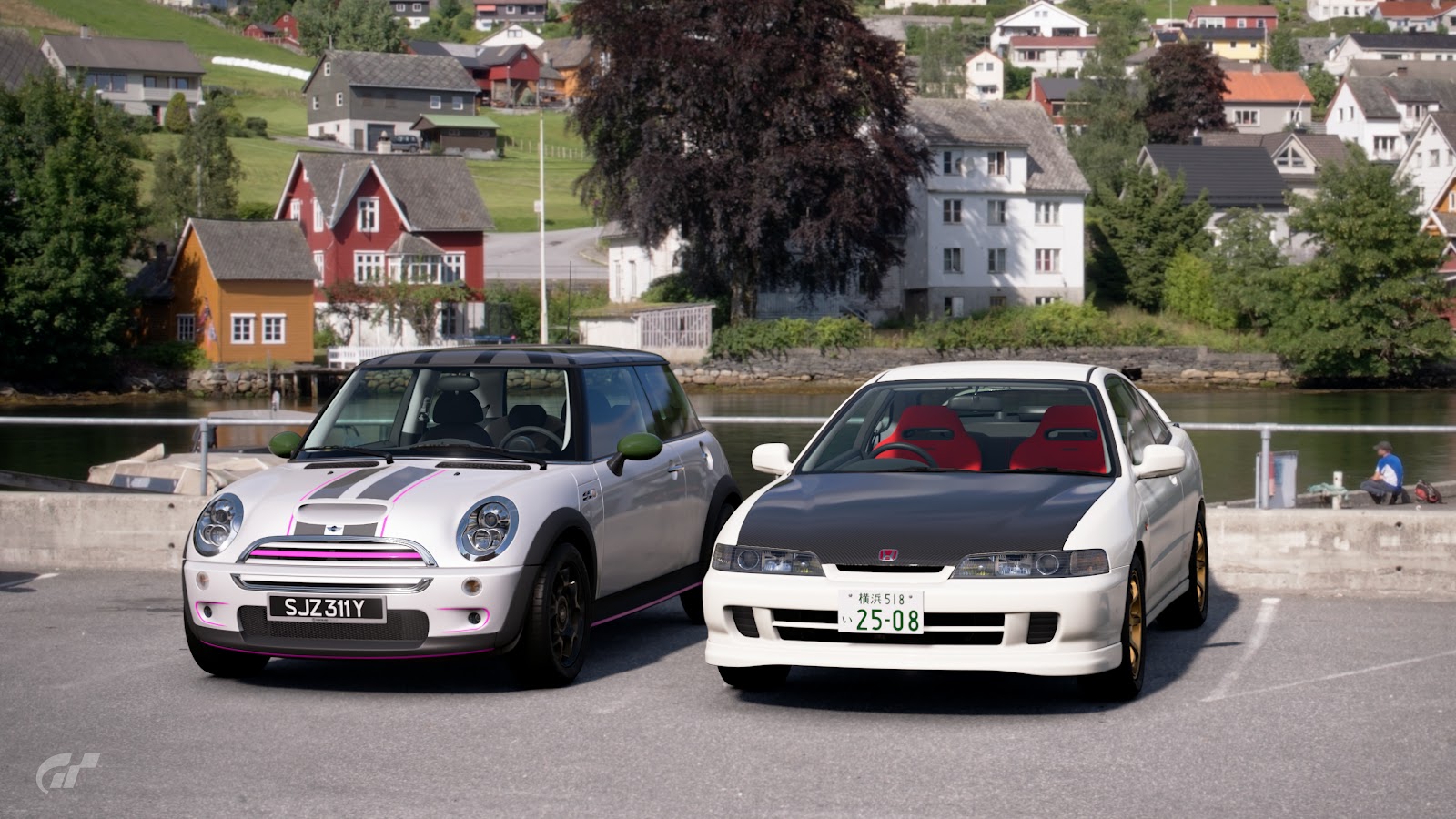
Very rarely even for those who drive many different cars for a living, they will come across that one car that just completely breaks every preconception of how things should be, what can reasonably be expected of a car or a category, and in doing so, unearths every yard stick in their mind, with every car they drive henceforth having to be measured against that new standard, spoiling that blessed person beyond any mere mortal's conception. A Lotus Elise's steering feel, for example. A Porsche Taycan's acceleration, or even a Honda Fit's packaging. When it comes to the way an FF sports car drives, the car that blew my overstimulated, desensitised sim racer mind and spoiled my cynical brain silly was the DC2 Honda Integra Type R, a car so magical that Honda themselves have never really replicated that magical feel all these years later.


I'm here to tell you that the DC2 ITR has itself been DC2 ITRed by the 2005 Mini Cooper S.

Just as vehemently as understeer usually dominates the experience of driving an FF sports car, the driving dynamics of the Cooper S is so unexpectedly fantastic that it could almost render irrelevant the fabled history of the Mini marque. You really needn't know any of the original Mini's successes in rally, how it revolutionised drivetrain packaging, or whether you can steer it from the roof to appreciate this modern Mini, because the R53 generation Cooper S does all the talking for itself without needing to rely on nostalgia when driven on the racetrack—not something many modern cars wearing old namesakes can lay claim to. Despite the sacrilege of being more than double the size of its forebearer, the Bayerische Mini Werke is, in my millennial eyes, in just that perfect sweet spot of both power and mass for a hot hatch; big enough to fit most, pack some grunt, and be seen and safe, but small enough to be chuckable, intuitive, and engaging to drive, before all the modern safety regulations and demand for insane power bloats and neuters cars to where they can no longer offer these sensation of an agile and responsive pocket rocket in the palm of your hand. Almost as if they knew they had to capitalise on that golden moment in history when such a car is possible, BMW fitted a supercharger onto the sporty version of the Cooper, the Cooper S, only for this generation of Coopers, making this week's car a special standout even in the long, ever growing history of Minis.


...which makes the peculiar omission of the supercharger whine in Gran Turismo Sport all the more sorely missed. This 2005 Mini Cooper S has been with the Gran Turismo series since 2010's Gran Turismo 5, but it took Polyphony Digital twelve years to finally give the Cooper S its supercharger whine in 2022's Gran Turismo 7, giving the quirkily styled car a personality to match. Here in GTS though, you'll have to make do with just the rather uninspired sound of the transversely mounted Tritec T16b4 inline four banger, though the extra 54 horses herded by the supercharger are all here and accounted for. The resultant 167HP (125kW) then goes through a close ratio 6 speed manual gearbox to the front wheels, another first for the now big boy, business meaning Mini, which can now bring its 1,180kg (2,601lbs) body up to 100km/h in somewhere around the 9.3 second mark on Sport Hard tyres.


As with any Mini, its acceleration isn't going to set anyone's pants on fire, not unless they had just jumped out of a burning Mazda Roadster. Even with all that gleaming and bespoke hardware, the R53 Cooper S only truly comes alive when it comes time for the supercharger to shut up and the Getrag gearbox to drop some gears. German this car may now be, but the R53 Cooper still embodies the spirit of a good David punching up against Goliaths with little power but much finesse, just as the Queen intended. Chuck this thing into a corner, and the car's four main strengths immediately become apparent, those being its diminutive body, light weight, incredibly direct and talkative steering, and some shockingly stiff 1.5Hz springs to prop it all up with. Despite the car not accelerating fast, the close ratios enabled by the 6 speed gearbox ensures that the engine can be kept screaming at all times, like it naturally wants to, making it sound and feel fast. Backed up by readily available responsiveness and some serious cornering speeds, the Cooper S is not only a serious track toy, but also one that never stops bombarding you with information and requests for your input, making it among one of the most engaging and technical drives I have ever driven here in GT Sport!


What that all translates to is that the car is so easy to learn and such a natural fit that it somehow skips the due process of feeling intuitive and jumps straight to feeling familiar, despite the fact that it was my first time helming one during race day, almost as if I met a younger, hotter version of my high school sweetheart I never knew she had. I'm usually someone who needs a few races to learn a car's idiosyncrasies before I can really bring it to my peers during race day, but in the Mini? I went at them hammer and tong from race 1! Despite our small group representing a range of driving abilities, most races ended up with about 6 cars all within three seconds of each other, a testament to how easy the Mini is to learn and how much it encourages close–knit tussles, a.k.a. the best kind of racecar, certainly better than Formula 1. More than inspiring immediate confidence, the way this car handles brings out the hooligan in every person. During race day, all I could think of were naughty thoughts, like, "Yeah, I can fit into that gap!" "Yes, I can take that hairpin at 120!*", and "hell yeah, I can take that gap in the hairpin at 120!*". I usually feel drained and tired at the end of our ~90 minute sessions, but the Mini gave me so much zest for life that I actually had a hard time winding down mentally after the session, wanting to drive it more! In other words, instead of draining me, driving the Mini somehow energises me!

*For legal reasons, these are exaggerations.


Drawbacks? Mostly just one if you can ignore the irony of an impractical hatch: The Cooper S, despite being the sporty variant of the Cooper, ironically still has an open differential, and it's an irony that will be at the forefront of the driving experience on the track that's quite literally impossible to ignore. It's not a super big deal on the Comfort Soft tyres the car comes default with in GT7, but in GTS where every car is slapped with Sport Hards, the extra lateral gs the car will gladly pull in the corners does transform the inside wheel into a Sports Hard mechanical eraser for road markings. Past the apex of a turn, you could be doing a middling 6,000rpm when you give the Cooper the beans, and well before the corner exit, you would have already smacked the limiter set at 7,000 several times, owing to the inside wheel spinning so fast and bringing the engine to the limiter, forcing a fuel cut and robbing the car of all momentum coming out of the turn. As an example, the car tops out at 172km/h in 4th gear, but you'll be smacking the limiter constantly while doing a mere 160km/h on Miyabi's centre section chicane, taken flat out. 12km/h (~7mph) doesn't sound like much in writing, but in a close ratio box mated to an engine that begs to be revved out and rewards the driver handsomely for doing so, it's completely counterintuitive that I have to take corner exits a gear higher simply to prevent the limiter from cutting in, which, while mechanically disadvantageous, does work out to be much faster. I don't even want to imagine this thing on anything other than the smooth, dry racetracks we ran. I mean, come on, an LSD isn't sorcery; Mazda can fit it on a Speed3 and a diesel Demio, why can't BMW on a sporty version of a sporty icon that has a history of winning dirt rallies and revolutionising drivetrain packaging?


Open diff or not, one thing for sure isn't open for interpretation: the R53 Cooper S is among some of the best FF cars you can drive in the game, even shaming some FR sports cars in the process; I genuinely think the R53 Cooper S is a better "traditional British recipe made better by foreigners" car than most Mazda Roadsters. As you can probably already guess with my heavy mentions of Mazda cars by this point, I'm a HUGE sucker for Mazdas, and so I hope it comes across how high a praise I mean it to be when I say I would rather a R53 Cooper S over most Roadsters. The supercharger of the Cooper S gives the car some real personality where the Roadster has none. Both cars heavily emphasise weight transfer and momentum driving, but the stiffer FF car won't kill you if you muck something up, whereas the softer FR car wouldn't hesitate to snap on you if you take liberties too far with it. In essence, I think a Roadster is more of a dance partner you have to respect, and a Mini is more of a toy you can just keep ragging on endlessly, and I don't care what it implies about me as a person that I prefer the toy over the dance partner. Short of the Japan–exclusive NR-A grade, a Roadster has never given me that serious liberating track toy feel before, and it'd need some serious bloat from a 2.0L engine just to share a track with this not–even–a–JCW Cooper.


Hell, I love it so much, it just might get my Car of the Year vote in a year where we tested the ND Roadster, S-FR, and R34 GT-R.