Saturday, 16 January 2021

My Rave About the FD RX-7

The third, FD generation of the Mazda RX-7 is my childhood dream car. It is the car that introduced me to video games and made me into a petrolhead. It has shaped me from a young age, and thus I am very biased towards it. This is not a review — this is me gushing about my childhood hero, my be all end all dream car, and it is going to be long, dry, perhaps a bit too personal and maybe even a bit cringe. You've been warned.


Mazda has always been largely synonymous with the Wankel Engine, even in the company's early years as an automobile manufacturer. Post WWII, the Japanese government was looking to consolidate part manufacturers to cut down on competition and reduce costs, and Mazda had to carve out a niche for itself as a company to avoid being consolidated into Toyota and Nissan, and thus turned to Germany, where Felix Wankel had been pioneering a revolutionary new engine. While Mazda was neither the first to the party, nor made the most power out of the curious contraption, it was the only one that achieved any sort of longevity with the novel engine, with the 1967 Cosmo Sport being an instant classic in the showrooms. To prove that they have solved the riddle of the Wankel Engine's inherent problems that had plagued all other adopters of this new technology, Mazda entered two Cosmo Sports into the grueling 84-hour Marathon de la Route held at the daunting Nürburgring, with one car failing at the 82nd hour due to axle failure, and the other car going the full 84 Hours, finishing fourth overall — not bad for a conceptually fresh and unproven engine.


Owing to this breakout success, Mazda managed to remain independent as a manufacturer, but more exciting perhaps is how the newly proven Wankel Engine seemed to be the logical next step to replace the traditional Internal Combustion Engine, just as EVs are now threatening the same. The Wankel Engine is more compact, lighter, ran quieter, and was smoother than a traditional piston engine of equivalent power output, but still had reliability issues any new tech is expected to have despite Mazda's success with it, and was notoriously thirsty. That last point relegated the Wankel Engine mostly to sports car applications when the 1970s oil crisis hit — an application where it felt most at home, being a lightweight, rev happy engine that needed to be wrung out to produce power — though it didn't stop Mazda from sticking it into all sorts of other vehicles such as a Familia Sedan, a 3 Rotor Cosmo luxury coupé, a pickup truck of all things, and even a freaking bus!


The first generation Mazda RX-7, chassis code SA22C and later FB3S, bowed in 1978 with the worldwide market in mind. Cheap, light, and fun-to-drive Japanese sports cars were just starting to gain traction in the US thanks to the 240Z, and even though the RX-7 was late to the party, it provided an exciting alternative to its already bloating rivals, characterised by, of course, its unique Wankel Engine. Then the second generation FC3S happened, and I don't want to talk about it more than I already have. In my review of the FC, I said that the third generation, FD3S RX-7 "is leaps and bounds better than the FC in every respect, objective and subjective", and that "It elevated the standards and definition of what a sports car should be and can be". And now it is finally time for me to back up and explain those claims.


The third generation RX-7, chassis code FD3S, was launched in October 1991 in its home market of Japan. While sharing the same name and a familiar chassis code, the FD is such a far leap from the FC that it's very difficult to think of the two as even related. While the FC is a soft, bloated, and boxy knockoff 928, the FD is a low, sleek, curvaceous and seductive beast unlike anything on the road, before or since. Even though the overall length, height, and wheelbase of the FD are all shorter than the FC, the increased width of the FD put the RX-7 for the first time in Japan's larger Class 3 category, to give you an idea of how serious Mazda were about designing the ultimate corner carving machine. Fully capitalising on the Wankel Engine's unique compactness and light weight, the entirety of the 255PS capable powerplant (251HP, 187kW) is situated aft the front axle to finally achieve the perfect 50:50 weight distribution, allowing the stiffer sprung 1,260kg (2,778lbs) package to gracefully dance through corners in conjunction with the precision offered by the Double Wishbones on all four corners (1991 Type R specs, taken from Gran Turismo 6). Tyres were also upsized to 225/50ZR16 front and rear, up from the 205/60VR15 shoeing the top of the line Turbo FC. Standing at only 1,230mm (48.4in) tall, the low, organic, and curvaceous body cuts through opposing air at only 0.31cd, which when coupled with the low frontal area of the sleek FD, puts the bloated and heavy cars of today to shame, as unfair a comparison as that may be to make.


The FD is a very pure, raw, and honest vehicle, if one can make such an assertion without sounding like a moron, and how it looked on the outside is a statement of intent, wholly representative of what lies underneath that immaculately curvaceous sheet metal. In fact, I daresay that the design of the FD is peak sports car design; never again will we be able to have a sports car as light, low and curvaceous as this, due to consumers now wanting everything in their cars, and how lawmakers feel the need to protect people who don't look left right left before crossing from idiots that drive when they shouldn't. Unlike the cars of today, nothing on the FD is fake, or are there only for aesthetic purposes; there are no fake vents, no fake exhaust pipes, no bogus audio piped into the cabin, no pretentious stamped in creases or chiseled out "character lines" that today's mundane and samey cars need to resort to to stand out. Everything on it is functional, and they all blend together so flawlessly, cohesively, and "flow" so well, it leads your eyes around it endlessly, without ever once feeling pretentious or ingenuine. It's like a girl that doesn't need a loud crop top, short skirts, or 10kg of makeup products to stand out; she's just pretty, as-is. As hard as it is for me to pick a favourite angle of the FD, the Series 8 (1998–2002) FD dead on from the rear is probably my favourite. The wraparound light cover with three circular lights on each side almost resembles a weighing scale indicating balance, binding the left and right sides together to also create a sense of cohesion. The four rounded red lights on the unified rear light cluster gives the car a very buttoned-down look, and the adjustable rear wing gives a very real sense of weight visually, suggesting a well put together drive. Coupled with the low and organic looking body of the FD, the unified rear light cluster gives the FD an unmistakable visage that is instantly recogniseable even from a distance.


Impressively (to me at least), the Series 8 RX-7's stock rear wing is an adjustable unit that actually produces downforce! It is possible to change between four angles of attack with the stock wing, at 1, 5, 10, and 14.5 degrees by removing the wedge shaped piece on each wing stand manually, which has four keyholes on the inside leading edge to accommodate the four preset angles of attack. Unfortunately in the Gran Turismo series, the wing doesn't change in appearance even if you change the downforce value, and the keyholes aren't modeled in in the game.


Because the engine is so compact, and because this is 1991 and there hadn't yet been a law that states you need a bit of a "cushion bubble zone" between your bonnet and the engine header, the bonnet line of the FD is set super low, thanks in no small part to the compact Wankel Engine. This in turn necessitated the pop up headlights, since laws at the time at least did require headlights to be a certain height off the ground, meaning that even the flamboyant pop up headlights are actually functional and not just vanity items. Personally speaking, I ADORE pop up and hidden headlights. I can't really explain why. Seeing them just connects my jaded adult self to the 8 year old kid inside me, and it just fills me with such unconditional joy every time I see a set. I love how sleek and cheekily stealthy they look, how they seemingly promise an imminent transformation, and even just tracing the panel gap lines to the beautiful headlight covers fill me with an inexplicable joy. In fact, you could say the same about the entirety of the FD RX-7's body.


Other stylistic standouts are the front bumper of the JDM only Series 8, which have the opened up light cluster below the pop ups. These position lights and turn signals have a mirror finish inside the cylinders, which make the "eyes" glisten in the daylight even when they're off. The car always has a confident, yet gentle look, almost as if it were smiling, without being too in-your-face about it like mid to late 2000s Mazda cars.


The doors too, look like teardrops pulled and stretched back, to give that sense of built up power. The window glass is properly framed, too, unlike those nonsensical frameless windows that need to pop up and down with each door opening. The door handles are flush with the car's body, which was almost unheard of back in the '90s, and it took about twenty years before other manufacturers started to adopt flush door handles in their performance cars and mileage conscious EVs.

(Also, yes, the white Spirit R in the reflection has modified scissor doors)

It is always such a delight to watch light dance across the subtle curves of the clean, widespread front bonnet of an FD as you move around it or as it moves, giving it a surreal sense of motion even if it's standing perfectly still.


The FD RX-7 is so beautiful that I simply cannot find an angle that isn't drop dead gorgeous and just somehow soothing to look at. It's the sort of car that is so charismatic and photogenic that you could point a phone camera at and just shoot for a great photo. While the SA, FB and FC generations that preceded the FD look very much like products of their time, the FD I maintain is the single best looking car to ever be mass produced, in my obviously biased opinion. Even though it was penned in the late 80s to early 90s, it never looks its age. It has an implicit, visceral feel to it that just appeals to something innate in all of us, which is perhaps why it still looks modern today. When I show photos of the car to my non petrolhead friends and family, they are all surprised to learn that the design is older than I am!

Don't worry, this is the first and last time I'm showing my face. I know how ugly I am.

It may surprise some to learn that the FD RX-7 is technically a hatchback! Almost the entire width of the car lifts from wing to the rear greenhouse glass. Even though it has a wide opening and surface area, it's lacking in depth, resulting in a boot that's almost like a kiddy pool in appearance. I think most will still be surprised by how much stuff the FD can carry, however.


Now, I want to know what is up with the discrimination against my FD RX-7 Gran Turismo Sport has, not letting it enter the Hot Hatch Challenge in GT League!

The stylistic theme continues on the interior of the FD: curvaceous, genuine, pleasing to look at, but never obnoxious or distracting. One might find the interior to be rather bland, admittedly, given that the interior is typical 90s Japanese sports car: swathe with nothing more than soulless, black plastic parts typical of cars of its era and price point, with the only reprieve from the monotony being special, limited edition cars with glaring red seats and complementary red stitching.


2002 Spirit R Type A interior.

While lacking in any fanciful materials of today's cars like Alcantara or Carbon Fibre, its appeal being a focused, pure driving machine carries over from the exterior, continuing that sense of cohesion and purity of purpose in design; the dash wraps around the driver, with everything within easy reach and glance, bringing focus naturally to the big, clear gauges on the instrument panel while creating a sense of coddling the driver. The tachometer sits dead centre in the dash and is the largest of the dials, with redline being at about 2 o'clock for easier viewing in the Series 8. Next to the dominating tachometer is the equally sized speedometer, which maxes out at 180km/h (~112mph), where the car is electronically limited to as per the weird jishu-kisei, or "mutual self-restraint" gentlemen's agreement between Japanese manufacturers at the time. The speedometer maxing out at mid 4th gear really makes me feel like a superhero doing insane speeds when in reality, I'm puttering along quite slowly, because of how much it travels in a small speed range, which I'd go as far as argue makes it easier to tell at a glance what sort of speed you're doing without having to read the numbers, though it admittedly is useless past mid fourth gear, and is probably on the top of the list to change for anyone looking to modify their cars. The only button on the steering wheel is the horn, and nothing else to distract you when you're driving, which is something I personally wish more car manufacturers had the sense to do. Amenities and creature comfort include air con, stereo, a cigarette lighter, a few pockets of cubby holes aaaand... that's about it. Anything else would be extra mass, y'know!


Despite the cramped dimensions, the car does feature a double bubble roof design, originally intended to accommodate racing helmets, meaning that, comfort and dignity notwithstanding, even slightly larger Westerners should be able to fit into the car. Once in, the car does an astounding job of lending its occupants an airy, wide open feeling, offering a panoramic view that's almost not an exaggeration to say. There really is a lovely sense of light in the cabin of the FD — even in models not equipped with a sunroof — no doubt helped greatly by the toothpick thin A pillars that could've only been possible in the yesteryear, along with the gigantic rear greenhouse glass that, while beautiful inside and out, probably hurts the chassis rigidity, and I imagine also a manufacturing nightmare, hence why they've become just about nonexistent today. Still, I ADORE the rear greenhouse glass. It gives off such a fighter jet inspired look, affording such a freeing sense of light, and it minimises blind spots and makes parking a breeze.


Lastly, because the later models of the FD RX-7 were never meant for export outside Japan, the car's interior has some... shall we say, quirks and features.


Push LOAD buttin
Insert duscs after"IN" is displayed

The FD RX-7 is considered by many to be the pinnacle of Mazda sports cars. It is, at the very least to me, the pinnacle of creative liberty for Mazda. It was born when technology was adequate, but regulations weren't nearly as strict. It was only with the backing of a rapidly inflating, yet ill-fated economic bubble could a relatively small and independent car company like Mazda finance the development of something to really challenge the larger automotive giants of Honda, Nissan, and Toyota, and perhaps even established brands worldwide. It is often said that the FD RX-7 was designed by a team of passionate engineers when all the accountants and marketing department were away on a vacation, and somehow got greenlit for production. That is what I mean by the car being very "honest". It just oozes and shouts purity of purpose, perhaps even to a fault, so focused on being an engaging, exciting drive, and so little else. It felt like no one but the engineers had a say in the car. It was never offered with any engine other than the Inline 2 Rotor 13B-REW, even when there was a bigger, more powerful 3 Rotor Mazda could've dumped into it, but would've upset the perfect weight balance of the FD. It never came with a convertible, despite the FC's success with it, because that adds extra mass and takes away from chassis rigidity. It was only offered with a 5 Speed Manual, with only two exceptions that I don't want to acknowledge the existence of, let alone talk about. It is a car that knows what it is and what it wants to do, and doesn't bother to try to be anything else, and I love it for that. Cars nowadays simply aren't built with this sort of purity of purpose, this cohesion of a big picture dreamt up by a small team of passionate engineers anymore. It isn't a product separated into tiers based on cost and market trends and demand; rather, it is a sports car, pure, plain and simple. The best that Mazda can give you at the time. And I love it for that.


Powering the flagship sports car of Mazda in the early 90s is of course the company's pièce de résistance: the Wankel Engine, better known by its fans by its in-house name, the Rotary Engine. A close relative to the R26B engine used in the legendary 787B racecar, the Inline 2 Rotor engine in the FD quoted at 1,308cc redlining at a stratospheric 8,000rpm may sound exactly the same to those who are familiar with the FC, but in the FD, they are all sequentially twin turbocharged; only the third production car to feature such a system, after the Porsche 959 and Mazda's own JC Cosmo. A smaller turbocharger with less inertia and less power would come online from near idle to 4,500rpm, and from there, the system would seamlessly switch to the bigger, more powerful turbo once the exhaust gases start seriously flowing, all the way to the redline of 8k. It is a massively complicated system, and as with everything on the FD, was prone to breaking. Diagnosis of the engine, with its miles upon miles of pipes from the twin sequential turbo system, was and still is a nightmare for many owners, with many opting to swap for a much simplified single turbo setup, sacrificing low end torque for reliable top end power. While many Rotary fans are quick to defend the reliability of their engines, saying things like, "they're reliable if you know how to take care of them, bruh", and "well the 787B's engine went full tilt 24 hours straight with no issues", the twin sequential turbo system is perhaps a bit too complicated for its own good, and has been cited to kick the rear end of the car out when the bigger turbo comes online mid corner, which can catch out the inexperienced or unprepared.

But that is not to say that the turbos are bad, per se. Me personally, I love the twin sequential turbo setup of the FD, and wouldn't swap it for anything else. As is the theme of the rest of the car, they are brilliant when they do work. While Rotary Engines are traditionally known to be very peaky engines with pathetic torque figures, the twin sequential turbos give the 13B-REW some semblance of life in the low range, and enough of a kick in the mid range to bring the rear end outwards, especially in the models with the way too slim 225 section tyres at all four corners. Peak power and peak torque comes at 6,500rpm and 5,000rpm respectively. Yes, these figures still suggest a peaky engine. Yes, you will still need to wring the crap out of it to get it to give you the magic. Unlike the turbochargers of today, they aren't designed to compensate for a downsized engine, or to make torque down low so lazy drivers can pass cars without having to downshift in their automatic gearbox SUVs; but rather, they're here to make a very lopsided engine more well rounded for the racetrack. The end result is a car that is never caught unprepared on the track, with adequate revs and torque to propel the featherweight FD out of any complex of corners, even low 2nd gear corners of a tightly wound mountain pass, with the Rotary Engine's natural peakiness taking care of the upper rev range.


Of course, the numbers don't sound like anything special today; a modern FWD hot hatch makes more than what this highly ornate setup does. But I personally find that the FD's torque curve is a very natural fit to the car, as it makes it possible to lug the car out of apexes from as middling as 5,000rpm, and the torque is never surprising or disruptive, just a natural feeling surge that climbs with engine speed, giving you power just as you're ready and able to use it, making for a very cohesive, balanced, and easy car to drive fast. Throttle management out of apexes of corners in the dry is more for ensuring you don't understeer off the track rather than keeping the rear from peeking out in the 255 section rear tyre equipped FDs, which I find difficult to break loose with power alone in any gear higher than 2nd. The sequential twin turbo setup is, to me, an oft neglected aspect — yet a big core component nonetheless I feel — of the FD's central theme: balance and cohesion. It's an especially big help in Gran Turismo Sport, as manual gearboxes shift criminally slowly and awkwardly in this game, and being able to minimise shifting by lugging the car is a godsend.


For comparison to NA Rotary Engines, the NA FC RX-7s made peak power at 7,000 and peak torque at 4,000, redlining at 8,000. The RX-8 made peak power at 8,200 and peak torque at 5,500, of 9,000. As a result of the sequential twin turbos, the FD RX-7 actually goes faster if you short shifted it a little at around 7,500rpm, as heretic as it must sound. Me personally, I wouldn't forgo that sweet sound of revving it out completely, though, as it's not a very perceptible loss without the instantaneous deltas of a racing game, and the car is certainly capable of holding onto a lower gear if approaching a braking point. As was already tradition by that point, Mazda fitted a beeper that was programmed to come on 500rpm before redline, at the magical 7,500rpm. I've personally never found a need for the beeper, as I think the engine is communicative enough without it in the previous games when the beeper wasn't replicated. I can sort of understand why it's there, though, as the engine revs so silky smooth, it's hard to not get lulled into thinking it could go on forever. The beeper does keep the car in tradition and gives it character, so I'm glad it's still there, especially because it doesn't sound like a 1980s alarm clock passing gas into a soiled diaper like the one in the FC.


What's infuriating to me isn't the beeping, but rather, that the turbo gauge is bugged in Gran Turismo Sport: it only toggles instantly between no boost, almost full boost, and full boost, which is most evident when you're launching the car from a standstill like we do in our weekly races. It's so unresponsive that it doesn't even blip at all on downshifts, and it's just an eyesore in what should've been a perfect cockpit experience.


The early 90s in the Japanese sports car scene was truly magical, as every automaker, backed by a short lived economic bubble, vied to claim dominance with their equally daring and innovative flagship sports cars. Nissan had their "Godzilla", three generations of the GT-R. Honda had the now legendary and much revered NSX. Toyota would soon drop a bombshell with the A80 Supra. Mitsubishi and Subaru would go on to have the rivalry of a lifetime with their Evos and Imprezas. The comparatively small, independent automaker in Mazda swam with these sharks and not only survived, but thrived. The debuting FD, when tested and raced in the professional hands of Best Motoring, set the fastest lap both in the race and time attack around Tsukuba, beating out Godzilla and the NSX, both of which costing more. It only gets beat by the AWD Godzilla and the Mid Engined NSX in the 0-400m dash, and took top time in a slalom test. It even took Bathurst 12 Hours 3 years in a row, from 1992 to 1994. In the hands of private customers, the FD was truly the Swiss Army Knife of sports cars, a testament to how well its base design catered to anything motorsports. It partook in and excelled at multiple disciplines of motorsports, from D1GP, Touge runsBonneville Salt Plane top speed runs, and even won Super GT in the GT300 class in 2006. It was truly the Jack of All Trades, and even master of some, which is why the FD RX-7 is such a respected household name in the aftermarket, with support for the car is still thriving today. As brilliant as the car already is fresh out of the factory, the combination of a lightweight, low slung, low drag, wide spread 2 door body with a perfect 50:50 weight distribution and a rev happy, compact engine up front driving the rear wheels proves to be an irresistible and highly capable base upon which many tuners still choose to build upon even today, such as Fujita Engineering, Knight Sports, Pan Speed, R Magic, Racing Beat, and RE Amemiya.


While it debuted strong, I struggle to make a case for it having bowed out the same. Owing to lacklustre sales figures in export markets, the FD RX-7 pulled out of America and Europe with just four years, from 1992 to 1995. That means that the more refined, further improved FD RX-7s were JDM exclusives. And if you know how quickly Japanese cars in the 90s evolved, you'd know that this is a big deal.


In the 90s, Japanese car manufacturers were limited by the aforementioned gentlemen's agreement to advertise no more than 280PS for their cars. This meant that, instead of using raw power as a crush, manufacturers had to look to other means to better and improve their cars, resulting in frantic, almost yearly small updates that often decided which car had an edge over its rivals. Due to lacklustre sales figures in export markets and Mazda's rapidly worsening financial situation in the 90s, updates for the RX-7 were minor compared to its contemporary rivals. Mazda's financial situation was such that it had to turn to Ford for help, who in 1996 owned as much as a 33.4% stake in Mazda. Along with Ford came a frantic restructuring of the company to increase profitability, and it was clear then, even in the mid 90s, that the RX-7 — and Rotary Engines in general — were in the proverbial back seats as crummy as the ones some FDs came with; there more for formalities and insurance than actually being used to accommodate anything of value. In the 12-year lifespan of the FD in the Japanese Domestic Market, the GT-R spanned three generations with leaps in its ATTESA AWD and Super HICAS rear wheel steering systems, getting a 6 speed in 1998. The NSX got a "big minor change" in 1997 (yes, Japanese expressions are weird) that saw its engine bored out and paired with a six speed gearbox, and then a major facelift with much improved aerodynamics in 2000. The Evo and Impreza each had seven or so versions since their inception up to 2002, but honestly, who can really keep track of those two in the 90s? The RX-7 in comparison, had its power slightly bumped a few times and went through three different rear wing and badge designs, I guess?


While pale in comparison to its rivals' evolution, the RX-7 did get some very important changes, in addition to the aforementioned power bump. Most important and impactful of these I believe are the upsizing of tyres from 225mm sections on all four corners to 235/45ZR17 up front and 255/40ZR17 in the rear for the top of the line Type RS model and special editions, which were previously exclusive to the excruciatingly limited Type RZ. This finally gave the "normal" RX-7s the driving characteristics of a proper FR cornering machine. In addition to this, chassis rigidity was also strengthened, resulting in a car that not only approaches its limits more linearly, but also makes it less nervous at and past its limits. Perhaps to compensate for not getting a 6 speed manual, the shortened fifth and final gear ratios that were also originally exclusive to the Type RZ has been made standard across the 5MT range (except for the oddball Bathurst R), which, when coupled with the slight power bumps the FD received over the years, means you'll actually see fifth on Suzuka's home straight in a late model FD. Lastly, the single most beautiful colour in all of recorded human history, Innocent Blue Mica, was made available for the final facelift on almost all models, replacing the very, very odd Montego Blue Mica. Not that the endless creases and curves of the FD really needed fancy paint to show it off, but with these high contrast paintjobs like Innocent Blue Mica and the Spirit R exclusive Titanium Gray Metallic to further accentuate it, the FD becomes almost dangerously addictive to stare at on the road.


The Spirit R that's in most modern racing games, such as Gran Turismo Sport, is the final model of the RX-7, meant to commemorate the end of its 25-year production run. Because the FD was on life support for the latter half of its life however, the Spirit R is simply a top of the line Type RS model with some mostly aesthetic bits thrown into it. However, one look at that list of special bits, and it's impossible to not salivate, as they're all from the best in the industry: Brakes are drilled rotors from Brembo, with special red paint and Mazda lettering on the calipers. Wheels are upsized to 17 inches, of immaculate BBS design. Seats are full on, bare Kevlar backed, thin buckets from Recaro in the Type A, in an attention commanding red, accompanied by red stitching in the steering wheel, shift knob, and parking brake lever. The steering wheel on all Series 8 RX-7s are Nardi items. And while not advertised, I'm sure Mazda fiddled with the breathing of the engine in the Spirit R, as not only is it ever so slightly faster, it also sounds distinctly different from the rest of its brethren, with its otherwise defining Rotary whine almost inaudible in the cockpit, offering only a generic, muffled exhaust noise to go along with your drive. The end result of all this produces what Gran Turismo Sport claims to be 296PS (292HP, 217kW) @ 6,500rpm and 332Nm (245.3lb-ft) @ 5,500rpm for the sportiest variant of the Spirit R, the Type A.


While extensive, the list of changes doesn't add up to a radically different driving experience in the Spirit R. The changes aren't as transformative as a Honda Type R or a Subaru 22B, but one look at a Spirit R, and everything just feels so... special, yet so naturally fitting. Nothing screams "90s special limited edition" like BBS wheels, and the red Recaro bucket seats make the regular ones look ghastly, so much so I almost wonder why they were locked behind special edition models. They seem to contrast and complement the body colours of the FD so well, though it does have the unfortunate side effect of making a red FD look... overwhelmingly red. Even though this is a limited edition model, these parts just look so right on the FD I wouldn't have the car any other way.


So here we are. I've bored you to death and back with the entire history of the FD RX-7. Now the question is, "how does it drive?"

It's worth noting that, as with most production cars in Gran Turismo Sport, the RX-7's stock settings are... very off. The spring rates are inconsistent across Gran Turismo 5, 6, and Sport, and the game defaults to -0.5° Camber for the front and -1.5° for the rear on almost all road cars, along with 0° toe up front and +0.6° for the rear toe. Gran Turismo 6 and the car's brochure both state the RX-7 has a 135mm (5.31in) ground clearance both front and rear, but Gran Turismo Sport instead mucks that up by giving the FD 120mm front (4.72in) and 130mm (5.12in) in the rear, throwing off the perfect weight balance of the FD. I've tried my best to look up the original alignment of the FD to no avail, and with the game's ambiguous units for damping, it's impossible to really replicate what the car would handle like if it were truer to real life. All of my driving impressions therefore are formed within the game, using the game's botched stock settings.


Even with all the muck ups, the Spirit R drives freaking amazing in the game.

Owing to its front midship layout, the lightness of the Rotary Engine, the resulting impeccable balance, and its impossibly low dimensions of its body, the car stops on a dime and slices into corners so effortlessly yet intuitively, that I'm forced to use the cliché of "telepathic" to describe it. It is an absolute delight in its precision and communication with the driver. The turn-in of the FD RX-7 I daresay is better than most bonda-fide rear mid engine supercars of any era, as I find that they tend to have a lot of "grandma hand holding understeer" built into them from the factory — not so in the FD. On corner exits, the steering feel never stops tugging away at you as you feel the weight shift over the rear, making for a very neutral and communicative corner exit.


Whether by design or just a happy coincidence, the diminutive dimensions of the cockpit mean that you're sat so low to the ground, with the gear lever shockingly close to the steering wheel, lending themselves so well to creating a sense that you really are in a racing car, and it's endless encouragement, affirmation, and drama, and it somehow always feels so fresh, just so right, every drive. In addition to the low seating position, you as the driver sit dead centre lengthwise in the car, and the car gives you a wonderful sense of rotation right about your bum whenever you take the steering wheel off centre, an intuitive feel the likes of which not many cars can give. You know exactly where each tyre is at any given point because of where you're seated, and you're never left to guess or be caught by surprise. Coupled with the car's perfect 50:50 weight distribution, the centre seating position really does give a phenomenally tactile sensation that the car is pivoted right between your feet, in the palm of your hands. Every little twitch of your every extremity results in an immediate and proportional change in the car, and it is such a joy to have a dance partner as capable and always willing as the FD.


What I find truly amazing is not only how the car never once breaks character in the entire sequence from braking for a corner and powering out, exhibiting an unshakable sense of balance and predictability, but also how engaging and rewarding the whole experience is. You feel everything in the car, and everything is within your control entirely. The car is such a playful, charismatic thing, making you as the driver pay attention to and be mindful of Every. Single. Thing. that goes on with the car when you chuck it into a corner. Braking for a corner? Yes, the front tyres are naturally the limiting factor in how well you decelerate, but make sure you don't turn the wheel too much, or the car will lean and elongate your braking distances, or worse still, slide the rear end out. The rear end of the car feels a little too soft for my liking, and there's excessive roll in the rear, which can very quickly unstick the rear end despite the ample 255 section tyres. On corner exits, everything comes into play; the chassis rigidity, the suspension setup that is now considered soft, the engine revs, the rear tyre grip, the front tyre grip, steering feel, road surface, balance and weight of the car... you can take nothing for granted in the FD, and as a result, you have to be on top of everything at all times in the FD, and it delivers in spades on all fronts, which is such an excruciating rarity among cars of any nationality and era.
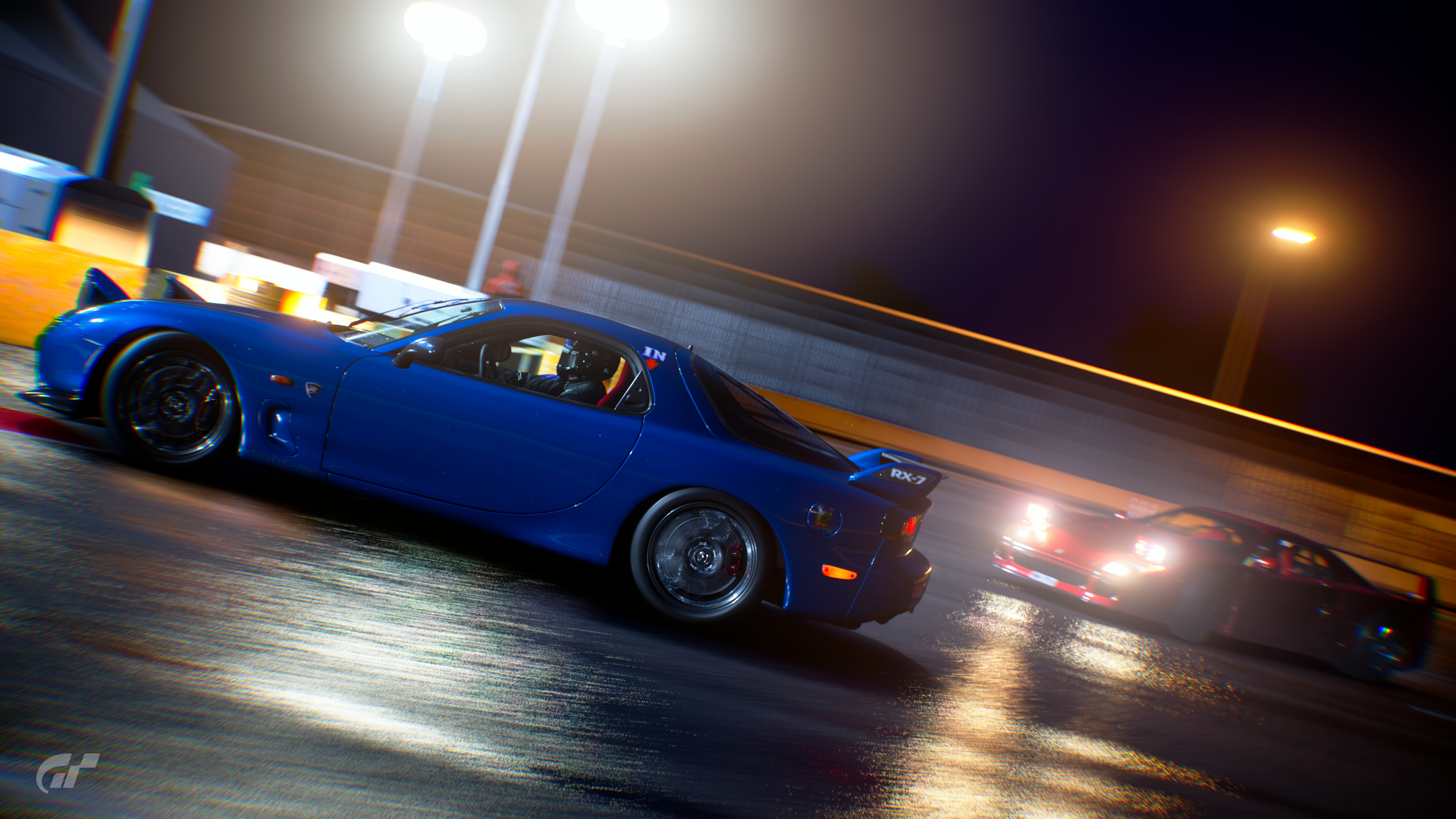

I get that it all sounds very intimidating, requiring the utmost skill and dedication to drive. While the FD demands everything from its driver, it is at the same time, overwhelmingly cooperative and always predictable, and therefore never intimidating. It just takes it upon itself to keep communicating to you how every component is doing at all times. It never does anything unexpected or even slightly rude if you treat it right, yet at the same time, will happily oblige you and kick up a mess if you ask it to. Slides can be held at whim and corrected just as quickly, because the core ingredients of a pure sports car, those being light weight, balance, and communication, all come together to ensure that the car behaves in a predictable fashion even when tyre grip is lost. There are no electronic nannies aside from ABS and a wholly unnoticeable EBD to yank control away from you when you most need it or least expect it — not even Traction Control. Everything is in your control and yours alone all the time. The car simply never betrays the trust it so instantaneously builds in its driver, and any accidental whoopsie is 100% my fault or overeager zest. I love that. That brings SUCH a huge smile to my face every time I go for a drive in my FD. And every time I do drive it, I never, ever want to stop. Not only is it capable and fun to drive, but it's so easy I could do it for hours on end, especially because the lightweight car is gentle on its tyres and brakes, though the heat from the transmission tunnel might cook you alive first before anything else, as these cars run notoriously hot even at responsible, sensible speeds.


THIS is what driving is all about. THIS is the engagement, neutrality, communication, predictability, specialness I'm looking for when I drive a sports car. THIS is why I have probably inadvertently mentioned the FD RX-7 in every review I've done up to this point, because this is the golden standard to which any and everything that wants to proclaim themselves to be sporty has to be held. A sports car is supposed to engage and enthrall me. It is supposed to reward me for performing an art form well, and punish me when I fail to pay it proper respect. It is an excellent car for the beginners to learn the basics of driving fast, as the FD is such a effective communicator, and also for the more experienced to play with and hone their skill.


While all that sounds amazing, I really struggle to make a case for why someone would buy a nearly 4 million Yen FD RX-7 in the early 2000s (trust me, you want at least a Type RS if you're keeping it stock, the upsized, staggered tyres totally transform the car). The R34 GT-R has more power, more gears, and is a lot easier to drive, even if they're excruciatingly close in lap times in my own testing. The Impreza is a lot more practical and cheaper in addition — even in Spec C trim — and any of these AWD machines will make mincemeat of the FD in adverse conditions. The S2000 may be down on power compared to the FD, but it has more gears, revs higher, is lighter, also cheaper, has a stiffer chassis, a bulletproof engine, has a retractable top, and even handles way better! The NSX-R will, in every measurable aspect, outperform the FD, weighing the same, having more gears, much more advanced aerodynamics, and has a rear-midship layout better suited for the track. And if one looks globally for competition and alternatives, the picture becomes even more bleak, as non Japanese manufacturers weren't subject to the weird gentlemen's agreement. The 996 911 GT3 is an all out track weapon that can give you the rawest of track experiences, and is a lot faster everywhere. As I previously mentioned, the FD was on life support in its later years, and its age really shows when you compare it to its contemporary sports car rivals. The suspension setup in the FD is also notably soft for a sports car, and I'm not really sure what Mazda was going for there, especially since the rest of the car seems to scream, "no compromise sports car". If you're not careful with it, you can very easily and quickly find yourself... becoming very busy with the Nardi steering wheel, shall we say. It's not a car you can abuse around a racetrack, but rather, something you have to come to understand and work with, more akin to a 993 Carrera Club Sport in that sense.


Despite its competitive shortcomings however, I urge anyone and everyone who loves cars and loves driving to try driving an FD RX-7 if they ever get the chance. Taken on its own, enjoyed for what it is and what it can bring to the table, it is still a fantastic sports car, one of the best ever produced in my mind. It is the standard to which I hold all sports and modern cars, which at first glance might seem unfair, given how I was just singing praises for the car's uncompromising and focused personality. But, if you can't deliver a driving experience today that is as good as a chassis that's older than I am, or out perform such a granddad that was on life support in his last years, then what business have you in saying your car is sporty, or that it's even a sports car?


The FD has shown me that a sports car is an ideology materialised. It is passionate intent. With today's technology and much more financially able manufacturers, I cannot imagine it being difficult to put into production a 2 door rear drive sports car that weighs around 1.3 tons with about 300HP and electronic nannies that can be turned completely off. The problem is, do you want to make me such a car? Do you think it will make you a profit? Do you think it fits your brand image? And that's why I'm always so harsh in my car reviews, and why I have probably inadvertently mentioned the FD RX-7 at least once in every review I've written so far. If you want to make a sports car, make it better than this, then we'll talk. Benchmark this sense of balance. Make sure your sports car is as involving, predictable, playful, and communicative as this. It's entirely irrelevant to me what your 0-100km/h times are, your 0-400m times, or how many gs you can pull around a skidpad. Time and technology will keep marching forward and make whatever numbers you can conjure up now seem pitiful. Can you make me something that never gets old? Can you give me a dynamic experience that constantly demands my everything to dance together? Can you make something that is unquantifiable, yet so magical? Can it make me feel the things that the FD can make me feel?


A sports car isn't supposed to make sense. It's something anyone of any age, from 7 to 77, takes one look at and think, "I want that!" Nobody needs a sports car, in the same way that nobody needs a 3000 dollar mechanical watch, a Van Gogh painting, to hit balls with bats, to design pixel art, or to practice Kendou with swords costing thousands of dollars. Rather, these are sports, these are art forms people pursue because they find meaning and satisfaction in doing them and doing them well. The acts and technology used may be outdated, but there still exists an appreciation for the workmanship of a watch, they can see the historic value in an old oil painting, and appreciate the technique required on display. I wholly believe that sports cars fit the description of all of the above and more. To draw upon the sword analogy (pun entirely unintentional), I don't want a sword that massages my hands and fires missiles and glows in the dark; that'd be missing the point of a sword entirely. I want a sword that is well weighted and balanced, is comfortable to hold, makes a "whoosh" sound when I angle a cut right, and is sharper than anything else. That's it. I don't want it to protect me, much less others. It is a weapon, I'll exercise the due caution and respect. I want to be careful about slicing my fingers off. I never want to be lackadaisical around it, because it should make me feel the exact opposite. It is much the same with cars. I just want it to drive well. I don't want it to help me keep lanes, brake for me, or be my phone... it is a weapon, I'll exercise the due caution and respect and be held responsible if anything happens. I never want to be lackadaisical around it, in the same way that I don't want others to be lackadaisical around my car, because safety I personally believe is a shared responsibility. I just don't want my sports cars to be so... complicated. To have its focus split so many ways. Instead of using technology to make me a sword that fires missiles, I want technology to make me a sword that is tougher and shaper. I don't want technology to take away from the actual act and feel of cutting with a sword. And if it happens to looks beautiful, then all the more better.


Of course I do want safety. I do want to be able to walk away from a crash and still be able to do it again. I believe in learning from mistakes. I want airbags, ABS, crumple zones, and rollover protection. That's it, really, and the FD I know for sure has the first two. I don't want the car to intervene and interject. I don't want it to intrude, and I don't want it to overwhelm itself. Thing is, with cars chasing horsepower figures, they need that kind of crap to keep themselves in check. No one is driving a 700HP car without aids.


I get that I'm in a shocking minority, which is probably why modern sports cars are such compromised, cumbersomely complicated and confused things nowadays. When I drive modern performance cars that do 0-100 in under 3 seconds with inane power that no one can possibly exploit even on a racetrack, held back by twenty million electronic nannies onboard that can't be switched off, meddling at every turn, I can't help but to wonder what cars the generation after mine will drive when learning how to go fast. I can't help but to wonder if they'll ever learn to perceive the nuances of a purely analogue sports car, know what they mean, and train up the muscle memory to react accordingly. I can't help but to wonder if they will then become the engineers of performance cars, and if they can understand how to make a car go fast or be fun to drive. I wonder if cars will be set up by computers more than people. Most importantly, I can't help but to wonder, in a world where instant gratification is quickly becoming the only affirmation in our lives, and where appearances and numbers mean more than anything else, if there's a place for old classics like the RX-7 and the highly refined art form it brings to our streets, if they will ever be understood even by the microscopic minority of the people who love cars. It will genuinely break my heart if one day a kid gets out of an FD RX-7 and tells me something like "it's slow sloppy and stupid I hate it".


I believe the FD RX-7 is an art form both in the tangible styling of the car, and the immeasurable sensations it delivers to a driver from behind its wheel. We're irrational creatures, some of whom buy expensive watches when their phones can tell them the time, some of whom hit balls for a living, some repeat a sword Kata in isolation thousands of times, and some of us love driving, even if just by ourselves. If we were rational beings, we wouldn't be so opposed to CVTs, and SUVs will be a niche market segment. Great cars like the NSX and the Viper wouldn't have a place in our world. A sports car is almost a celebration of irrationality, of the intangible. It's supposed to be unabashedly pandering. Raw. Communicative. Honest. Beautiful. Balanced. I should be able to trust it and take liberties with it, and it should duly slap me across the face if I take things too far. And it is these unquantifiable traits that make the FD RX-7 so, so beloved. I don't care about 0-100 times. I want an experience that will, like the styling of the FD, never get old. I want the car to talk to me. I want to daily drive it, to show everyone what I'm passionate about. I want to drive it. By myself. I want it to be special. I want it to be selfish. I want it to be made with my enjoyment its top priority. I want it to be uncompromising. I want to see, feel, someone's soul, passion, and intent in it, not profit margins and PR stunts. And cars like that are excruciatingly rare, if not extinct, by today's standards.


While I love the FD RX-7 more than I can possibly put into words, I'm... almost glad that Mazda hasn't tried to build a direct successor to it. Seeing the NSX and Supra name be dishonoured like they've been, I can't help but to worry about the same fate befalling the "next RX". Maybe we really can't have an excellent sports car in the same vein as the FD today. Maybe it's something that could only have been possible in the 90s. I can recognise when I'm in the minority, that I'm an ancient dinosaur when it comes to my tastes. I'm just glad to see that same spirit alive in modern Mazdas, and that they seem to be doing well for themselves. I'm glad my memories and my feelings towards the FD hasn't been insulted by a subpar product that shares nothing in philosophy with the original. And maybe that's good enough of a victory in a world where the Mustang has become an electric SUV, and half of Lamborghini's sales are from the Urus.


I apologise for the long, philosophical, and borderline political rant. This is just too near and dear to me. I promise this is the last time I'm going to ramble so much about philosophy and politics (until I review an electric car...). Just as is with sports cars, I believe the best writings and expressions come from honesty. And I want to embody that so much, it perhaps works to my detriment, as is probably already evident in my reviews and life choices. It is the reason I took up engineering and Japanese in college. It is the reason why I always fly to Hiroshima every time I visit Japan. To me, the FD is neither a good or a bad car. It's not a Beater or a Sleeper. It isn't simply the Car of the Week, or even the Car of the Year for me. It is, quite simply, The One.

Wednesday, 30 December 2020

puh30122020

I know what this looks like. You're looking at the publish date and thinking, "it's going to be a reflection of the year thing/ new year resolution type post", but it isn't. It's just me having to force myself to write something down and publish it, so I wouldn't have another gap in a December for this blog's history.

I feel like my feeling the need to make a piece of writing "good", to "flow", to "capture the reader's attention at first sentence", etc., is starting to bleed into my personal writing. Maybe I'm subconsciously trying to make some really fucking abstract point even I have no conscious idea of. Something, something, trying to get me to be interested in my own life and its goings-on. Trying to find appreciation, blahblah. Never feeling good enough and overcompensating, trying to reach out to hold someone's attention in dumb desperation, or just a sign that I'm starting to lose myself to "work", that some lines are starting to get blurred.

See, this is why I really dislike forcing myself to write, or do anything, because it just comes across as so confused, half hearted, and a complete fucking mess no one has any use for or understanding of. I don't know if anyone else feels this way. I don't know if I will ever find another piece of writing elsewhere that really explores feelings like this. Maybe I really am a weirdo. Maybe others do have these feelings, but aren't in the habit of writing. Maybe everything just has to be 140 characters or less and need an eye catching photo attached to it to gain any attention. I get this feeling I'd feel so alone, adrift, and clueless regardless. I'm so awful at expressing myself. Hell, I'm awful at making sense of what I feel to begin with. How can I expect anyone else to really understand me and offer any solace, any company? Maybe I'm an extraordinarily stupid person for not knowing how to deal with these feelings on my own as a grown ass adult. Maybe I'm just stupidly weak for letting these doubts cloud and cripple me. I just don't know what to do. I've nowhere really to be, but I'm lost nonetheless.

What is the meaning of any of this? Why am I just being kept alive? If suicide is so readily labelled selfish, why can't the love that keeps me imprisoned here just as readily be labelled selfish as well? I'm no longer actively thinking of and wishing for death, because I'm very, very slowly starting to not just realise, but appreciate how much I am loved by my family, the latter of which I feel I never had much of a sense for prior. The thought of killing myself disgusts me. But... at the same time, I don't feel I've much of a reason, or even a right, to be alive. To consume food. To incur a financial cost. To meet, and ask things of people. To exist completely detached from society, to be of absolutely no tangible use or benefit to anyone. To be unable to make anyone happy. To be quantifiably a good-for-nothing. A defect in the manufacturing line.

How true are those statements? Is it truly enough to simply be alive? Does just seeing me safe and sound, does just spending time with me doing simple things like chatting and being out for a meal, bring joy to my friends and family? Does it count if I've put no real conscious effort into it? Is it enough to just be alive in a prison? Why does it never feel enough? Why do I feel so... distant, detached, from people in general? Why does it feel like I've no hope of conversing with them, to match their wavelengths? Why does it feel like we're all speaking different languages by this point?

Are my life experiences invalid? Am I not allowed to feel the way that I do, or think the things that pervade my mind? Am I simply weak, or merely misunderstood? Am I exceptionally stupid, or uniquely perceptive? Why can I never come to the same answers as these "normal" people, who surround me, who live with me? Perhaps I do not have a right to be philosophical. Maybe there's no value in me questioning the way the world works. Perhaps mental healthcare is only reserved for the well to do. Maybe I really do need to pay someone just for them to really listen to me.

What do I want to do right now? I'm disinterested in everything. The thought of society sickens me. I hate myself so much I cannot fathom why anyone would want to be my friend. I don't want to live. I don't want to die. I don't want to think.

Is there any hope left for me? Is there any justification anyone can conjure up to help me, to spend resources on me? What sort of help do I think I want? What exactly is wrong with me? How do I cure myself if I don't even know what is wrong with me? Maybe I'm insane, or maybe I'm the only sane person I know. Maybe I'm sick. Maybe I've just been hurt. Maybe I've hit my head against a wall one time too many.

Does everyone have a right to live? Does everyone have a right to be happy? Is there value simply in the existence, or happiness, of someone? Why do you think that?

Monday, 28 December 2020

Car of the Week - Week 115: Mercedes-Benz SLR McLaren '09

XSquare's Car of the Month Reviews: 2009 Mercedes-Benz SLR McLaren

Symbiotic relationships seem to just come together naturally without a thought: a bee gathers nectar from a flower while helping the flowers reproduce, you buy a train ticket and it brings you where you want to go, etc.. When Mercedes announced at the 1999 North American International Auto Show that they were designing a supercar together with their then Formula 1 partner McLaren, everyone justifiably moistened their undergarments a little at the thought of a car that combined the seemingly boundless innovation, speed, sublime handling, and elite feel of a McLaren with the luxury, build quality, and stability Mercedes have always been known for. The attention commanding and downright salivating Vision SLR Concept made it to production largely intact as the "Mercedes-Benz SLR McLaren", with "SLR" being a homage to Mercedes' dominant, but tragic, 300 SLR racecar. In both cases, the "SLR" stands for "Sport Leicht-Rennen", or "Sport Light-Racing", in English. With help from the wizards in Woking, the modern car tips the scales at a scant 1,768... wait, what? Is that in kilos? That would be 3,898 pounds!


Something has clearly gone terribly awry in what seemed like a straightforward symbiotic relationship between McLaren and Mercedes. The flower has attempted to gather honey from the bee, the train company has tried to pay you to move its carriages across the country, and the world has seemingly gone mad. What seemed so natural, such a foregone conclusion, has been turned onto its head: The powertrain is so Mercedes it hurts — a 5.4L V8 used in several other Mercedes models prior, including the likes of the G Wagen. In the SLR, it is supercharged so hard that there apparently was no other gearbox that Mercedes could get their hands on that could reliably handle the 616HP (459kW) and 780.5Nm (575.7ft-lb) of raw power, and no one else would help poor Mercedes design such a gearbox, so they were left with no other choice but to use their in-house five speed auto... on a 600k USD supercar in the 21st century. And to top it all off, instead of putting this entire colossus of contradiction together in Germany where quality is assured, the cars are assembled in Woking, which I can only assume means, "a shed". Gee, I sure hope McLaren aren't a very new mass production brand that will run into several QA issues and PR disasters within just ten years of making their second ever road car.


Truly, this is one of the most, if not the most misunderstood car ever put into production, because of how outwardly conflicted it is. Is it a luxury GT car? Is it a circuit weapon? And you will see that conflict and confusion everywhere in the SLR: massive power going through a 5 speed auto. Full carbon bodied car that somehow weighs nearly 1.8 tons. Thin carbon bucket seats set atop heavy, motorised rails. Brakes that are designed to catch fire. A car with ample boot space but spitefully little interior storage spaces. You get the idea. This is less a symbiotic relationship and more two roommates arguing who gets to draw the line in a shared bedroom. They say that he who tries to catch two rabbits will catch neither, but does that mean that the SLR is a good-for-nothing car?


Well, on the track, the first impression is that the car is shockingly balanced, despite appearances. There is very little pushing understeer on corner entry like one would expect of a front heavy car. This is because the entirety of the gargantuan 5.4L Supercharged V8 sits aft the front axle, creating a front-midship layout, creating a sense of balance that baffles each drive, especially with a constant reminder of how long the hood is as you stare at it continually from behind the wheel. Adding to this sense of bewilderment, the sheer heft of this javelin of a car is more than masked by the insanely capable carbon ceramic brakes fitted as standard on the SLR, which, in tandem with the flip up airbrake on the boot lid of the car, made stopping the car feel like stopping a Tsunami dead in its tracks every time I stomped on the brakes, and it boggles my mind every time. That is to say, in my one week with the SLR, it has never gotten old to me, and it has a way of astounding me anew each drive.


I said that the balance this car exhibits was shocking, because one would think that a car with the proportions that this has would be horrendously front biased in weight. According to Gran Turismo 6 however, the SLR has a weight distribution of 47:53 F/R, and this is achieved via a conscious effort to shift many weighty components as far back as possible to counterbalance the humongous engine and gearbox pairing up front. Some of these components, such as the onboard tools, battery, brake and washer fluids have been shifted to below the boot floor completely aft the rear axle. While Mercedes has tried to make the weight distribution close to a perfect 50:50, the car has a rather far out centre of gyration, with quite a concentration of mass overhanging both axles (the auto box contributing to the front). Because of this, the car is prone to swinging its rear out on corner entry if you're especially aggressive with your turn in under trail braking, and you need to properly baby the rear end to prevent sliding and losing pace. This also entails having to properly plan a line through successive corners, as the car does not handle abrupt corrective inputs very well. This makes the SLR a fantastic car at nine tenths, but make no mistake: this isn't a ten tenths car in the slightest, lest you fancy an aftermarket shade of brown to break up the sea of black to compensate for not speccing a red two tone interior like my peers in their silver cars have.

Although, I do quite like actually having pedals in my black car.

Although this sounds scary on paper, in practice, you have to really provoke the SLR to get it to act up. The car even gives ample, early, and progressive warnings before sliding, and because of the long wheelbase of the car, it is always just a quick flash of counter steer away from getting back onto the straight and narrow even if you choose to indulge, since there's always weight over the front tyres. Even when sliding, the car never once felt beyond my control or took me by surprise, and it is quite a lot of cheeky fun if you've sufficient runoff area to get something wrong.


You read that right: this near 1.8 ton car is fun to drive, and most of it I feel can be attributed to the suspension setup of this car, which is easily the highlight of my experience in the SLR, as I find it to be so well judged and capable. It is set up to cater to shockingly aggressive driving the likes of which no 600k GT car has any business being subject to, and when coupled with the SLR's near perfect weight distribution, made for very predictable and enjoyable spirited driving. Even when shod with uprated Sport Soft tyres for our weekly races, the SLR not only took the stickier rubber in stride without losing its balance, but felt downright happy to wear them. I do however wish that the rear end is set tighter all around as it's a just slight nuisance around a track for my personal preference; I'd like the rebound damping to be stiffer, I'd like more anti roll in the rear, and the differential especially I find is set way too loose, and one tyre fires are a common occurrence in the SLR with me behind the wheel. Because of the looser than preferable rear end, I find that the car severely dislikes sudden and tight chicanes, especially downhill ones. The slightly excessive roll means off neutral braking zones such as la Sarthe's Mulsanne and Bathurst's The Chase are a challenge to brake consistently for, and the rear brakes don't get to do much work either.


While I only have nitpicks about the suspension setup, the steering feel is... ahh... how do I put this politely...? "Quite rubbish," I think is the British way of saying it, especially for the speeds that this thing is capable of and the sheer mass of what you essentially hold in between your two palms. I think I have had more feedback letting wet noodles slip from a pair of disposable chopsticks than I've felt in the steering of the car, and it's not like the steering is numb because it's been overboosted, either; it's a proper workout to haul this thing around a track at racing pace, and I was sweating quite profusely after each race I did in this thing, and I doubt the December weather is to blame.


To spice things up ascertain how much racing pedigree and prowess the SLR has, I thought an on-track comparison test was in order. Being unable to source a Carrera GT for a comparison test and refusing to drive an Enzo even offered a loaner one for free, I decided to hop into something... a little unusual. Something that, considering the brands they come from, shouldn't share a shred of similarity with each other, yet I find are more alike than each would perhaps like to admit. I brought... a 2006 Dodge Viper.


Hear me out, okay? Both have ridonkulously big engines sat in a front long clamshell bonnet, sending absurd power to a short deck rear via very outdated gearboxes. Both are early 21st century cars. Both are base versions of their families. Both are coupé versions of cars offered as convertibles. I mean, hey, they both even have side exit exhausts! Of course, sitting in a Viper is like sitting in a detention room chair in comparison to the Mercedes, and the Viper costs... I don't know, less than a sixth of the SLR? Oh, and the Viper is 108 brake horsepower down from the SLR, but weighs a whopping 203kg (448lbs) lighter. You know you're dealing with something truly otherworldly when it makes a Viper of all things the nimbler, lighter weight, underpowered underdog in the comparison.


With the ghastly auto box in the SLR narrowing the power deficit, I at first thought that a track focused weapon like the Viper might be a bit too much to race against the SLR. Hoo boy, was I wrong. My fastest lap around Red Bull Ring in clear traffic was about a whole second off of Rick's 1:38 in racing conditions. While I was able to make up some ground in the braking zones and corners, it wasn't nearly enough to offset the acres of difference the SLR pulls on the straights. Overall, it wasn't even close — it wasn't even a race. At the end of the four lap sprint, I couldn't even see a Merc on the short home straight of Red Bull Ring in my Viper. Purely as a track toy, I prefer the Viper for its comparative lightness, manual gearbox, shorter wheelbase, and tighter suspension setup, but there really is no arguing the results of the "race" around RBR: the SLR is not only a better car to live with, but is also faster than the prison bus that is the Viper.

Lap 1 Turn 3: The last time I was able to share road width with an SLR.

Goddamnit SLR, can you conform to expectations ONCE in your life?!

Off the track, I think I like the SLR even more. Stylistically, it is my favourite Mercedes, because I think it is by far the most unique and daring of designs from the German brand, blending grace, aggression, and exuding a sense of imposing grandeur just because it can, for the sake of it, like a nuclear powered grandfather clock. It doesn't look like it's trying to take itself too seriously like almost every other modern Mercedes, but is still instantly recogniseable as one. I also like how I never have to worry about scraping this thing because it's not a track weapon like the Carrera GT, and this thing puts such ridiculous ease into speed, it feels no different at 20 or 200. It is rock solid at speed, and the subtle supercharger whine pries a cheeky smile from me every time I drive it, giving it a sense of occasion and character more reserved for American muscle than anything from the Germans.


Yes, the five speed auto is unfortunate, and I would take even a five speed manual if it were ever offered, but over the course of the week, this slushbox had grown on me. I mean, for starters, at least they didn't go for an automated manual in the early 2000s, like BMW and Ferrari. I think that, short of a traditional stick shift, a torque converter automatic is really the next best thing, as the shifts are smooth and notably quicker than the notoriously bad paddle shift cars of the early 21st century. I think Mercedes did the best they could with it as well, as I find that the ratios are spaced out well and intuitively, and the long, wide ratios evoke some serious nostalgia of driving 80s and 90s Japanese crap boxes, albeit scaled up in the SLR to hit a claimed top speed of 334km/h (207.5mph). The taller ratios also make driving in the wet surprisingly easy, and I really like the obnoxiously loud clicking sounds the paddles make. I'm not kidding you when I say the "KA-CHUNK" sound both paddles make are so loud that they're distinctly audible even through the supercharger, engine, road and wind noise, even at speed. I know I'm in the minority in this: I'm the sort of person that loves to hear a mechanical keyboard clickety clack away as I type, as I do love hearing the sound from others. I love the extra layer of feedback and affirmation from buttons and such, though I can easily imagine it being overbearing to others. There's a certain romance, a certain mechanical involvement, a certain appreciation of a process that's hard to put into words, akin to reading a physical book instead of a digital copy, or listening to a mechanical watch tick. A sort of old school touch befitting a heritage-rich car company like Mercedes.


While I realise I can only say this now in hindsight, I really love how rare and therefore special these cars have become, simply because of how misunderstood they were and still are. The design doesn't look like it has aged a day, and it really makes for a very special sight to behold on the streets today.


If someone walked up to me, plopped 600k into my hands and told me I could only spend it on anything from the 2000s, I should opt for a Carrera GT despite having never driven one before. I might be swayed by the sonorous LFA and a house to keep it in. I might buy six Viper ACRs in different colour combos. I might even buy a Mazda RX-8 Type RS and retire for life, or at least until inflation catches up to me. But I suspect I might find myself contemplating an SLR McLaren, because, in spite of its obvious flaws, I find myself being more than pleasantly surprised by what it has to offer on more than a few occasions, and I genuinely cannot name another car that makes such explosive and irresponsible performance so easy and relaxing to use. It's not often I find myself liking a car I might actually bring out on a date with someone, either.


The SLR may well be the most conflicted and misunderstood car in recent memory, with endless visible conflict over trying to be a luxury GT car and a super sports car, but it does them both so well with such flair and character, it's hard to not be impressed by what a stunning package the car is. The SLR may have caught neither the luxury GT nor super sports car rabbit, but it at least has them both in one pen within sight. The world may have gone mad, but that doesn't mean that it doesn't accidentally poop out something truly special and amazing. They just happen to cost a lot oftentimes. Yes, yes I'm salty. Not because the car is bad, but because I can't afford one. This car is a true Sleeper in my eyes.

I just wonder what McLaren's part in all this is, aside from putting it together.


I have no idea why I did this. Probably more for the paddles going KA-CHUNK KA-CHUNK than the actual performance of the car.


S1: 21.222 / 0:21.222
S2: 51.528 / 1:12.750
S3: 36.766 / 1:49.516
S4: 33.223 / 2:22.739

Fuel consumed for 5 flat out laps: 27ℓ
Top speed: 293km/h (148.5mph)

2:22.739 - Mercedes-Benz SLR McLaren '09
2:26.928 - BMW M4 Coupé (F82) '14
2:27.999 - Lexus RC F '14
2:32.381 - Mazda RX-7 Spirit R Type A (FD) '02
2:32.479 - Nissan Skyline GT-R V・spec II Nür (R34) '02
2:32.512 - Toyota GR Yaris 1st Edition RZ "High performance" '20
2:34.127 - BMW M3 Coupé (E46) '03

Tuesday, 24 November 2020

Car of the Week - Week 111: Toyota GR Yaris 1st Edition RZ"High performance"

Due to some horrifically debilitating issue that was only vaguely described to me as "instability", Car of the Week offices have cut down in operations for this week, and apologise for any inconvenience caused. To translate, their entire server room caught on fire this week, and the closest thing they've in their offices that resembles an extinguisher is leftover champagne from their celebrations of actually getting a PS5. They do not apologise for ALL for the inconvenience surely caused to their employees, whom they still expect to churn out a review by the same deadline. That means no affluent flights around the world to run the car around in hot blooded competition nor videos of such racing, no professional photographers, much less editors. No fanciful hotels, and certainly no car sourced for me to review. This means that I have to go buy it for myself... and actually take care of the thing — by my man child self — so that it might be worth something when I flip it after the review.

Despite appearances, this job isn't very profitable. In fact, sometimes, I pay to work. It's good incentive to either get on Vic's driving level to draw in crowds and sponsors to spray brand names all over your car, become the de facto advertising arm like Nismo and his Twitch channel, or just... you know, write better reviews that others actually want to read. But hey, this is fun worth paying for, and cars like this week's is what my old, retired, condescending butt suffers months for to get a chance to sample: this week, we're testing the Toyota GR Yaris 1st Edition RZ"High performance". No, there isn't a space between the "RZ" and the opening quotation marks, nor is the "p" in "performance" uppercase. Yes, I checked and double checked. I don't know if the car is supposed to be "High performance", or if the people in charge of naming it were tasked to put on a "High performance".


...oh my god, I think I can actually see where people are coming from when they tell me I'm overly condescending in my reviews.

Upon my arrival at the GR Yaris launch event at Fuji Speedway in a Taxi, I was led to the paddock area, where a bunch of creatively designed Yarises (Yarii?) sat in the dark, already donning liveries bearing the names of some of my colleagues who couldn't be here. Someone else — I'm not sure who — has set aside a plain body car for me true to my MO... in non factory standard pink.


The staff's response to my outburst of "ITTAI NANI ZAA FAKKU, KORE WA?!", was that it's apparently a very popular colour on the Yaris, especially among the younger, tech savvy demographic of Yaris buyers, whatever correlation technology has with a flat pink paintjob in the even flatter corporate answer I was given. Also, I'm not sure if they've been made aware, but I'm semi retired now? Acting young isn't my sort of thing, and I'm certainly no spring chicken by racing driver standards, physically or mentally. Because of my age, I've absolutely no idea why kids would suddenly fawn over a pink Yaris. I suppose it does make it easy to find this otherwise nondescript box of a car in a parking lot, which apparently is enough to qualify it as being "technologically advanced". And there I was thinking cars today are getting too complicated for their own good.

Because of how fast these things were selling, every car on exhibit has been spoken for, and so it was either drive this accursed pink Yaris, or not do my job properly for the second week in a row. My balls weren't just in the figurative vice; they are, against all conventional laws in the known universe, rapidly losing mass as I sized up my exhibitionistic cage this week.


The GR Yaris is Toyota's first car to feature a performance oriented AWD system in 20 years since the Celica, coined the GR-FOUR, and offers drivers three options for centre torque split depending on the drive mode selected: 60/40 F/R in Normal Mode, 30/70 for Sport Mode, and, very oddly, 50/50 for Track Mode, when I could've sworn the industry lingo for that was, "don't". The GR Yaris is built as a homologation model for Toyota to enter the WRC, and I can already hear the shockwaves generated from one of my colleagues' throbbing erection all the way over here even before he publishes his review, even though I've only had mixed feelings about homologation model cars so far, much to my chagrin (believe me, I want to like things). It will be hard to disagree with him this week though, as this production car packing amenities such as air con, stereo, requisite safety equipment, kiddy youthful stuff like Android Carplay and smart ways to get into the car (whatever that means) weighs in at a sports car humiliating 1,290kg (2,844lbs), and I gotta say, that really restored a little bit of faith in humanity that we can still get a car this light in 2020. For some context, that's just 50 kilos (132lbs) more than a GT86, while packing 70HP (53kW) more and AWD.


To help achieve that anorexic figure, the GR Yaris shares barely any body panels with the base car, and even unabashedly boasts bare carbon fibre parts assembled in Toyota's Motomachi plant, famous for being the plant where the LFA was assembled. On the GR Yaris, the black woven magic is most prominently on display as the single piece roof panel (which looks more like marble than CF, but eh, I'll trust that no one will take a prank that far). The chassis may operate on logic that seems more suited for a Mr. Bean show than motorsports: sawing a Yaris into two aft the front doors, and then gluing a sawn off C-HR at the rear to form a 3 door hatchback with a much widened rear track over the base Yaris, but the whole package works surprisingly well stylistically, and if Master Driver Morizo is to be trusted, should work even better on the track. That's right: the CEO of Toyota, Toyoda Akio, otherwise known as "Master Driver Morizo", had more than an obsessive amount of time behind the wheel of the car when in development phase, and thus personally signs each "First Edition" GR Yaris on the windscreen. However, when I checked my pink car, there was no signature on it. Of course I asked about it. Apparently, there was no way Toyoda-san was putting his signature on a pink car, and if he's known by the kids as the most "hip", "trendy", "straight fire" and "boss autofocus (whatever those mean)" of CEOs, then it just proves that my views aren't outdated or overly condescending.

I groan and stretch out to my body to break the tired, slight hunch I've had this whole time looking at the car, cracking a few bones in the process. Time to make me feel young again then, eh Yaris-chan?


On a wide open and smooth track like Fuji, it was immediately clear that the GR Yaris is as close to a racing car as modern rules and regulations will allow; it's taut, immediate, darty, light on its feet, and responds wonderfully proportionately and immediately to your extremities' every twitch. It rarely puts a wheel wrong on the track, as there are no perceptible electronic nannies or pretentious engineers who think they know the best way to drive to veer this carbon shroud monstrosity off the strict racing line; only the 268HP (200kW) that it has, an immensely capable AWD system, and the driver's clumsy, aging foot. However, I did notice some slight pushing understeer under trail braking, which is perhaps to be expected given the front mass bias of this hatchback chassis and AWD. There seems to be a certain way to coax it into biting a corner, and I'm sure Impreza or Evo owners will know what I'm talking about. Me personally though, I'm not used to driving AWD cars, and thus struggle with hitting apexes in this thing, and I've had to compensate by braking earlier than I perhaps need to. The brakes on the GR Yaris does slow it down exceptionally well, especially when coupled with the drag of a hatchback shape, and braking points are almost on par with GT3 racing cars, which made for a particularly easy drive around Fuji, especially with that accursed first corner following a near 1.5km straight.

The GR Yaris' seemingly paradoxical combination of light mass, AWD, and shocking power to boot means that acceleration out of low speed corners makes this thing a true pocket rocket. In the few hours of spirited driving I've had in it thus far, I never got used to how fast the GR Yaris gains speed out of a corner; it surprises me still from time to time, and I still understeer out of corners as a result, not because the suspension is floppy or the tyres weren't up to the task, but because I'm an ex racing driver and not a rocket scientist with a laptop: handling rocket launches is WAY beyond my pay grade and JD.


The only time it will attempt to yank itself from your grasp is if you ask it to, because this car, in track mode with 70% of the torque going to the rear, will swing its rear out on you if you're abusive with your feet, all without ever touching the handbrake. Even then, it's always a quick flash of counter steer away from returning to the straight and narrow. Rather than a fault of the car, I get this distinct impression its set up that way for either a driver way more skilled than I, or to just enable the car to slide better on dirt. You can certainly predict and control it, as even when the car starts to slide, it never ever once felt like it ever gets away from under your fingertips and toes, as the car maintains some composure while always being communicative, up to and way past its limits. You certainly feel the centre differential locking up and causing the front wheels to go as well if you... *ahem* encourage it a little mid slide, allowing for some hairy moments of all wheel drift if you're skilled enough. Make no mistake, this is a driver's car, way more so than most pretentious "sports" cars.


As brilliant as the car is on a paved racetrack, it only truly comes alive on a narrow winding mountain pass with bad road conditions. There, the rally car roots of the GR Yaris really began to shine and become apparent: the car sailed over very pronounced bumps and never once gave me a surprising moment, as the car maintains composure and control over every undulation, dip, and rise in the road. The extreme front mass bias on the GR Yaris makes its the aforementioned tail happiness a scary inevitability rather than a slap on the wrist for overly aggressive driving on narrow, rapidly twisting mountain roads, as the featherweight rear end will step out without fail under most downhill braking zones if you've even a slight lock of steering applied under braking. While I was quietly lamenting the lack of a fully adjustable centre diff before taking delivery of my car, I don't think I would've set any more torque going to the rear even if I did have the option, as the car is right on the verge of being a nuisance in Sport Mode*, which is exactly how I like my cars to handle. It will certainly require years of driving RWD cars on the limit and precise pedal and wheel control on these roads to properly rein back in this 3 door hatchback before you smack head first into a wall, but this just means you get to (and have to) slide this thing round corners. Because I don't drift, I can't tell you how well it drifts, and so I defer you to the British Toufu delivery driver colleague for that matter, though I do have this oddly vivid dream that a certain Kiwi was sliding it round Tsukuba as well. Does that not belong in a review? Ahh well, I suppose my editor will edit it out if it doesn't.

*I don't actually know if it's in Sport Mode. Feels like it with how tail happy it is.


As I close out my first week of ownership with a GR Yaris, I'm feeling... oddly conflicted about it. Usually, with cars, my brain tells me I shouldn't like something my heart loves, but with the GR Yaris, it's the exact opposite: my brain tells me I should love this thing and praise it like the second coming of your preferred deity, but I'm just not feeling it in my heart. I consciously recognise that it's everything a sports car should be, and the talent and passion of the people behind it is clear as day. It's properly lightweight, has just the right amount of power, does not care about 0-100 times, practicality, or fuel economy. It is properly special, crazy, and limited. It even has a six speed stick! It's fun to drive! It would make an FD RX-7 or R34 GT-R sweat around any given track! I legitimately think that this is the single best enthusiast's car you can buy new today, and that you'd have to be a medically certifiable loon to feel otherwise. But it's just... I don't know if after this week, I'll wake up one morning and go, "you know what? I would REALLY want to drive the GR Yaris instead of my FD RX-7 or 981 GT4".


For a while, I wondered if I still had a pulse. I wondered if I should still be doing this job if I can't fall in love with a GR Yaris. I wondered if there was something horrifically wrong with me. And then I took my FD out on the same roads as I had the Yaris, and I immediately smiled. I immediately felt special. I was seated so low to the asphalt I could smell it. The impeccable balance the FD had was so much more fun to work with. The effortlessly silky smooth whine of the Rotary Engine kept telling me emphatically I was truly in something special and unique, and despite the 13B having told me that for a good portion of my life, it never once got old. And when I parked it back and locked it up, I couldn't help but to look back at it and smile like the kid I had been when I first saw it. Thrice. And I think it helped me realise why the Yaris just hadn't done it for me.


It could've been properly balanced. It could've been set lower to the ground. It could've been something designed from the ground up to light your senses on fire and be the best toy money could buy, instead of being a Frankenstein thing cobbled together to be capable. It could've had a truly unique engine. It could've stuck out in your shopping mall's parking lot even without a garish paintjob. It could've been something you took ONE glance at and immediately want. It could've been the car that spoke to that 10 year old kid inside me. It could've been the A90 Supra. It could've been the GT86. It could've been an MR2. All this passion, all this engineering, could've went into the body of a properly balanced sports car, but it didn't.


Toyota is capable of being so amazing, yet they just always seem to miss out on that last 5 or so percent of making something that is truly must-have, no ifs, not buts, no second thoughts. And I suppose the GR Yaris is Toyota at its purest and best. You could say that the GR Yaris is Toyota's essence distilled and saturated into a car. And that car is a three door hatchback. I want it, but I don't know if I want it. Every time I look at it, I see Toyota at their indisputable best in decades, perhaps even ever, but I also get the contradictory feeling that it could've been that much better. And it's such a bummer feeling to have when you look at your sports car.

I really am overly condescending and there truly is no joy left for me in this world. I'm sorry, my FD. I know you're tired. But you can't retire yet.

I apologise for my old man tastes and rambling, and also for my indecision about the car. I hope no one was expecting this to be a proper review.

Saturday, 7 November 2020

Car of the Week - Week 109: Alfa Romeo 4C Gr. 3 Road Car

The madmen. They've gone and done it. We're finally testing an Alfa for the first time in COTW.

I've never really gotten the appeal of Alfas, or understood how they haven't yet gone bankrupt. Their cars supposedly have such "soul" and much "passion", but to the uninitiated, they're just cars that break silly and break often. There's even a saying in the car community to sum this up that goes, "You can't be a true petrolhead until you've owned an Alfa". The gist of the saying is that, by owning a car that was as horrifically and unbelievably prone to breaking as though designed by the Italian cousins of Edward Murphy, you'll experience the most distilled and purest of automotive joy, as your hands will never be clean and you'll always be late for work or stranded. Or just begging for help on Alfa forums. That's the essence of the joys of motoring, isn't it? Such soul! Much passion!

I honestly can't even tell if the saying is a joke, or if it's actually meant to be taken seriously, as a way to romanticise pain and hardship and for Alfa owners to justify to themselves that they've made a good purchase. Or maybe they just want attention. I don't know. And I don't want to know. But alas, either by the blind loyalty of the extremely niche market of rich petrolhead masochists or some black art sorcery support system I'm not privy to, Alfa Romeo is still in business today, and this week, I'm blindfolded, gagged, whipped, and half kicked, half pulled by the leash of my employment contract obligations into the dungeon of despair that is Alfa ownership for a week.


Somehow, I get a feeling that this wasn't the car the masochists have adorning their bottomless pits of pain when they recite their memes with dipsticks embedded in them.

For starters, the car didn't explode when I pressed the engine start button. The wipers work, as do the lights, and the wheels haven't fallen off at the daunting parking lot speeds of 10km/h! Rather than the car, it was the person, i.e. me, that caught a bad case of the Alfanxiety Romeouminate the moment I read that we're testing an Alfa Romeo and broke down this week, missing the meet and hence why this review in isolation. It's contagious, apparently. And its transmissible through text. But hey, employment contractual obligations.

To ensure that I'll have at least ten combined minutes in motion behind the wheel this week to formulate an opinion worthy of your money, the unerring and frighteningly effective mechanics at COTW have made every reassurance that the car will work as intended, making sure every wire is as securely connected and protected as being put into a straitjacket, every body panel is as persistently part of the car as a scar, and the engine will be as incapable of dying as someone who's selfishly told that suicide is selfish and not a solution, no matter how much they want to. But, perhaps due to their obsession with the mechanical and electrical components, something in the interior did manage to break unnoticed: the seats on this particular press car are completely stuck in place like a bad coping habit, because being not quite right is just part of the Alfa DNA, just as depression can be. It's amazing how elevated and refined an art form hiding pain and personal flaws can be.


Sitting in an Alfa to me is akin to walking into a modern art gallery: I don't understand the appeal of any of it. I'm sorry, but if you've to explain to someone what your art means and why it's important, your piece of art has failed to move people as intended. For Alfa Romeo, that last sentence is often more literal than figurative.

The original 4C is a car that, like other Alfas, I didn't really understand. I had an opportunity to quickly test drive the Launch Edition once, and I found it to be way too rear happy under any circumstance and lacking in front end grip, resulting in both under and oversteer, sometimes simultaneously. This was not helped at all by how rough I found the gear changes from the DCT to be. If you're going to make a tiny, lightweight, expensive, problematic, highly compromising, focused sports car, at least make it fun to drive, maybe? Offer a manual, perhaps? I hear the 4C's styling has such "soul" and much "passion", but it's not like the Elise, Cayman, and A110 are particularly awful to look at. Overall, it's an immensely capable car, one that I appreciate for existing as an alternative to the Cayman (I do sometimes try to be unbiased, I swear ;) ), but I'm admittedly not a fan of these rear mid engined short wheelbase cars with souped up econobox engines. With a tune, perhaps it could be something really special, but do you really want to open the aftermarket Pandora's Box with a car that's already so prone to going wrong even when everything is within the manufacturer's scope of normal use?


So, what's changed in this "Gr. 3 Road Car" from the base 4C? Well, a rather handsome body kit which just so happens to generate downforce, for a start. Unsurprising, given that the road car borrows more than heavily from the Gr. 3 race cars that Alfa enters in FIA-GT's Gr. 3 category. What hasn't been carried over however, is the shadow scraping ride height of the racing cars, resulting in a horrifying wheel well gap accommodating enough to hide all your problems and feelings in, comically destroying the svelte proportions and menacing stance of an otherwise serious business looking car, along with any hope of controlling airflow under the body in an act of self sabotage. The turbo with an engine attached to it to was already boosting to within millimetres of it the Inline 4's life in the stock car, but here, boost has been further upped to a gasket shredding, casket teasing 1.5 Bar (21.7psi), to produce 330kW (443HP) and 447.8N⋅m (330.3ft-lb) from the 1742cc package, and specific power ratios that would make a Rotary Engine judge in jealousy.

On the inside, the road car borrows from the racing car a very helpful rear facing camera and a aftermarket looking screen used exclusively for the rear view, jutting out of the dash where the air con vents should've been, because who needs air con in a road car? And if you're thinking of ripping it out, don't. The rear window has been sealed shut by a dark, opaque wall, much like a heart in response to a trauma in the past, meaning that dinky, disruptive, air con robbing screen is your only rear view aside from your side mirrors.


Highly irritating and completely baffling is the gearbox of this Gr. 3 Road Car: it uses an automated manual operated by the stock car's paddles, which were used to shift a rather brisk DCT auto in the stock car. "Oh, you want a manual in a 4C? Here, have a manual in a 4C. What are you upset about now? We gave you exactly what you asked for!" So, counter-intuitively, shifts in the G3RC take several times the duration of the DCT in the stock car, or what an average driver can manage if they were just given three pedals and a stick, while somehow being rougher still when shifted mid corner. I've shifted vans faster and smoother than this gearbox changes gears! As a result of being fitted with a shit gearbox that feels lifted right out of the early 2000s, you have to drive this thing like a manual with auto rev matching to get the best out of it; you have to manually lift off the gas and gently roll back into it mid corner to prevent the rear end from jerking loose, and I'm almost certain manually lifting helps the revs drop faster for a quicker upshift. Trust me when I say that whatever pace advantage you might have being able to left foot brake in this two pedal setup is more than negated by the utterly disgraceful and insufferable shifts of this thing. I know I just whined about how the 4C doesn't have a manual option, but this alternative is so much worse, it's borderline offensive. Feels like an autistic kid trying to change himself to adapt and fit into a world he doesn't understand, and I can't even tell if it's done out of spite or a genuine effort to better themselves.


And it's such a shame, too, because the reworked ratios in this shit gearbox are brilliant and complement this engine so well, being short, peppy, and ensuring you always have revs and torque for every situation. Not that the engine really needs much coddling; one of the highlights of the stock car was its engine, which made peak torque at a near idle 2,000rpm, and pulls all the way to the redline of 7,000, making it a joy to wring on a track and easy to use on the streets. With the increase in boost in the G3RC also came a shifting of the powerband towards the upper range, and redline has been increased to a a therapist worrying 8,500rpm. Peak torque in the G3RC comes in only at 5,500rpm as a result, and the engine still likes to have its naughty little neck wrung, resulting in an engine that has an ample powerband for the track, but becomes a little irritating to work around at pedestrian pace, especially with that farce of a gearbox. The powerband is so linear and predictable in both these cars that it truly felt like an NA at times, and lag was minimal.


The original car's highly irritating handling vices, such as the pushing understeer on turn in and tail happiness everywhere, have been almost medicated and numbed out completely. In fact, aside from the very similar engine noises and largely intact interior, there is absolutely nothing at all from behind the wheel that resembles a 4C. The car has bulked up markedly in dimensions, increasing in length and width by 350.5mm and 81.3mm respectively (13.8in, 3.2in), while being dropped 5.1mm in overall height (0.2in). Wheelbase looks to have been increased as well, though I wasn't given the exact numbers, nor did I bring a ruler for a test drive. To really rein in the tail happy car, tyres have been upsized as well for both the front and rear; might as well, right? Given the flared bodykit?


All this sounds wonderful for performance, but once I got onto the track, I felt somehow more frustrated driving this beefed up G3RC than I did the stock car: the differential was set up astoundingly tight, and when coupled with the chunky rear tyres, understeer was very pronounced, especially on power. I was constantly trying to fight the differential to meet the apex on turn in and stay on the road for corner exit, much to the dismay of the front tyres screaming in agony, and you can tell the completely unassisted steering of the 4C was not meant to wrestle itself like this. Because I was always fighting the differential, the car was very prone to snapping in an instant between chronic understeer and severe acute oversteer, without much warning or leeway in transitioning and modulating between the two. Add to the fact that this car SOMEHOW gained a not-even-funny 370kg (816lbs) over the EDM 4C, and you have a driving experience that is completely unrecogniseable from the stock 4C. I mean, what the hell even? Is it the god awful gearbox? Are the flared fenders made of Osmium? Was the road car BoPped too to be as uncompetitive as its racing car cousins? Or has it been binge eating on comfort food to mourn the end of the 4C's production?


At the end of the day, it's a mid engine sports car. It's not terrible; it's capable in the right hands. It's still light by today's standards at 1,320kg (2,910lbs), and is plenty powerful for its mass. It looks good. But... who is it? What gives it its own flavour? What sets it apart from the oceans of other mid engine sports and supercars? What does it say or do differently than anyone else? Only that it's an Alfa? The problem is made even worse now that it has grown in size — and mass, to be your cookie cutter Cayman with a quarter of its charisma and reliability. I never liked the original 4C much, but this just feels like it has tried too much to change into something it never should've been, either willingly or otherwise, and is worse off for being less distinct and expressive as a result. The only interaction you'll have with it is fighting: fighting the differential on the track, fighting the wheel, and fighting the automated manual at town speeds and at every upshift. And unlike the red Italian rear mid engined 2 door supercar with chronic understeer making around 450PS that has chunky rear tyres, wonky shifts, and a steering wheel I've to wrestle at every turn from last week, there was no epiphany to be found in mastering the 4C G3RC. There is no reward to be had for getting everything just right on the track in this car. You simply coexist with the car in the best of times, and have a messy fight with it at its worst.

And what are you fighting for, anyway? It's never fun. It never made me smile. It doesn't communicate with me. It's just a car with no character. The more it changed, the more it threw away what made it unique and special, and now the only thing that's left of it is a fast car with a stupid gearbox, broken seats, and a lousy diff. And no, being constantly problematic and ill isn't a character trait.


No matter how debilitating an illness is, you can't let it define you as a person. You want to be the guy that likes to write as a hobby because it helped him get through tough times, not the guy who's always brooding and condescending in writing because of his past. You want a car to be an involving, cooperative, communicative, fun to drive, and unique experience, that then tends to require a bit more justifiable attention on and off the track, rather than the car that always breaks down that might be capable if it made it onto a track and didn't then decide to Irish Whip you into a barrier at the slightest push to get to know it better.


Because if being sick consumes you to the point where it becomes your only identifiable trait, who would you be if you were cured? What would you then be known for? If you let it define you so much, do you even want to be cured? Would it be a scary thought to lose your one defining trait? And that's why an illness can never be allowed define someone, no matter how debilitating and all consuming it may be. And that I feel is what has happened to the 4C Gr. 3 Road Car: it thinks that being pretty and constantly broken is all it needs, and it's almost comfortable and used to being the sick kid, expecting you to bend to fit its expectations and be loved regardless rather than come to a compromise for both sides. There was never any communication, and the power in this relationship is too skewed to one end. And I realise you can't force someone to talk to you if they don't want to open up, even if you've every intention to get to know them and help. Or maybe it has so many problems, it doesn't even know where or how to begin conveying it. Well, I guess I'll help it a little. By ripping it a new one.

I never was any good at dealing with crap like this.